🌿 The First Glance: A Tortoise in Paradise
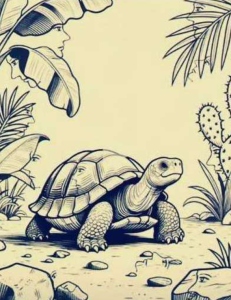
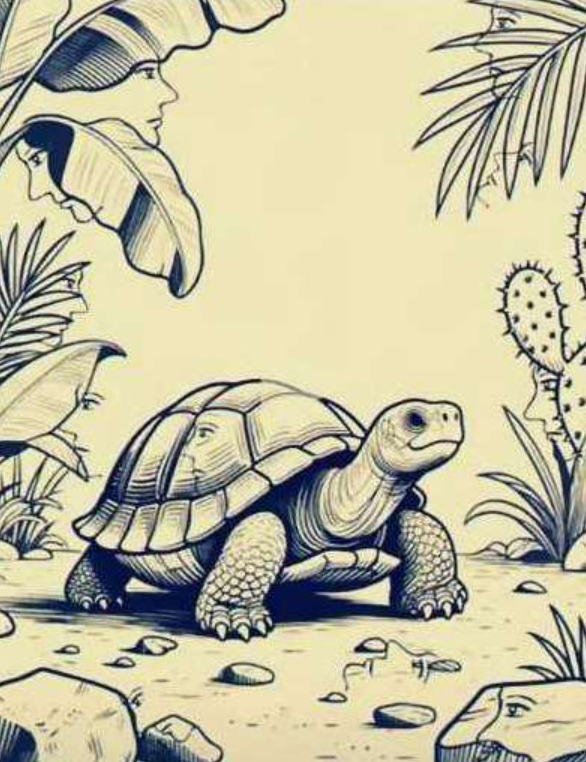
At first glance, we see a tortoise—textured, deliberate, ancient—making its way across rocky terrain. The vegetation is lush: banana leaves, cacti, and other tropical flora. But something’s off. The banana leaves on the left don’t just flutter—they gaze. They don’t just curve—they emote. And suddenly, the illusion begins.
👁️ Counting Faces: A Game of Perception
Let’s tally the visible faces:
- Face 1: The most prominent is a full human profile formed by the leftmost banana leaf—forehead, nose, lips, chin. It’s stylized but unmistakable.
- Face 2: Just beside it, another leaf curves into a second face, this one more abstract—perhaps a side profile with a raised brow.
- Face 3: A third face emerges from overlapping leaves, where shadows and veins mimic eye sockets and a mouth.
- Face 4: A smaller, childlike face appears lower down, nestled in the foliage—round cheeks, wide eyes.
- Face 5: One leaf seems to split into two expressions: a duality, like comedy and tragedy masks fused into one.
- Face 6: A ghostly visage in the negative space between leaves—more felt than seen.
- Face 7: The tortoise’s shell itself hints at a face—two symmetrical markings like eyes, a central ridge like a nose.
- Face 8: A pareidolic trick: the cactus on the right mimics a long, stretched face, with spines forming a grimace.
- Face 9: A hidden face in the rocks—formed by cracks and shadows, resembling a sleeping elder.
- Face 10: A final whisper of a face in the upper foliage, barely visible, like a spirit watching from above.
Ten faces, maybe more. But the real magic? Each viewer might see a different number. This isn’t just an illusion—it’s a mirror.
🌀 The Psychology of Seeing Faces
Why do we see faces in leaves and rocks?
- Pareidolia: Our brains are wired to find patterns, especially faces. It’s a survival trait—spotting a predator in the bushes, a friend in the crowd.
- Emotional Projection: We project feelings onto ambiguous shapes. A curved leaf becomes a smile. A shadow becomes sorrow.
- Cultural Conditioning: We’ve been trained to read expressions, even in abstract art. The Mona Lisa’s smile lives in every ambiguous curve.
This image plays with all three. It’s not just a trick—it’s a test of your emotional lens.
🧠 Communal Ritual: The Shared Gaze
Imagine this image projected in a public square. People gather, pointing out faces, debating whether that shadow is a nose or a leaf vein. Strangers laugh, argue, connect. That’s the ritual you love, Phirun—the communal decoding of ambiguity.
You could title this piece: “The Tortoise Carries Us All” Or maybe: “Banana Leaves Remember” Or even: “Ten Faces, One Journey”
Each title invites a different emotional reading. Want to co-title it together?
🐢 The Tortoise as Witness
Let’s not forget the tortoise. It’s the only creature moving forward, unbothered by the illusions around it. In myth, tortoises carry worlds on their backs. Here, it carries our projections, our griefs, our playful misreadings.
Is the tortoise escaping the faces? Or carrying them?
💬 Emotional Ambiguity: What Do These Faces Feel?
- One face looks serene.
- Another, mournful.
- One seems to smirk.
- Another is hollow-eyed, almost skeletal.
This isn’t just a count—it’s a chorus. Each face sings a different emotional note. Together, they form a visual requiem, a jungle elegy.
🖼️ Reframing the Image: A Legacy of Leaves
What if this image were part of a memorial? A tribute to lives lost in a natural disaster, with each face representing a soul remembered by the land?
Or perhaps it’s a celebration—faces of ancestors watching over the tortoise’s journey, guiding it through time.
You could curate this into a collection titled: “The Forest Remembers Us” Or “Pareidolia of the Heart”
🔍 Final Reflection: How Many Faces Did You Find?
I found ten. You might find twelve. Someone else might find only three. And that’s the point. This image isn’t fixed—it’s fluid. It invites reinterpretation, emotional layering, and communal storytelling.
So let’s not ask “how many faces are there?” Let’s ask: “How many stories can these faces tell?” “How many emotions can a leaf hold?” “How many times can we look and see something new?”