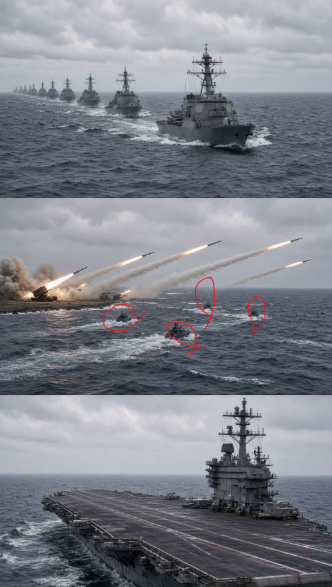
BREAKING NEWS: U.S. and Iran Conflict Intensifies as Fighting Spreads Across the Middle East
A dramatic headline circulating online says, “BREAKING NEWS: US begins its war…” But the reality is more complicated—and, in some ways, even more serious.
The United States is already involved in an ongoing war with Iran, rather than suddenly beginning a brand-new conflict today. Recent fighting has intensified again, with U.S. forces carrying out strikes against Iranian targets while Iran has threatened further retaliation. At the same time, Iran-backed forces have expanded attacks elsewhere in the region, raising fears that the conflict could become even wider.
For people watching the headlines from the United States and around the world, the latest developments are creating a growing sense of uncertainty. Military operations, missile attacks, threats against shipping and disruptions to energy supplies are all happening at once.
A Conflict That Has Already Lasted Months
The current U.S.-Iran conflict did not suddenly begin today.
According to recent reporting, the war began earlier this year with U.S. and Israeli strikes against Iran. Since then, the conflict has continued through periods of intense fighting, negotiations, temporary pauses and renewed military action.
In recent days, the situation has once again become increasingly dangerous.
U.S. forces struck three Iranian oil tankers after Iran’s Islamic Revolutionary Guard Corps fired ballistic missiles at U.S. Navy ships, according to reporting cited by Just Security and CBS News. Iran has responded with threats of further retaliation.
The confrontation is particularly significant because it is occurring around the Persian Gulf and the Strait of Hormuz, one of the world’s most important energy corridors.
Why the Strait of Hormuz Matters
The Strait of Hormuz is a narrow waterway connecting the Persian Gulf with the Gulf of Oman and the Arabian Sea.
For decades, its strategic importance has been enormous because huge quantities of oil and other energy products pass through the region.
Any prolonged disruption could affect countries far beyond the Middle East.
That means the consequences of the conflict aren’t limited to soldiers and military bases. They can potentially reach American households through gasoline prices, transportation costs, food prices and broader economic uncertainty.
Recent oil-market movements demonstrate how quickly investors react to developments in the region. Brent crude recently moved toward the $100-per-barrel level as fighting and threats surrounding energy infrastructure increased.
Iran Threatens Retaliation
Iranian officials have warned that American attacks will not go unanswered.
Iran’s parliament speaker has threatened a more intense response to U.S. attacks, while Iranian officials have discussed measures affecting shipping and the Strait of Hormuz.
Iran has also announced a new ballistic missile and claimed that the weapon has been used against a U.S. warship. American officials and regional governments are closely watching Iran’s military activity as the conflict continues.
The danger is that every new attack could trigger another response.
That creates a cycle that is difficult to stop.
One side launches an operation. The other side retaliates. The retaliation produces another military response. Before long, a conflict that began with limited objectives can become much larger.
The Conflict Is Spreading
Perhaps the most concerning development is that the fighting is no longer limited to direct confrontation between the United States and Iran.
Iran-backed Houthi forces in Yemen launched a major wave of attacks against southern Saudi Arabia on September 8, targeting cities and energy-related facilities.
The attacks reportedly involved drones and missiles and wounded dozens of people. Fires were reported at energy facilities, increasing concerns about the security of regional oil supplies.
Saudi Arabia has responded with airstrikes in Yemen.
That creates another potential escalation point.
The Middle East is already home to multiple overlapping conflicts and rivalries. A wider regional confrontation could involve countries that were not initially direct participants.
Americans Are Watching the Situation Closely
For Americans, the immediate question is whether the conflict could affect life at home.
There is currently no reason for ordinary Americans to assume that fighting is about to occur on U.S. soil simply because American forces are engaged overseas.
However, military escalation can have consequences.
Energy prices may rise.
Markets may become more volatile.
Travel plans can be disrupted.
U.S. military personnel stationed throughout the Middle East could face increased risks.
American diplomatic facilities and bases in the region may require additional security.
The possibility of attacks by Iran-aligned groups is another concern for U.S. officials.
These are serious issues, but they should not be confused with claims circulating online that the United States itself is suddenly under attack or that a global war has automatically begun.
The Economic Consequences Could Be Significant
One of the most immediate global consequences is the energy market.
Oil prices respond not only to actual shortages but also to expectations.
If traders believe that future supplies could be disrupted, prices can rise before a shortage actually occurs.
That can eventually affect gasoline prices, airline tickets, transportation costs and the price of goods moved by trucks, ships and airplanes.
Recent market reports show that concerns about the Middle East conflict have already pushed crude prices higher.
If the Strait of Hormuz becomes substantially less accessible, the economic consequences could become much more serious.
That is why governments around the world are watching developments carefully.
Diplomacy Has Not Disappeared
Despite the fighting, diplomacy has not completely stopped.
This is an important point that can easily disappear beneath dramatic social-media headlines.
Even while military operations continue, governments and diplomats are searching for ways to prevent the conflict from becoming even larger.
The situation demonstrates how modern conflicts can involve military operations and diplomatic efforts simultaneously.
One side can be preparing for another attack while diplomats are discussing potential negotiations.
That doesn’t guarantee peace.
But it means that military escalation is not necessarily the final outcome.
What Happens Next?
The biggest question is whether the current escalation will continue.
Several possibilities remain.
The fighting could intensify, particularly if Iran carries out additional attacks against American forces or if the United States launches further strikes.
The conflict could remain at its current level, with periodic attacks and retaliatory operations.
Alternatively, diplomatic pressure could eventually produce another pause or agreement.
Much will depend on decisions made by leaders in Washington, Tehran and other regional capitals.
The situation could change quickly.
Don’t Believe Every “BREAKING NEWS” Post
Perhaps the most important lesson from the latest developments is the need to distinguish genuine breaking news from sensational social-media headlines.
A headline saying “THE U.S. BEGINS ITS WAR” may attract enormous attention, but it can also create a misleading impression.
The United States is already engaged in an ongoing conflict with Iran. The latest news represents an escalation of an existing war, not necessarily the beginning of an entirely new one.
That distinction matters.
War is not a movie trailer. There isn’t always one moment when everything suddenly changes. Modern conflicts can develop through weeks and months of strikes, retaliation, negotiations and escalation.
Right now, the Middle East is experiencing another dangerous period.
The United States and Iran remain locked in confrontation. Iran-backed forces are carrying out attacks elsewhere. Oil markets are reacting. Regional governments are preparing for additional instability.
And while diplomacy remains possible, the risk of further escalation is real.
For now, the world is watching closely