🐶😳 DID YOU KNOW? WHY DOES YOUR DOG SMELL YOUR PRIVATE AREAS? THE SURPRISING REASON BEHIND THIS COMMON DOG BEHAVIOR!
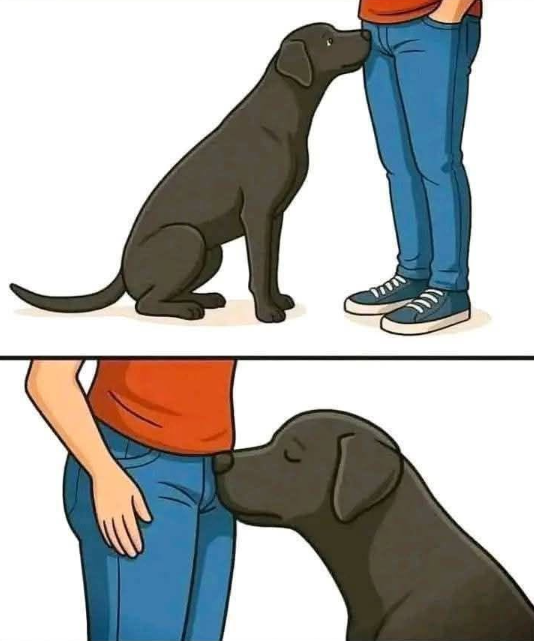
Have you ever noticed your dog approaching you or a visitor and sniffing around the private areas of the body? 😳 It can be embarrassing, surprising, and sometimes downright uncomfortable, especially when guests are around. But before you get upset with your furry friend, there is something important you should understand.
Dogs experience the world through their noses, and sniffing is one of their most important ways of gathering information.
What may seem strange or inappropriate to humans is actually a completely natural behavior for dogs.
🐾 1. Dogs Gather Information Through Smell
Humans depend heavily on their eyes and ears to understand the world. Dogs, however, have an extraordinary sense of smell.
Their noses contain far more scent receptors than human noses, allowing them to detect odors and chemical signals that people cannot even notice.
When a dog sniffs a person, it is collecting information about that individual. It may recognize familiar scents, detect changes in body odor, and distinguish one person from another.
For dogs, smelling is a little like reading a newspaper. Every scent can tell them something interesting.
😳 2. Why Are Dogs Interested in Private Areas?
Certain parts of the human body naturally produce stronger scents because they contain sweat glands and other sources of body odor.
Dogs may be particularly interested in these areas because they provide concentrated scent information.
Apocrine sweat glands, which are found in areas such as the armpits and groin, produce secretions that contribute to individual body odor.
Dogs can detect these smells much more easily than humans can.
This behavior is not necessarily sexual, aggressive, or disrespectful. It is usually ordinary canine investigation.
🐕 3. Your Dog May Be Learning About You
Dogs recognize people partly through their unique smells.
When your dog sniffs you after you return home, it may be gathering information about where you have been and what scents you encountered.
Your dog may also notice changes in your natural scent caused by exercise, stress, hormonal changes, or everyday activities.
However, this does not mean dogs can reliably diagnose medical conditions simply by sniffing someone.
❤️ 4. It Can Be a Sign of Curiosity
Dogs are naturally curious animals. They investigate unfamiliar objects, people, animals, and environments with their noses.
When a visitor enters your home, your dog may approach and sniff because the person has a different scent.
This is especially common when meeting someone for the first time.
Your dog is not trying to embarrass you. It is simply using the communication system it understands best.
🧠 5. Dogs Have an Extraordinary Sense of Smell
A dog’s sense of smell is incredibly powerful. Depending on the breed and individual dog, its ability to detect certain odors can be dramatically greater than ours.
Dogs also have a specialized scent-processing structure called the vomeronasal organ, which helps detect certain chemical signals.
Their noses help them explore their surroundings, recognize familiar animals, investigate food, and communicate with other dogs.
🚫 6. How Can You Stop This Behavior?
Although sniffing is natural, you do not have to allow your dog to sniff everyone’s private areas.
You can teach your dog more appropriate greeting habits.
Try these simple steps:
- Teach a greeting command: Use words such as “sit” or “leave it” when someone approaches.
- Reward good behavior: Give your dog a treat when it greets visitors calmly.
- Redirect attention: Offer a favorite toy or ask your dog to sit beside you.
- Supervise visitors: Keep your dog close when introducing it to unfamiliar people.
- Be consistent: Everyone in the household should use the same commands and boundaries.
Never punish your dog harshly for normal sniffing behavior. Calm training and positive reinforcement are generally more effective.
🐶 7. Should You Be Worried?
In most cases, no. Sniffing is a normal part of canine behavior.
However, if your dog suddenly develops obsessive sniffing, becomes unusually intrusive, or displays other changes in behavior, discussing the situation with a veterinarian or qualified dog trainer may be helpful.
Remember that dogs also need opportunities to explore smells safely. Walks that allow supervised sniffing provide mental stimulation and enrichment.
❤️ Final Thoughts
The next time your dog approaches and starts sniffing, remember that it is experiencing the world differently from you.
What seems embarrassing to humans is often simply a dog’s natural way of exploring, recognizing, and understanding the people around it.
Our dogs cannot ask questions with words, but their noses help them discover an incredible amount of information.
They are curious, intelligent, and wonderfully unique animals.
So, did you already know why dogs do this, or does your furry friend sometimes surprise you with this behavior? 🐕❤️
Share this with another dog lover who might find this surprising!