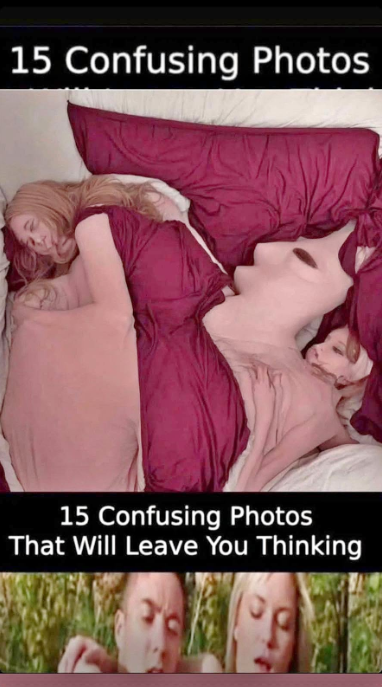

Confusing Photos That Will Leave You Thinking
Some photographs are easy to understand the moment you see them. Others make you stop scrolling, stare at the screen, and ask yourself a simple question: “Wait… what am I looking at?”
The internet is filled with photographs that seem impossible at first glance. A person appears to have an extra arm, a dog seems to have an unusual body, a building looks as though it is leaning in an impossible direction, or an ordinary object suddenly appears enormous. In many cases, there is no digital manipulation involved at all. The confusion comes from perspective, timing, shadows, reflections, framing, or the way our brains interpret visual information.
Collections of these photographs have become especially popular online because they encourage viewers to slow down and solve the mystery. Recent collections of “confusing perspective” images show just how easily an ordinary scene can become bizarre when photographed from an unusual angle.
Here are some of the most fascinating types of confusing photographs — and why our brains can have such a difficult time understanding them.
1. The Disappearing Body Part
One of the most common photographic illusions happens when two people stand close together.
Imagine a person standing behind a friend with their arm positioned directly alongside the friend’s body. In the photograph, the two arms may appear to belong to one person.
The brain normally assumes that every visible body part belongs to the person whose face it is closest to. When the alignment is unusual, however, that assumption can temporarily fail.
You may see what appears to be an impossibly long arm before realizing that another person is standing behind the first.
This is why photographs involving groups of people can sometimes look completely bizarre until you identify where each person’s body actually begins and ends.
2. Objects That Suddenly Look Gigantic
Perspective can dramatically alter our perception of size.
A small object positioned close to a camera can appear enormous compared with something much farther away. A person holding a tiny object at exactly the right distance may look as though they are carrying something gigantic.
The same trick works with animals.
A bird flying close to a camera can appear larger than a person standing several yards away. A distant mountain can appear to rest directly behind someone’s head.
Nothing unusual has happened in the real world. The photograph simply compresses three-dimensional space into a two-dimensional image.
Our brains then have to reconstruct depth from limited information.
3. The Floating Object
Another classic example involves objects that appear to float.
A tree stump may look as though it is hovering above the ground because its lower section blends into the surrounding grass. A piece of furniture can appear detached from the floor because shadows and perspective hide the connection.
Recent collections of confusing photographs include examples in which ordinary objects appear to float or become strangely separated from their surroundings.
Lighting is often responsible.
Shadows normally provide important clues about where an object is located. When a shadow disappears, blends into another shadow, or falls in an unexpected direction, the brain may misinterpret the object’s position.
4. Animals With Mysterious Shapes
Pets are particularly good at creating confusing photographs.
Dogs and cats frequently curl their bodies into unusual positions, hide their legs behind furniture, or stand directly behind another animal.
The result can look almost surreal.
A dog’s head may appear attached to another dog’s body. A cat sitting behind a chair may seem to have no legs. A bird standing at an unusual angle may appear to have a completely different shape.
These photographs remind us that we don’t always consciously identify every part of an object.
Instead, the brain rapidly categorizes what it sees.
If the available visual information contradicts that expectation, confusion follows.
5. Shadows That Look Like Something Else
Shadows are among the most effective sources of accidental illusions.
A person standing beneath a streetlight may cast a shadow that looks dramatically different from their actual shape. A group of animals viewed from above can produce shadows that seem to represent completely different animals.
One particularly striking example documented in a recent collection involves zebras viewed from above, where their shadows can initially be mistaken for additional animals.
The explanation becomes obvious once you recognize the relationship between the animals and their shadows.
But before that moment, the photograph can look like a scene from a fantasy movie.
6. Buildings That Appear to Defy Gravity
Architecture can also create strange visual effects.
Photographs taken from low or unusual angles can make buildings appear to lean dramatically. Roads may appear to climb straight into the sky. Stairs can become difficult to interpret because the camera angle makes it unclear which direction they are traveling.
Perspective is one of the fundamental clues the visual system uses to estimate depth. Parallel lines appear to converge as they move into the distance, helping us understand the three-dimensional arrangement of a scene.
When a photograph presents those lines in an unusual way, our normal assumptions can produce an incorrect interpretation.
7. When the Sky Looks Like Water
Sometimes the confusion comes from an unexpected similarity between two environments.
A photograph of a road, for example, may contain reflections that make the pavement resemble a river. A body of water viewed from the right angle can appear like a road stretching toward the horizon.
Clouds can also create similar effects.
The brain relies heavily on context. If an image contains a large blue area, we may quickly assume it represents sky or water depending on the surrounding objects.
Change the context, and the same color and texture can be interpreted differently.
8. Perfectly Timed Photographs
Not every confusing photograph depends on perspective.
Sometimes it is simply a matter of timing.
A camera captures only one instant. That instant can produce an arrangement that exists for less than a second.
A person jumping behind a wall might appear to float. A bird flying behind someone’s head may look as though the person has wings. A basketball photographed at exactly the right moment can appear to be attached to someone’s body.
These photographs are fascinating because the photographer may not have planned the illusion.
The camera simply happened to capture the perfect moment.
9. Reflections That Create Another World
Mirrors, windows and polished surfaces can make ordinary scenes extremely confusing.
A reflection can appear to be another room, another person, or another object. If the boundary between the reflection and the real environment is difficult to see, viewers may initially interpret the image incorrectly.
Water is particularly effective because its surface can behave like a giant mirror.
A photograph taken beside a perfectly calm lake can make mountains, buildings or trees appear to continue beneath the surface.
The result can look like an impossible inverted world.
10. When Two Objects Merge
Another common illusion occurs when two objects overlap perfectly.
A person’s head may line up with a lamp, creating the appearance of an unusual hairstyle. A tree trunk may appear to grow from someone’s body. A pole behind a person can look like part of their clothing.
These images demonstrate why photographers often pay attention to the background.
A small object positioned directly behind someone’s head can completely change the meaning of the photograph.
The effect becomes even stronger when the colors or shapes of the two objects are similar.
11. The Famous Leaning-Tower Effect
One of the most interesting examples of perspective illusion involves photographs of the Leaning Tower of Pisa.
In the famous “leaning tower illusion,” two identical photographs can appear to show towers leaning at different angles when placed side by side. Scientific explanations of the illusion point to the way the visual system interprets perspective and depth.
This is a powerful reminder that seeing is not simply a matter of receiving information through the eyes.
The brain actively interprets that information.
It makes assumptions about distance, orientation, lighting and geometry.
Most of the time, those assumptions work extremely well.
Sometimes, however, they produce a fascinating mistake.
12. Why Our Brains Get Fooled
The human visual system is remarkably efficient.
Instead of consciously analyzing every pixel in a scene, the brain rapidly organizes information into recognizable objects and patterns.
That efficiency is useful in everyday life. Imagine having to consciously calculate the exact position, size and distance of every object in a room before reaching for a cup.
Fortunately, the brain does the work automatically.
But shortcuts can sometimes create errors.
Research into photographic perception has shown that perspective, lens choice and viewing distance can influence how people interpret the apparent shape and depth of objects in photographs.
That is one reason an ordinary photograph can become confusing without any manipulation whatsoever.
13. The Importance of Looking Again
Perhaps the best part of confusing photographs is the moment when everything suddenly makes sense.
At first, your brain presents one explanation.
Then you notice a small detail.
Maybe there is another person’s arm behind the subject. Maybe what looked like a giant object is actually close to the camera. Maybe the mysterious shape is simply a shadow.
Suddenly, the entire photograph changes.
That moment is satisfying because your brain has successfully rebuilt the scene.
Recent online collections continue to demonstrate how perspective, timing and unusual camera angles can create photographs that look almost impossible at first glance.
The Final Mystery
Confusing photographs remind us that cameras do not necessarily show reality in the same way our eyes experience it.
A photograph freezes a single moment, removes much of our normal depth information and presents a three-dimensional world on a flat surface.
Our brains then try to reconstruct what happened.
Usually, they succeed.
Sometimes, they don’t.
And that is exactly what makes these images so entertaining.
The next time a photograph makes you stop and wonder whether you’re seeing a giant animal, a floating object, an impossible building or a person with an extra body part, don’t immediately assume the picture has been edited.
Look at the background.
Follow the shadows.
Trace the edges of objects.
Check where people’s arms and legs actually begin.
Look for reflections.
Then look again.
Very often, the mystery has a perfectly ordinary explanation — but finding it can be almost as entertaining as seeing the confusing photograph in the first place.
In a world filled with increasingly sophisticated digital images, there is something especially delightful about a photograph that can confuse thousands of people without any special effects at all.
Sometimes all it takes is a strange angle, perfect timing, an unexpected shadow and a brain that is trying just a little too hard to make sense of what it sees.