Fiction: A Security Scare in Washington
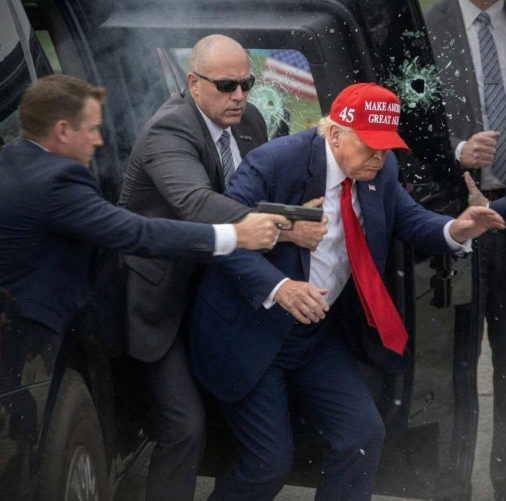
The morning air over Washington, D.C., was unusually calm. Commuters crossed the city’s familiar streets, government employees hurried into federal buildings, and tourists gathered near the National Mall, unaware that the day would soon become one of the most closely watched security incidents in recent memory.
Just after sunrise, members of a presidential security detail noticed unusual activity several blocks from the location where a public event was scheduled to take place. Standard operating procedures immediately went into effect. Streets were quietly redirected, nearby buildings were notified, and additional law enforcement officers moved into position.
Within minutes, social media exploded with speculation.
Some posts claimed an attack had occurred. Others insisted they had heard loud noises near the security perimeter. Amateur videos appeared online showing police vehicles, helicopters, and emergency responders converging on the area. None of the videos clearly showed what had happened, yet millions of viewers began drawing conclusions before investigators had released a single official statement.
Inside a federal command center, analysts worked quickly to separate fact from rumor.
“We verify first,” one senior official reminded the team. “Everything else comes later.”
Investigators reviewed surveillance footage from traffic cameras, nearby businesses, and security systems. Witnesses were interviewed individually to compare timelines. Officers checked every report, no matter how small, because experience had taught them that the smallest observation sometimes revealed the biggest clue.
Meanwhile, television networks interrupted their regular programming with special reports. Anchors repeatedly emphasized that information was still developing and cautioned viewers against believing unverified claims circulating online.
Government officials held a brief press conference later that morning.
“There has been a security incident under investigation,” a spokesperson announced. “There is no confirmed evidence supporting many of the rumors currently circulating online. We ask the public to remain calm while investigators complete their work.”
The statement slowed some of the speculation but not all of it.
Across the country, millions continued refreshing news feeds every few seconds. Every new photograph or short video clip generated thousands of comments, each proposing a different theory.
Some believed the unusual police presence indicated a sophisticated security threat.
Others argued it was simply a precaution after suspicious behavior had been reported nearby.
Hours later, investigators reconstructed the sequence of events.
A suspicious unattended package had been discovered near a route that officials had intended to use for transportation later that day. Security protocols required the area to be secured immediately while bomb technicians evaluated the object.
Specialized robots approached the package carefully.
Explosive detection equipment scanned its contents.
For several tense minutes, no one outside the investigation knew what the outcome would be.
Finally, technicians determined that the package contained harmless construction equipment accidentally left behind by contractors working overnight.
The discovery relieved investigators but also raised another concern.
How had a routine security response transformed into nationwide panic within less than an hour?
Communication specialists began studying the online timeline.
The first inaccurate post had appeared only minutes after police blocked traffic.
A second account copied the original message while adding dramatic details that had never been confirmed.
Within twenty minutes, hundreds of accounts repeated the same unsupported claims.
By lunchtime, millions of people had encountered at least one inaccurate version of the story.
Experts later described the event as a textbook example of how misinformation can spread faster than verified facts.
During an afternoon briefing, cybersecurity researchers explained that algorithms often reward emotionally charged content, allowing speculation to travel rapidly before corrections receive similar attention.
“People naturally want answers during uncertain situations,” one researcher explained. “Unfortunately, uncertainty creates ideal conditions for rumors.”
As investigators wrapped up the physical investigation, communications teams focused on restoring public confidence.
Detailed timelines were released.
Traffic camera footage confirmed when roads had been closed.
Emergency radio logs showed the sequence of decisions made by responding agencies.
Independent journalists compared official records with eyewitness accounts and concluded that authorities had followed established security procedures appropriately.
The incident gradually faded from the front pages over the following days, replaced by newer stories.
However, universities and journalism schools continued discussing the event for months afterward.
Students examined how headlines influenced public perception.
Researchers measured how quickly corrections spread compared with the original rumors.
Security professionals reviewed operational decisions to determine whether future responses could provide more public information without compromising safety.
One lesson stood above all others.
Modern communication allows information to travel almost instantly, but speed does not guarantee accuracy.
Officials noted that responsible reporting requires patience, verification, and multiple reliable sources before dramatic conclusions are shared.
Citizens also have an important role. By checking trusted sources, avoiding sensational claims, and waiting for confirmed information, the public can reduce the spread of misinformation during fast-moving events.
The security scare eventually became less memorable than the conversation it inspired about media literacy and public responsibility.
In an era when anyone can publish information within seconds, distinguishing between verified reporting and speculation has become more important than ever.
The day’s events demonstrated that emergency responders, journalists, and ordinary citizens all share responsibility for ensuring that facts—not rumors—shape public understanding.
Although the morning began with uncertainty, it ultimately ended as a reminder that careful investigation remains the foundation of trustworthy reporting. Facts gathered patiently may not spread as quickly as dramatic rumors, but they provide something rumors never can: confidence that the public is learning what actually happened rather than what someone merely imagined.