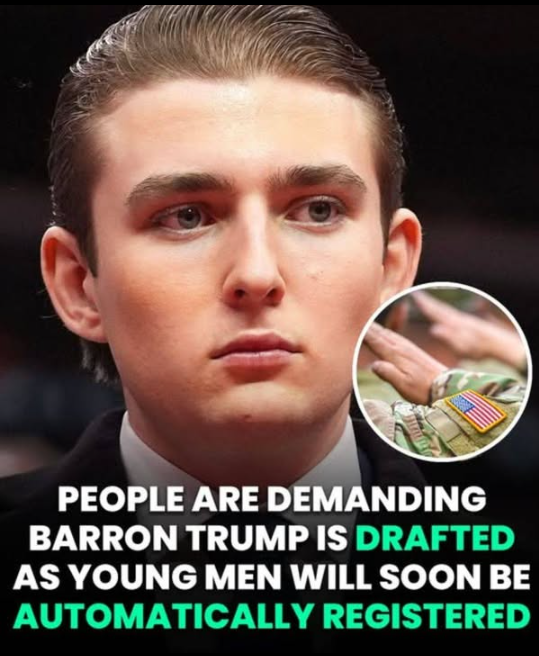
The idea that Barron Trump could be drafted into the U.S. military has recently circulated online alongside headlines about young men being “automatically registered” for selective service. But when you strip away the viral framing, the reality is far more straightforward—and far less dramatic.
To understand why Barron Trump “can’t be drafted” (at least not in the way some posts suggest), you have to look at how the U.S. military draft system actually works, what “automatic registration” means, and the basic legal and practical realities of conscription in the United States today.
The Draft Doesn’t Currently Exist
First, the most important point: the United States does not currently have an active military draft. The draft ended in 1973 after the Vietnam War, when the U.S. transitioned to an all-volunteer force. Since then, no one has been forcibly conscripted into military service.
What does still exist is the Selective Service System. This is essentially a standby system—a database of eligible men that could be used if Congress and the president ever decided to reinstate a draft in a national emergency.
So when people talk about someone being “drafted,” they’re actually talking about a hypothetical scenario. No draft = no one being called up, including Barron Trump or anyone else his age.
What “Automatic Registration” Really Means
Recently, there’s been renewed attention on proposals to make registration with the Selective Service automatic rather than something young men have to do themselves.
Right now, U.S. law requires most men between the ages of 18 and 25 to register. Failure to do so can lead to penalties, including loss of access to certain federal benefits. Some proposals aim to streamline this by pulling data from government databases—like driver’s licenses or tax records—to register eligible individuals automatically.
However, this does not mean:
- People are being drafted immediately
- A draft is imminent
- Specific individuals are being targeted
It simply means the government would maintain a more complete list of eligible individuals if a draft were ever reinstated.
Why Barron Trump Isn’t in Immediate Danger of Being Drafted
At the center of viral speculation is Barron Trump, the son of former president Donald Trump. The narrative often implies that, because of new policies, he might soon face compulsory military service.
That claim doesn’t hold up for several reasons.
1. Age and Timing
Barron Trump was born in 2006, meaning he is just reaching the age where registration becomes relevant. Like any other male U.S. citizen, he would be expected to register with the Selective Service within 30 days of turning 18.
But again, registration is not induction. It’s just being added to a list.
2. No Active Draft
Even if Barron is registered (manually or automatically), there is no mechanism currently in place to draft him—or anyone else. Congress would need to pass legislation to reinstate the draft, and the president would need to sign it into law.
That’s a massive political step, one that hasn’t happened in over 50 years.
3. College and Deferments
Historically, during times like the Vietnam War, young men enrolled in college could receive deferments. While policies could differ in a future draft, education, medical status, and other factors typically play a role in determining eligibility.
If Barron Trump chooses to attend college, that could be a factor in any hypothetical scenario.
4. Security and Practical Realities
There’s also a practical dimension. As the son of a former president, Barron Trump is likely to have a level of visibility and security considerations that would complicate any standard military assignment.
While the law does not exempt individuals based on family status, in practice, high-profile individuals are often handled differently for safety and logistical reasons.
Could a Draft Ever Return?
Theoretically, yes. The Selective Service exists precisely because the government wants to be prepared in case of a large-scale conflict requiring rapid troop expansion.
In such a scenario:
- Congress would pass a law authorizing the draft
- The president would approve it
- A lottery system would likely determine the order of induction
Even then, not everyone registered would be called. The draft historically selects individuals based on age groups, health, and other criteria.
Why Viral Claims Take Off
The idea that “even Barron Trump could be drafted” spreads quickly because it combines several emotionally charged elements:
- A well-known public figure
- Fear of war or instability
- Confusion about government policy
It creates a sense of immediacy and personal impact, even though the underlying claim is misleading.
Social media often amplifies these narratives by stripping away nuance. “Automatic registration” becomes “forced enlistment,” and a bureaucratic update gets framed as a dramatic shift in national policy.
The Bigger Picture
The conversation around automatic registration is really about administrative efficiency, not military mobilization. The U.S. government wants to ensure compliance with existing law, not signal an impending draft.
For young men across the country—including Barron Trump—the reality is simple:
- Registration may become automatic
- No one is currently being drafted
- A draft would require major political action
Until those steps happen, concerns about specific individuals being forced into military service are speculative at best.
Final Thoughts
The claim that Barron Trump “can’t be drafted” is technically true—but also somewhat misleading. The more accurate statement is that no one can be drafted right now, because the system to do so isn’t active.
Barron Trump, like millions of other young men, may be subject to registration requirements. But that’s where the story ends—for now.
The gap between registration and actual conscription is enormous, involving legal, political, and social hurdles that make any immediate draft highly unlikely. So while the headlines may suggest urgency, the reality is far more grounded: this is about paperwork, not deployment