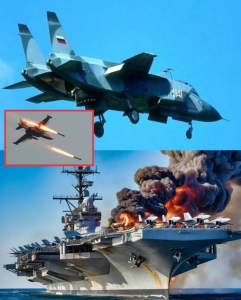
“15 minutes ago in New York… See more.” At first glance, it looked like a catastrophic military strike—fighter jets launching missiles and a massive explosion engulfing what appeared to be a U.S. aircraft carrier. Smoke billowed into the sky, flames tore through the structure, and the sense of urgency in the caption made it feel immediate and real.
But the reality behind images like this is often far different from what the caption suggests.
To begin with, there are no aircraft carriers stationed in New York City. Naval vessels of that size do not operate in the narrow waterways around Manhattan in active combat conditions, and certainly not in a way that would allow a direct aerial strike to occur “15 minutes ago” without massive, immediate coverage from every major news outlet in the world. An event of that scale would dominate every screen, every alert system, and every official communication channel within minutes.
Instead, what this image represents is a carefully constructed piece of visual misinformation.
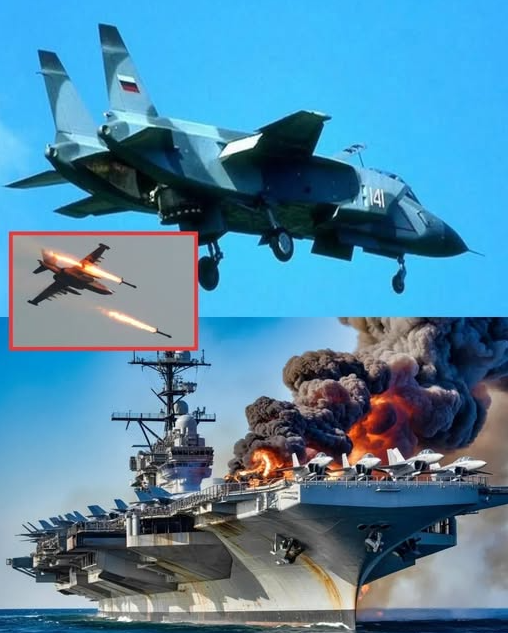
The top portion of the image shows a military jet in flight, equipped with missiles. The bottom portion depicts an aircraft carrier engulfed in flames after what appears to be a devastating strike. There is also a smaller inset image showing missiles being launched. When combined, these elements create a dramatic and convincing narrative: an attack has just occurred, and the viewer is witnessing it in real time.
However, this type of composition is a classic example of how misleading content is created and spread online.
First, the elements in the image are almost certainly taken from different sources. Military aircraft photos are widely available, often captured during training exercises or air shows. Similarly, images of explosions on ships may come from controlled tests, past incidents, or even digitally altered scenes. By stitching these visuals together, someone can create a powerful but entirely fictional scenario.
Second, the caption plays a crucial role. The phrase “15 minutes ago” is designed to create urgency, discouraging viewers from questioning the authenticity of the image. It taps into a natural human instinct to react quickly to potential danger, especially when it involves a major city like New York. The addition of “See more” encourages clicks and shares, spreading the content further without providing any actual information upfront.
This combination of dramatic imagery and urgent language is highly effective. It bypasses critical thinking and goes straight to emotional response.
But when you step back and analyze it logically, the inconsistencies become clear.
If such an attack had truly occurred in or near New York, there would be immediate and overwhelming evidence beyond a single circulating image. Emergency services would be responding, government officials would be issuing statements, and reputable news organizations would be providing continuous updates. None of that accompanies posts like this.
Instead, these images tend to appear in isolation, often shared across social media with little to no credible sourcing.
There is also the technical aspect to consider. The scale and positioning of the aircraft carrier, the angle of the explosion, and the lighting differences between elements can often reveal that the image has been edited. While modern editing tools can create highly realistic composites, subtle inconsistencies still exist for those who look closely.
More importantly, the scenario itself raises questions. A direct missile strike on a U.S. aircraft carrier would represent a major act of war, triggering immediate military and political consequences on a global scale. It is not the kind of event that would be quietly reported through a vague social media post.
So why do images like this spread so quickly?
Part of the answer lies in how information is consumed today. People scroll rapidly, often reading only headlines or captions without investigating further. When something looks shocking or dangerous, it stands out and gets shared. Each share adds a layer of perceived credibility, even if the original content is false.
Another factor is the blending of real-world tensions with fictional content. There are ongoing global conflicts and military activities that make such scenarios feel plausible. When people are already aware of heightened tensions, they are more likely to believe that an attack could happen suddenly.
This is exactly what makes these posts so effective—and so problematic.
They exploit real fears to spread misinformation.
It’s also worth noting that not all misleading content is created with the same intent. Some may be designed purely for attention or engagement, while others may aim to influence opinions or create confusion. Regardless of the motive, the result is the same: people are left misinformed, anxious, and unsure of what to believe.
The best defense against this kind of content is a combination of awareness and critical thinking.
When encountering a dramatic claim, especially one tied to a powerful image, it helps to pause and ask a few simple questions. Is this being reported by multiple reliable sources? Does the scenario make sense given what you know about the world? Are there details that seem inconsistent or exaggerated?
Taking just a moment to reflect can prevent the spread of false information.
In this case, the image and caption do not represent a real event in New York 15 minutes ago. They are part of a pattern of viral content designed to capture attention through shock and urgency rather than accuracy.
Behind every such post is a reminder of how easily perception can be shaped by visuals and wording. What appears to be a breaking crisis can, upon closer examination, turn out to be a constructed narrative with no basis in current reality.