The operation sounded like something straight out of a high-budget military video game—fast-moving aircraft, elite commandos, deception tactics, and a race against time deep inside hostile territory. But this wasn’t fiction or a mission from Call of Duty. It was a real, high-risk U.S. military rescue mission carried out inside Iran—one that officials are already calling one of the most complex and daring operations in recent history.
It all began when a U.S. Air Force F-15E Strike Eagle was shot down over Iran during escalating conflict in the region. The jet carried two crew members: a pilot and a weapons systems officer. Both ejected safely, but what followed turned into a nightmare scenario for the U.S. military—two American servicemen stranded deep behind enemy lines, with Iranian forces actively hunting for them.
The first rescue happened quickly. Within hours of the crash, U.S. forces located and extracted the pilot. But the second crew member wasn’t so lucky. Injured, alone, and hiding in rugged mountainous terrain, he had to survive for nearly two days while evading capture. According to reports, Iranian forces—including units of the Islamic Revolutionary Guard Corps (IRGC)—were closing in, even offering rewards for information leading to his capture.
This is where the mission shifted from urgent to extraordinary.
To buy time, U.S. intelligence agencies—particularly the CIA—launched a deception campaign. False signals and misleading information were spread to confuse Iranian forces about the pilot’s location and the timing of any rescue attempt. This kind of psychological and informational warfare added a layer of complexity rarely seen outside of movies.
Meanwhile, the stranded airman relied on survival training—moving away from the crash site, hiding in difficult terrain, and using communication systems to stay in contact with U.S. forces. Every hour mattered. The longer he stayed hidden, the higher the risk of being discovered.
Then came the rescue.
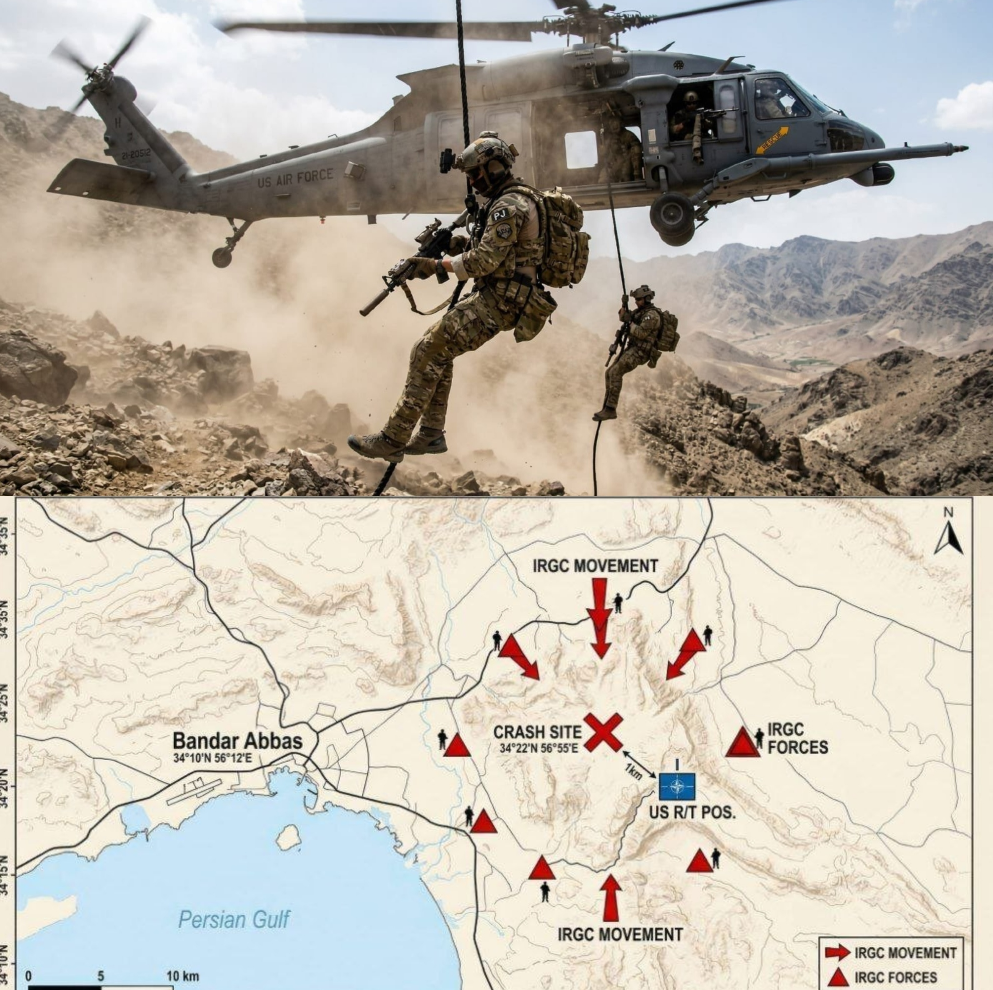
Under cover of darkness, U.S. Special Operations forces launched a coordinated assault and extraction mission. Dozens of aircraft were involved—fighter jets for air cover, drones for surveillance, and helicopters and transport planes to carry in elite rescue teams.
The terrain made everything harder. The rescue zone was mountainous, remote, and deep inside Iranian territory—hundreds of miles from friendly bases. That meant limited margin for error. Any misstep could have led to a larger confrontation or even a hostage crisis.
As the rescue teams moved in, the situation escalated into active combat. Reports indicate that U.S. aircraft provided air support, striking nearby Iranian positions to prevent them from reaching the downed pilot first.
On the ground, special forces located the injured officer, secured the area, and prepared for extraction. But it wasn’t a clean getaway. U.S. aircraft came under fire from Iranian defenses, including ground weapons and possibly surface-to-air systems. Some equipment was damaged, and in certain cases, U.S. forces reportedly had to destroy their own aircraft to prevent them from falling into enemy hands.
Iranian sources even claimed multiple U.S. aircraft were shot down during the operation—though those claims have not been independently verified.
Despite the chaos, the mission succeeded.
The second crew member—injured but alive—was extracted and flown out of Iran along with the rescue teams. U.S. officials confirmed that both airmen were safely recovered, marking the end of a tense, two-day ordeal.
What makes this operation so remarkable isn’t just the rescue itself—it’s the scale and coordination involved. This wasn’t a simple pickup mission. It combined intelligence warfare, aerial combat, ground operations, and rapid-response planning under extreme pressure. Hundreds of personnel, multiple aircraft types, and real-time intelligence all had to work together flawlessly.
It also carried enormous political risk. Conducting a ground operation inside Iran—a hostile country—could have triggered a much wider conflict if things went wrong. The presence of U.S. forces on Iranian soil, even briefly, underscores just how high the stakes were.
President Donald Trump praised the mission, calling it “one of the most daring search and rescue operations in U.S. history.”
Military analysts have echoed that sentiment, comparing it to some of the most complex rescue missions ever attempted. The combination of hostile territory, active enemy pursuit, and the need for secrecy made it extraordinarily difficult.
At its core, though, the mission reflects a long-standing principle of the U.S. military: leave no one behind.
That commitment drove planners to take enormous risks, deploy elite forces, and execute a mission that could have easily gone wrong at multiple points. Instead, it ended with both crew members safely recovered—a rare success story in an otherwise tense and escalating conflict.
Still, the operation also highlights something else: the growing intensity of the confrontation between the U.S. and Iran. The fact that an American fighter jet was shot down—and that a rescue mission required such force—shows how volatile the situation has become.
In the end, the mission may sound like a scene from a video game—but the reality is far more serious. Real lives were on the line. Real bullets were fired. And the consequences, if it had failed, could have been far-reaching.
It was not just a rescue. It was a reminder of how quickly modern warfare can blur the line between cinematic and real—and how, sometimes, reality is even more intense.