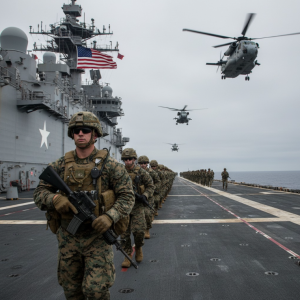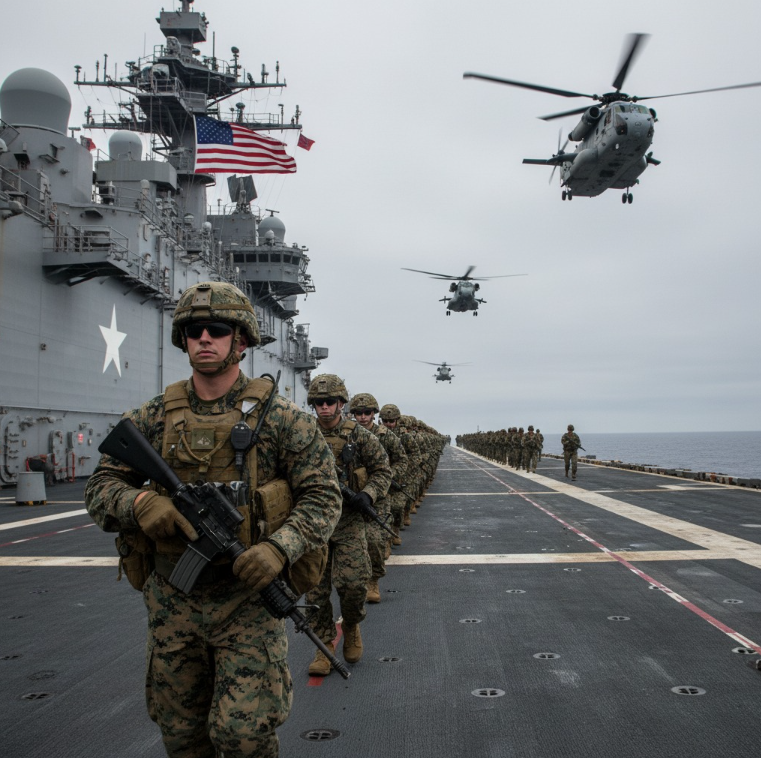
Tehran was already on edge, but the latest developments in the Persian Gulf have pushed tensions even higher. Reports that the United States deployed the amphibious assault ship USS Tripoli along with thousands of Marines toward the Strait of Hormuz have sent shockwaves through the region, raising fears of a wider confrontation and reshaping the strategic balance in one of the world’s most critical waterways.
The USS Tripoli is not just another warship. It is a powerful America class amphibious assault vessel capable of carrying advanced aircraft such as F-35B fighter jets and MV-22 Osprey tiltrotor aircraft, along with a full Marine Expeditionary Unit. This combination allows it to function as a floating base for rapid-response operations, ranging from humanitarian missions to full-scale combat. The deployment of such a ship signals that the United States is preparing for a wide range of contingencies, not merely a symbolic show of force.
According to defense officials, more than two thousand Marines have been deployed alongside the USS Tripoli as part of a broader reinforcement effort in the Middle East. These Marines are trained for expeditionary warfare, meaning they can quickly launch operations from the sea onto land, secure key infrastructure, or respond to emerging threats. Their presence in the region dramatically increases the United States’ ability to act swiftly if the situation escalates further.
The Strait of Hormuz itself is at the center of this unfolding crisis. This narrow passage connects the Persian Gulf to the open ocean and serves as a vital artery for global energy supplies. Roughly a fifth of the world’s oil passes through it, making any disruption there a matter of global concern. In recent weeks, tensions have surged as Iran has been accused of targeting shipping and threatening to restrict access to the strait, triggering fears of economic fallout and energy shortages.
The deployment of the USS Tripoli and its Marines appears to be part of a broader strategy to ensure freedom of navigation in the strait. U.S. officials have indicated that they want to maintain the ability to escort commercial vessels and potentially neutralize threats such as anti-ship missiles or naval mines. This suggests that the mission is not only defensive but could involve preemptive actions to secure the waterway.
From Tehran’s perspective, the arrival of such a formidable force is deeply alarming. Iranian leaders have long viewed U.S. military presence near their borders as a direct threat. The addition of thousands of Marines and advanced naval assets reinforces the perception that Washington is prepared to escalate if necessary. This perception is further fueled by increasingly aggressive rhetoric from both sides, with warnings of severe consequences if diplomatic solutions fail.
Recent news reports indicate that thousands of U.S. Marines have been deployed to the broader Middle East theater as tensions with Iran intensify. At the same time, conflicting signals about negotiations and military intentions have created a climate of uncertainty. Some reports suggest that diplomatic efforts are ongoing, while others highlight preparations for potential military operations, leaving observers unsure which path will ultimately prevail.
The presence of the USS Tripoli also brings with it significant airpower. The F-35B jets it can carry are among the most advanced stealth fighters in the world, capable of conducting precision strikes, surveillance, and air superiority missions. This capability enhances the United States’ ability to project power across the region, potentially deterring adversaries but also increasing the stakes of any confrontation.
In addition to its aviation capabilities, the ship supports amphibious operations, meaning Marines can be deployed via helicopters, landing craft, or tiltrotor aircraft. This flexibility allows for operations in a variety of scenarios, including securing coastal areas, evacuating civilians, or conducting targeted raids. The versatility of the Marine Expeditionary Unit makes it one of the most adaptable forces in the U.S. military arsenal.
The broader regional context further complicates the situation. Ongoing conflicts involving multiple actors, including Iran, Israel, and allied groups, have already created a volatile environment. The introduction of additional U.S. forces adds another layer of complexity, increasing the risk of miscalculation or unintended escalation. Even a minor incident in such a tense setting could quickly spiral into a larger conflict.
Economic implications are also significant. Disruptions in the Strait of Hormuz have already contributed to rising oil prices and concerns about global energy supplies. Any prolonged instability in the region could have far-reaching effects on economies worldwide, affecting everything from fuel costs to international trade. This economic dimension adds urgency to efforts to stabilize the situation, even as military preparations continue.
Despite the heightened tensions, it is important to note that the deployment of the USS Tripoli does not necessarily mean that conflict is inevitable. Military forces are often positioned to deter aggression and provide options for policymakers rather than to initiate hostilities. The presence of a ძლიერი and capable force can sometimes prevent conflict by signaling readiness and resolve.
However, the risk remains real. The combination of military buildup, political rhetoric, and strategic importance makes the Strait of Hormuz one of the most dangerous flashpoints in the world today. Each move by one side is closely watched and often mirrored or countered by the other, creating a cycle of escalation that can be difficult to break.
For now, the situation remains fluid. The USS Tripoli and its Marines represent a significant increase in U.S. military capability in the region, but their ultimate role will depend on how events unfold in the coming days and weeks. Whether this deployment leads to de-escalation through deterrence or contributes to further tensions will be determined by the actions and decisions of leaders on all sides.
What is clear is that the stakes could not be higher. The Strait of Hormuz is not just a regional concern but a global one, and any disruption there has the potential to affect millions of people around the world. As the USS Tripoli moves into position and Marines prepare for any scenario, the world watches closely, aware that the next chapter in this unfolding crisis could have far-reaching consequences.