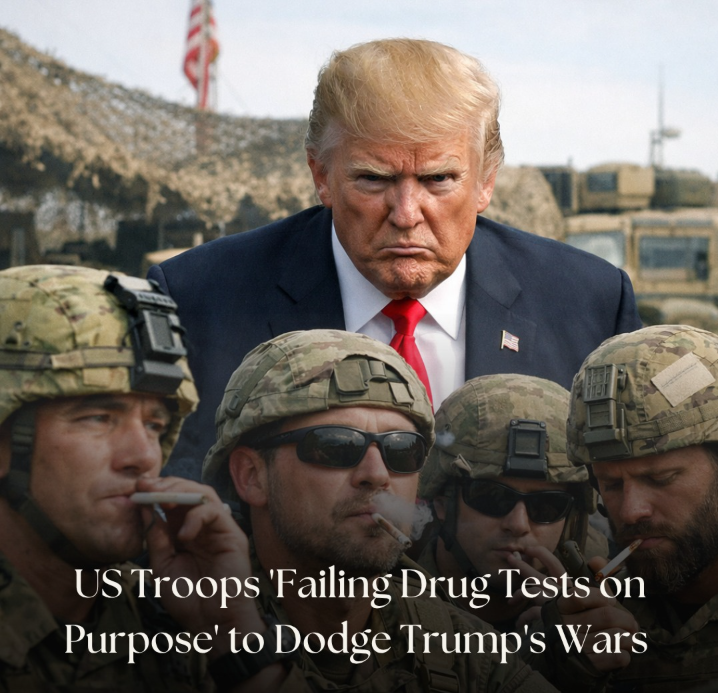
The claim that United States troops are deliberately failing drug tests as a form of silent protest to avoid deployment in potential conflicts has spread quickly across social media, often framed in dramatic and alarming terms. At first glance, it may sound like a coordinated act of resistance within the military, a hidden rebellion against orders tied to controversial geopolitical decisions. But when examined more closely, the narrative becomes far less clear and far more questionable.
There is currently no credible evidence from verified military sources, official statements, or reputable journalism confirming that U.S. troops are engaging in widespread intentional drug test failures as a protest tactic. The U.S. military enforces strict drug policies, and testing is conducted regularly across all branches. Service members who fail drug tests face serious consequences, including disciplinary action, discharge, and long-term impacts on their careers and benefits. These penalties make the idea of mass intentional failure highly unlikely as a coordinated strategy.
Historically, there have been isolated cases of individuals attempting to avoid duty through various means, but these situations are typically handled on a case by case basis and are not indicative of a broader organized movement. The structure of the military, with its chain of command and strict accountability systems, makes it extremely difficult for such a widespread and coordinated protest to occur without detection or documentation.
It is also important to understand how military deployments work. Troops are not randomly sent into conflict zones without preparation or notice. Units undergo training, receive orders through established channels, and are supported by logistics and planning that involve thousands of personnel. Avoiding deployment is not as simple as failing a drug test. In many cases, doing so would not prevent deployment in the way the claim suggests, and could instead result in immediate removal from service under unfavorable conditions.
The origin of this claim appears to be rooted in speculation and the amplification of unverified anecdotes. Social media platforms often accelerate the spread of such narratives, especially when they align with existing political tensions or public fears about military conflict. Headlines are frequently written in a way that provokes strong emotional reactions, encouraging people to share before verifying the information.
Another factor to consider is the broader context of civil military relations. Members of the armed forces are bound by a professional code that emphasizes duty, discipline, and adherence to lawful orders. While individuals within the military, like any group, may hold diverse personal opinions about political leadership or foreign policy, the institution itself operates under a framework designed to maintain cohesion and effectiveness. Open or covert mass protest actions would undermine that framework and are therefore taken very seriously.
That said, it is not uncommon for rumors about internal dissent to surface during periods of heightened political tension. Throughout history, various claims have emerged suggesting dissatisfaction within the ranks during controversial conflicts. However, distinguishing between legitimate concerns and exaggerated or false narratives requires careful attention to evidence and sourcing.
Experts who study military behavior and morale generally rely on surveys, retention rates, and official reports to assess the state of the force. These indicators provide a more reliable picture than viral claims. While there can be challenges related to morale, recruitment, or retention at different times, there is no substantiated data supporting the idea of a widespread, organized effort by troops to sabotage drug tests as a form of protest.
It is also worth noting that spreading unverified claims about the military can have real consequences. Such narratives can erode public trust, create confusion, and unfairly portray service members in a negative light. For those who serve, maintaining discipline and readiness is a fundamental part of their role, and broad accusations without evidence can be damaging.
When encountering headlines that use phrases like shocking silent protest or failing on purpose, it is helpful to approach them with skepticism. These phrases are often designed to capture attention rather than convey verified information. Checking multiple reputable sources, looking for official confirmation, and considering the plausibility of the claim are important steps in evaluating its accuracy.
In this case, the available information suggests that the claim is not supported by credible evidence. While it is always possible that isolated incidents occur, there is no indication of a widespread or coordinated effort of the kind being described. The narrative appears to be driven more by speculation and sensationalism than by documented reality.
Ultimately, understanding complex issues like military behavior and national security requires careful analysis and reliance on trustworthy information. In a media environment where stories can spread rapidly and without verification, taking the time to question and investigate claims is more important than ever.