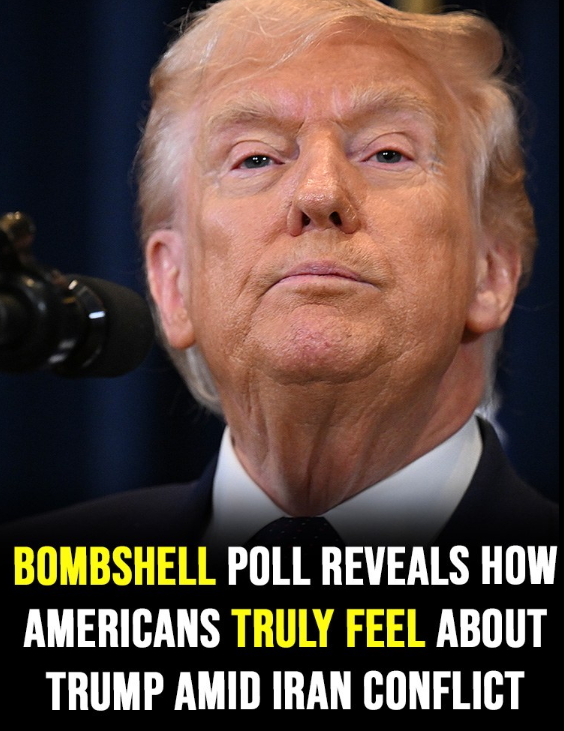
Eye-Opening Poll Shows What Americans Really Think About Trump’s Iran Strategy
Recent national polls are revealing something striking: Americans are deeply divided—and in many cases skeptical—about how President Donald Trump is handling the escalating conflict with Iran.
While some voters support the administration’s aggressive military approach, multiple surveys show that more Americans oppose the strategy than support it, and many are worried about the long-term consequences. The results paint a complex picture of a country uncertain about war, economic fallout, and national security.
Below is a closer look at what the latest polling data reveals about public opinion.
A Majority of Americans Oppose the Military Action
One of the most consistent findings across recent polls is that more Americans disapprove of the military campaign than approve of it.
A national survey conducted shortly after the strikes found:
-
56% of Americans oppose U.S. military action in Iran
-
44% support it
Another survey by Reuters/Ipsos reported similar results:
-
43% disapprove of the strikes
-
27% approve
-
The rest remain unsure.
This indicates that while support exists, opposition currently outweighs approval by a noticeable margin.
Political analysts say this reflects the public’s caution about entering another Middle East conflict after decades of wars in the region.
Strong Political Divisions
One of the most striking aspects of the polling data is how sharply opinion splits along party lines.
Polls consistently show:
-
Republicans mostly support Trump’s strategy
-
Democrats overwhelmingly oppose it
-
Independents tend to lean against the military action
For example:
-
Around 85% of Republicans support the action
-
Up to 89% of Democrats oppose it
-
Roughly 60% of independents disapprove.
This partisan divide highlights how foreign policy decisions are increasingly shaped by domestic political loyalties.
Supporters of Trump argue that strong action is necessary to deter Iran’s military ambitions and nuclear program. Critics say the strikes risk escalating a dangerous conflict without a clear strategy.
Americans Want to Avoid Ground Troops
If there is one point where Americans largely agree, it is this: they do not want U.S. ground troops sent into Iran.
Polling shows overwhelming opposition to deploying soldiers:
-
74–75% of Americans oppose sending ground troops
-
Fewer than 20% support it.
This reflects a broad national reluctance to become deeply involved in another prolonged war in the Middle East.
Many voters appear willing to tolerate limited military action, such as airstrikes, but not a full-scale ground war.
Many Americans Say the Goals Are Unclear
Another major concern revealed by polls is confusion about the purpose of the military campaign.
According to surveys:
-
Only 33% say Trump clearly explained the goals of the strikes
-
64% say the administration has not clearly explained the objectives.
Similarly, nearly two-thirds of Americans believe the administration failed to communicate a clear strategy or endgame.
When voters don’t understand the mission, analysts say, support tends to weaken quickly.
This has historically been a major factor in declining public support for wars.
Concerns About Safety and Escalation
Another major issue shaping public opinion is fear that the conflict could make the United States less safe rather than more secure.
Polls show:
-
About half of Americans believe the strikes make the U.S. less safe
-
Only around three in ten believe they improve national security.
Many respondents worry about:
-
Terrorist retaliation
-
Cyberattacks
-
Regional escalation
-
A prolonged war involving multiple countries
These concerns are especially strong among independents and younger voters.
Economic Fears Are Growing
The conflict is also raising economic concerns, particularly about fuel prices.
In one national poll:
-
67% of Americans expect gasoline prices to rise because of the conflict.
Energy markets often react quickly to instability in the Middle East, and voters are highly sensitive to changes in gas prices and inflation.
Nearly half of respondents say the conflict could negatively affect their personal finances.
For many Americans, the economic consequences may shape how they evaluate the war going forward.
Young Voters Are Especially Skeptical
Another surprising trend in the polling data is the reaction from younger voters.
A recent survey found that:
-
70% of voters aged 18–29 disapprove of Trump’s performance related to the conflict.
Some younger voters who supported Trump during the 2024 election say they feel disappointed because he campaigned on avoiding new overseas wars.
Analysts say this group could play a major role in shaping political outcomes in future elections.
A Nation Still Undecided
Despite the strong opinions revealed in polls, a significant portion of Americans remain uncertain about the conflict.
Many people say they are still waiting to see:
-
Whether the military strategy succeeds
-
Whether the war expands or ends quickly
-
Whether Iran retaliates against U.S. forces
Polls also show about one-quarter of Americans remain unsure about whether they support or oppose the strikes.
This uncertainty means public opinion could shift rapidly depending on how events unfold.
What the Polls Really Reveal
Taken together, the polling results tell an important story.
Americans generally agree on several key points:
-
They are wary of another large war in the Middle East
-
They strongly oppose sending ground troops
-
They want clearer explanations of military goals
-
They are concerned about economic consequences
At the same time, the country remains deeply divided politically over whether the strikes were justified.
The Bottom Line
The latest polls show that Trump’s Iran strategy faces a complicated public response.
Support remains strong among his political base, but nationally, more Americans oppose the military action than support it, and many worry about escalation, safety, and economic fallout.
As the conflict continues, public opinion could shift dramatically depending on the results of the strategy—and how clearly the administration explains its next steps.
For now, the polls reveal a nation watching closely, concerned about the future, and still deciding whether the risks of this confrontation are worth it.