Who Tatiana Schlossberg Was
Tatiana Celia Kennedy Schlossberg was born on May 5, 1990, into one of America’s most storied political families. She was the daughter of Caroline Kennedy—the only surviving child of President John F. Kennedy and Jacqueline Kennedy Onassis—and Edwin Schlossberg, a noted designer and artist. As a granddaughter of JFK, she carried forward both the public legacy and the private history of one of the nation’s most famous families. Wikipedia
Raised in New York City, she grew up alongside her siblings, including Jack Schlossberg and Rose Schlossberg, in a family shaped by public service, intellectual engagement, and profound personal losses. Over decades, the Kennedys have experienced a series of tragedies—from assassinations to accidents—that have deeply affected several generations. Wikipedia
Tatiana matched her lineage with her own accomplishments in journalism, writing, and environmental advocacy. After studying at Yale University and later at Oxford University, she became a respected environmental journalist and author. She wrote on science, climate, and environmental policy for major publications, including The New York Times, The Washington Post, Vanity Fair, The Atlantic, and Bloomberg. In 2019, she published her first book, Inconspicuous Consumption: The Environmental Impact You Don’t Know You Have, which explored the hidden environmental costs of everyday life. People.com
Her work reflected a commitment to the environment and public understanding of science—an arena that often bridged her journalistic skill with pressing global issues.
Diagnosis and Illness
The story of Tatiana’s illness began in May 2024, but she didn’t instantly know she was seriously ill. Hours after giving birth to her second child, a daughter, routine blood work revealed a startlingly high white blood cell count—well above the normal range. Subsequent tests confirmed she had acute myeloid leukemia (AML), a type of blood cancer that can be aggressive and difficult to treat. Parade
What made her case especially devastating was that the strain of leukemia included a rare genetic mutation known as “Inversion 3”, a marker often associated with poorer outcomes and typically seen in older patients. Doctors immediately began intensive and aggressive treatments to combat the disease. Parade
Tatiana’s diagnosis came suddenly and shockingly. In her own words, she had felt healthy—she had swum miles and led an active life, even shortly before the diagnosis. In her poignant November 2025 essay for The New Yorker, titled “A Battle With My Blood,” she candidly wrote about her disbelief and the surreal nature of facing terminal illness after the joy of new motherhood. Parade
Treatment Journey
After her diagnosis, Tatiana underwent a multi-faceted treatment regimen:
-
Chemotherapy: Intensive cycles designed to destroy cancerous cells.
-
Bone marrow transplants: At least two are known—one using stem cells donated by her sister Rose Schlossberg and another from an unrelated donor.
-
Clinical trials: She also participated in experimental treatments, including CAR-T cell therapy, in hopes of finding new ways to halt the disease’s progression. Parade
Despite these efforts, which spanned many months and involved some of the best medical resources available, her leukemia proved resistant. Physicians eventually informed her that standard treatments were no longer expected to bring remission, and she was facing a terminal prognosis. Newser
In interviews and in her writing, she spoke openly about the emotional weight of her situation—not only her own suffering but the impact on her young family. She expressed deep concern that her two small children, a three-year-old son named Edwin and her daughter born in 2024, might soon live without her presence. New York Post+1
A Heartbreaking Public Revelation
In November 2025, on the 62nd anniversary of her grandfather’s assassination, Tatiana made the brave decision to publicly disclose her diagnosis in her New Yorker essay. It was a deeply personal piece that revealed not just medical facts, but her inner world—her hopes, fears, love for her family, and reflections on mortality. Encyclopedia Britannica+1
She also used the platform to touch on broader issues, at one point voicing criticism of public policies she felt hindered medical research. Specifically, she wrote about how reductions in certain research funding—championed by her cousin, Robert F. Kennedy Jr., who at the time was in public office—had the potential to affect advances that might have helped patients like her. TheWrap
Her essay resonated widely—both for its eloquence and for its raw vulnerability—bringing attention not only to her own plight but the human dimensions of living with terminal disease.
Her Death and Family Statement
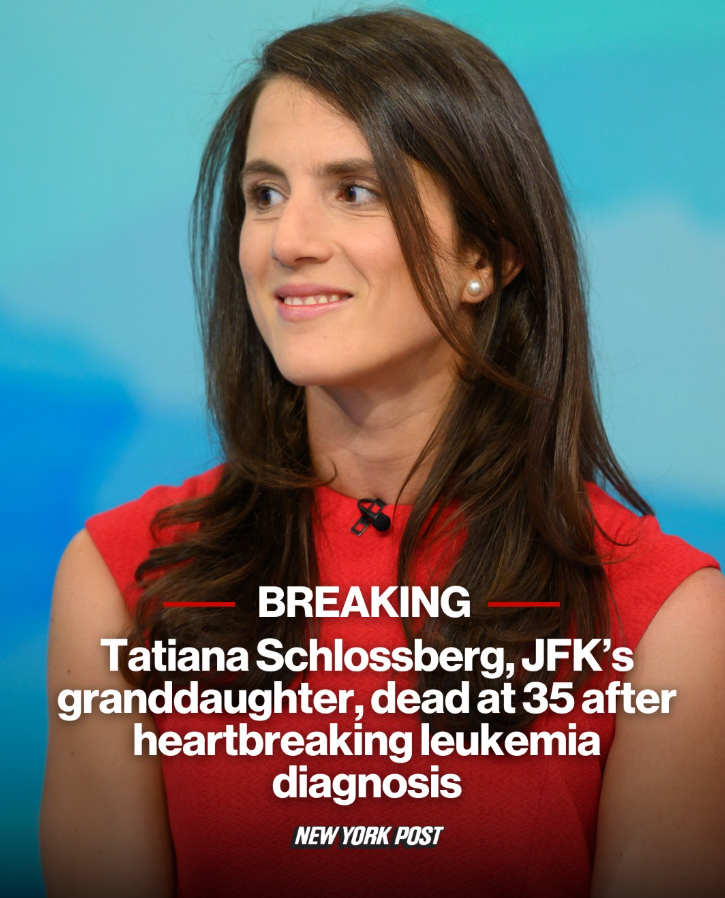
On December 30, 2025, Tatiana Schlossberg died at age 35 following an 18-month battle with leukemia, her family announced publicly via the John F. Kennedy Library Foundation. They shared a simple but deeply felt message:
“Our beautiful Tatiana passed away this morning. She will always be in our hearts.” AP News
Her passing drew widespread attention and condolences from journalists, public figures, and many members of the public who had followed her work and her story.
Tatiana is survived by:
-
Her husband, Dr. George Moran
-
Their two young children, including their son Edwin and their daughter
-
Her parents, Caroline Kennedy and Edwin Schlossberg
-
Her siblings, including Rose and Jack Schlossberg People.com
Public tributes noted not just her professional achievements, but her courage, intelligence, warmth, and unwavering dedication to her family.
Legacy and Reflection
Tatiana Schlossberg’s life and death highlight many layers of human experience—ambition and accomplishment, privilege and purpose, suffering and grace. She was a gifted writer and thinker who used her voice to inform public discourse on environmental issues and later, through her own illness, on the realities of living with terminal disease.
Her story also brought attention back to the Kennedy family’s complex legacy—a story of public service shadowed by personal tragedy. From the assassination of her grandfather in 1963 to more recent loss, the family has endured hardship that has touched the nation’s consciousness. Encyclopedia Britannica
Above all, Tatiana’s courage in the face of suffering—choosing to share her journey publicly, expressing her love for her children, and speaking honestly about fear and hope—left a powerful imprint on those who read her words this year.
Her passing at such a young age is undeniably tragic, but her voice, integrity, and reflection will continue to be remembered through her writing and the many lives she touched.