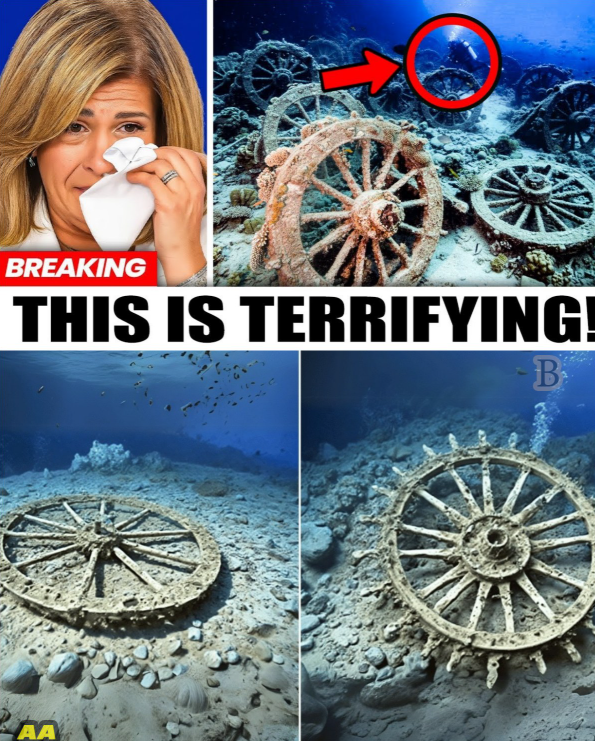

Beneath the Red Sea: Divers Discover a 1.5-Mile “Chariot Graveyard” That Shakes History
In recent weeks, social media has been flooded with dramatic headlines claiming that divers have uncovered a 1.5-mile-long “chariot graveyard” beneath the Red Sea, allegedly confirming one of the most famous—and controversial—stories in human history: the biblical account of the Exodus. According to viral posts, underwater explorers found ancient chariot wheels, horse remains, and weapons scattered across the seabed, supposedly frozen in time after a catastrophic drowning thousands of years ago.
The story is gripping. It promises a discovery so monumental that it would reshape archaeology, theology, and our understanding of ancient civilizations. But as with many viral claims that “shake history,” the truth is far more complex—and far more revealing about how misinformation spreads in the modern age.
So what’s really beneath the Red Sea? And why does this story refuse to disappear?
The Viral Claim: A Discovery Too Big to Ignore
The claim usually follows a familiar pattern:
-
Divers allegedly discovered hundreds of ancient chariot wheels stretching for 1.5 miles across the seafloor.
-
The site is said to lie along a proposed crossing route of the Israelites fleeing Egypt.
-
Some versions include images of circular coral formations interpreted as wheels, alongside claims of horse skeletons and gold-plated artifacts.
-
The discovery is framed as suppressed or ignored by mainstream archaeologists.
These posts are often accompanied by dramatic language—“hidden for 3,000 years,” “history rewritten,” “scientists stunned”—and shared millions of times across Facebook, TikTok, and YouTube.
But despite the boldness of the claims, no verified archaeological authority has confirmed such a discovery.
Where Did the Story Come From?
The origins of the “Red Sea chariot graveyard” story can be traced back decades, primarily to fringe theories promoted in the late 20th century. Some amateur explorers and religious writers proposed alternative locations for the biblical Red Sea crossing, often pointing to the Gulf of Aqaba rather than the traditional Gulf of Suez.
In the 1990s and early 2000s, a handful of underwater photographs—many showing naturally occurring coral formations—were circulated online and described as chariot wheels. Over time, these images were repeatedly reused, re-captioned, and enhanced with increasingly sensational claims.
Crucially, none of these images have been independently verified, dated, or excavated using accepted archaeological methods.
What Does Real Archaeology Say?
Professional underwater archaeology is a meticulous, slow-moving discipline. Any discovery of this magnitude would require:
-
Peer-reviewed documentation
-
Carbon dating
-
Stratigraphic analysis
-
Artifact recovery under controlled conditions
-
Publication in academic journals
To date, no such evidence exists for a chariot graveyard beneath the Red Sea.
Archaeologists who specialize in the region have repeatedly stated that:
-
Wooden chariots would not survive intact underwater for millennia, especially in saltwater.
-
Bronze or iron components would corrode beyond recognition.
-
Horse remains would disperse rapidly due to scavengers and currents.
-
A battlefield-scale debris field would not remain neatly arranged for thousands of years.
In short, the physical conditions of the Red Sea make the viral narrative extremely unlikely.
The Problem With the “Wheel” Images
Many viral posts focus on circular shapes seen underwater, claiming they resemble chariot wheels. Marine scientists and geologists point out that:
-
Coral naturally grows in radial and circular patterns
-
Erosion frequently produces wheel-like rock formations
-
Human brains are wired to recognize familiar shapes—a phenomenon called pareidolia
In controlled studies, these formations have consistently been identified as natural geological or biological structures, not man-made artifacts.
Why the Story Persists
If the evidence is so weak, why does the story keep resurfacing?
1. It Connects Faith and Proof
For many people, the idea of physical evidence supporting a sacred text is deeply compelling. The story offers certainty in a world full of ambiguity.
2. Social Media Rewards Sensation
Platforms prioritize content that sparks emotion—wonder, shock, or outrage. “History-shaking discovery” travels faster than “no evidence found.”
3. Distrust of Institutions
Claims that evidence is being “hidden” resonate in an era where skepticism toward experts and institutions is widespread.
4. AI and Image Recycling
Old images are now enhanced, recolored, and recontextualized using modern tools, making them appear new and credible.
What About the Exodus?
It’s important to note that questioning the chariot graveyard claim does not disprove the Exodus.
Many historians agree that:
-
The Exodus narrative likely reflects a complex mixture of history, oral tradition, and theology
-
Large-scale population movements in the ancient Near East did occur
-
Egypt and Canaan were deeply interconnected culturally and politically
However, most scholars agree that if an Exodus-like event happened, it would not leave behind a neatly preserved underwater battlefield.
Why Responsible Skepticism Matters
History is full of genuine, astonishing discoveries—sunken cities, shipwrecks, ancient tools buried for tens of thousands of years. These discoveries are thrilling precisely because they are verified, documented, and reproducible.
When unproven claims are presented as fact, they:
-
Undermine real archaeological work
-
Create false expectations
-
Distract from authentic discoveries
-
Blur the line between belief and evidence
Critical thinking doesn’t diminish wonder—it protects it.
The Real Story Beneath the Red Sea
The Red Sea is an archaeological treasure—but not in the way viral posts suggest.
It contains:
-
Ancient shipwrecks from Roman, Islamic, and Ottoman periods
-
Trade routes used for thousands of years
-
Coral ecosystems older than recorded history
-
Evidence of human maritime activity spanning civilizations
These verified discoveries tell a rich, fascinating story of human ingenuity, exploration, and survival—one grounded in evidence rather than myth.
Final Reflection
The idea of a 1.5-mile chariot graveyard beneath the Red Sea is powerful, cinematic, and emotionally resonant. But extraordinary claims require extraordinary evidence, and so far, that evidence simply does not exist.
What this story truly reveals is not a hidden battlefield—but the enduring human desire to connect past, faith, and meaning in tangible ways.
History doesn’t need exaggeration to be awe-inspiring. When we respect the difference between mystery and misinformation, the real past becomes even more extraordinary.