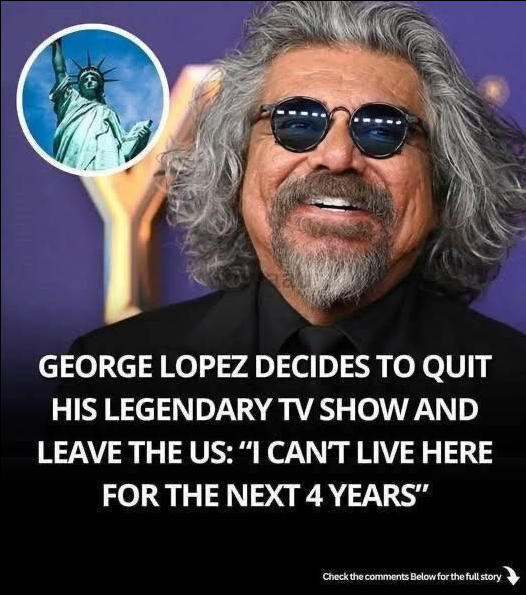
George Lopez Drops Bombshell: Leaving the U.S. and Stepping Away From TV — What It Really Means
Headlines suggesting that George Lopez is “leaving the U.S.” and “stepping away from television” have sparked a wave of surprise, concern, and speculation among fans. For a comedian whose voice has long been intertwined with American pop culture—particularly Latino representation on mainstream TV—the idea feels seismic. But as with many attention-grabbing claims, the truth is more layered than a single dramatic sentence. Rather than a sudden disappearance, what appears to be unfolding is a moment of reflection, transition, and recalibration for a performer who has already lived several full creative lives.
George Lopez has never been just a sitcom star. From the beginning, his comedy was rooted in identity, family, politics, and lived experience. When George Lopez premiered in 2002, it was groundbreaking—not simply because it featured a Mexican American family in prime time, but because it did so without flattening them into caricatures. The show ran for six seasons and cemented Lopez as a household name. Later projects, including Lopez Tonight and Lopez vs. Lopez, continued his exploration of family dynamics, generational trauma, and cultural pride.
So why the talk of stepping away now?
Over the past few years, Lopez has been increasingly candid about burnout, disillusionment with the entertainment industry, and frustration with the political and cultural climate in the United States. In interviews and stand-up routines, he has joked—sometimes pointedly, sometimes half-seriously—about leaving the country or reducing his presence on American television. Those remarks, often delivered with the exaggeration that comedy invites, have recently been amplified and reframed as definitive plans.
What’s important to understand is that comedians often speak in metaphor and provocation. When Lopez talks about “leaving,” he is frequently expressing emotional distance rather than logistical intent. Like many artists who have spent decades in the spotlight, he is reckoning with what he wants the next chapter to look like—and whether the traditional TV system still serves that vision.
Television itself has changed dramatically since Lopez first broke through. Network sitcoms no longer dominate cultural conversation the way they once did. Streaming, short-form content, and live touring have shifted where audiences engage. For a veteran performer, stepping away from TV doesn’t necessarily mean stepping away from creativity. It can mean redirecting energy toward stand-up, podcasting, writing, or projects that allow more control and authenticity.
There’s also the matter of legacy. At this stage of his career, George Lopez has little left to prove. He opened doors for Latino comedians, challenged stereotypes, and built a body of work that still resonates. Choosing to slow down—or even to relocate part-time—can be less about escape and more about preservation. Many artists reach a point where protecting their peace becomes more important than maintaining visibility.
The “leaving the U.S.” narrative taps into a broader cultural moment. Increasingly, public figures across industries speak openly about feeling exhausted by polarization, outrage cycles, and the pressure to constantly comment on every issue. Lopez’s comments reflect that fatigue. Whether he ultimately moves abroad, splits time between countries, or simply fantasizes about distance, the sentiment resonates with many Americans who feel similarly overwhelmed.
Stepping away from television, too, does not have to be permanent. Lopez has stepped back before, only to return in new forms. His recent work has shown a willingness to be more vulnerable, addressing aging, health, and complicated family relationships. That kind of storytelling often requires space—away from rigid formats and expectations.
Fans reacting with alarm may be overlooking a quieter truth: transitions are not endings. If Lopez reduces his TV presence, it may signal a desire to engage audiences differently, not less. Live comedy remains one of his strongest platforms, offering immediacy and freedom that television rarely provides. There is also the possibility of behind-the-scenes work—mentoring, producing, or developing projects for the next generation of Latino voices.
It’s also worth noting that no official, definitive announcement has confirmed a permanent departure from either the U.S. or television. Much of the “bombshell” framing comes from selective quotes and viral headlines that favor drama over nuance. Lopez himself has not framed his future in absolutes. His language tends to suggest openness rather than closure.
In that sense, the story says as much about audiences as it does about him. We often expect public figures to remain static—forever entertaining, forever available. When they express uncertainty or a desire for change, it can feel unsettling. Yet change is precisely what has allowed Lopez to remain relevant for decades.
If George Lopez is indeed entering a quieter phase, it would be consistent with a career defined by self-direction. He has always pushed against expectations, whether in content, casting, or tone. Choosing when and how to step back is another form of that autonomy.
Ultimately, the real takeaway isn’t that George Lopez is vanishing. It’s that he is reassessing. After years of giving his voice, his humor, and his perspective to the public, he appears to be asking a simple, human question: What do I want next? Whether that leads him abroad, off television, or into an entirely new creative lane remains to be seen.
What’s certain is this: George Lopez’s impact is already secure. If he chooses to speak less, it will not erase what he has said—or what he has meant—to generations of viewers who finally saw themselves reflected on screen.