💵 A Man Steals $100, Buys $70 Worth of Goods, and Gets $30 Change… How Much Did the Store Really Lose?
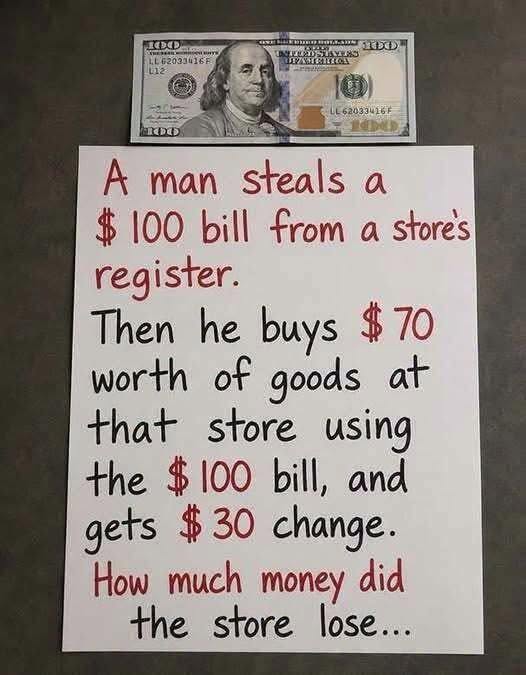
At first glance, this looks like a simple money problem. A man walks into a store, steals a $100 bill from the cash register, and then uses that same $100 bill to purchase $70 worth of merchandise. The cashier gives him $30 in change.
The question sounds easy, but there is a clever twist that has confused thousands of people:
How much money did the store actually lose? $70, $100, or $130? 🤔
Before jumping to an answer, take a moment to follow every step of the situation. The trick is understanding that the same $100 bill is involved twice, but it does not mean the store loses $100 twice.
Let’s break down this interesting brain teaser.
💰 Step 1: The Man Steals $100
Imagine a small neighborhood store on an ordinary afternoon.
The cashier is working behind the counter, customers are browsing the shelves, and everything seems perfectly normal.
While the cashier is distracted, a man takes a $100 bill from the cash register and walks away.
At this moment, the store has lost $100 in cash.
The cash register is now short by $100, and the store owner has suffered a direct financial loss.
But the story does not end there.
🛒 Step 2: The Man Returns to Buy Something
A little later, the same man comes back into the store.
This time, he behaves like an ordinary customer. He walks through the aisles, chooses several products, and brings them to the cashier.
The total price of his purchases is $70.
He then takes out the exact same $100 bill he stole earlier and hands it to the cashier.
The cashier has no reason to suspect that the money originally belonged to the store.
From the cashier’s perspective, the customer has simply paid with a $100 bill.
The cashier accepts the payment and prepares to give him the correct change.
💵 Step 3: The Cashier Gives Him $30
Because the purchase costs $70 and the customer pays with $100, the cashier gives him $30 in change.
The transaction looks perfectly normal:
- Merchandise: $70
- Payment received: $100
- Change returned: $30
The man walks out with $70 worth of merchandise and $30 in cash.
But remember something important: the $100 bill he used to pay was stolen from the same store.
This is where the puzzle becomes interesting.
🧠 Step 4: Calculate the Actual Loss
Let’s examine what the store has lost.
First, the store loses the original $100 bill when the man steals it.
Then the man uses that stolen bill to pay for his merchandise.
Although the cashier receives the $100 bill back, the store must give him $30 in change and $70 worth of merchandise.
In other words, the store ends up with the stolen $100 bill again, but it has given away $70 in goods and $30 in cash.
The total value of what the thief walks away with is:
$70 + $30 = $100.
Therefore, the store’s total loss is $100.
📊 The Final Calculation
Here is the easiest way to understand the answer:
| Item | Store’s loss |
|---|---|
| Original stolen money | $100 |
| Merchandise given away | $70 |
| Cash change given | $30 |
| Total value taken by thief | $100 |
The $100 bill is not counted as an additional loss after it returns to the register.
The store has lost $70 worth of merchandise and $30 in cash.
[
70 + 30 = 100
]
<big>The correct answer is $100.</big>
🤯 Why Do So Many People Get This Puzzle Wrong?
The reason this question confuses people is that it encourages us to count the same money more than once.
Some people immediately say $130 because they add the original $100 stolen to the $30 change.
Others say $170 because they add the stolen $100, the $70 merchandise, and the $30 change.
But those calculations fail to account for the fact that the original stolen $100 bill returns to the store during the purchase.
The important thing is to follow the actual movement of money and goods rather than simply adding every number mentioned in the story.
This is a classic example of how a small change in perspective can make a seemingly complicated problem much easier.
🔍 Another Way to Understand the Puzzle
Imagine that you are the store owner.
At the beginning, your cash register contains $100.
The thief takes that money.
Your register is now missing $100.
Then the thief comes back and gives you the same $100 bill as payment.
Your original $100 is back in the register.
However, you give the thief $30 from your register and hand over $70 worth of merchandise.
At the end of the situation, your store has lost:
- $30 in cash.
- $70 in merchandise.
Your total loss is $100.
It does not matter that the thief used the stolen money to make the purchase. The store still ends up giving away $100 in value.
🧩 The Bigger Lesson Behind This Brain Teaser
This little puzzle teaches an important lesson about financial thinking.
When calculating a loss, it is essential to understand what actually leaves your possession and what comes back.
Money can move from one place to another several times during a transaction. If you do not follow those movements carefully, you might count the same amount twice.
This principle is useful beyond simple brain teasers.
Businesses regularly track cash, inventory, payments, refunds, and expenses. Accurate accounting requires understanding the difference between money received, money spent, and the value of products sold.
A transaction can involve several numbers without creating several separate losses.
That is why slowing down and examining each step is often better than rushing to an answer.
🔥 NOW IT’S YOUR TURN!
Let’s see how many people can solve this puzzle without looking at the explanation!
A man steals $100 from a store.
He returns and purchases $70 worth of merchandise using the stolen $100 bill.
The cashier gives him $30 in change.
How much did the store lose?
💵 A. $70
💰 B. $100
🤯 C. $130
🧠 D. $170
Think carefully before answering!
The correct answer is B. $100 because the thief leaves with $70 worth of merchandise and $30 in cash.
👇 COMMENT YOUR ANSWER BELOW!
Did you solve it immediately, or did this little money puzzle trick your brain?
Share it with your friends and family. Let’s see who can get the right answer without doing the math twice! 😂💵