“Harvest of Hope”
The morning sun spilled across the fields like honey, warming the dew-kissed grass and coaxing sleepy chickens from their coops. The farm was alive with motion—boots crunching on gravel, laughter rising from the kitchen tent, ducks waddling toward puddles left by last night’s rain.
And in the center of it all sat June.
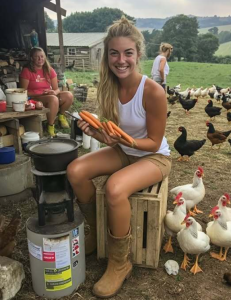
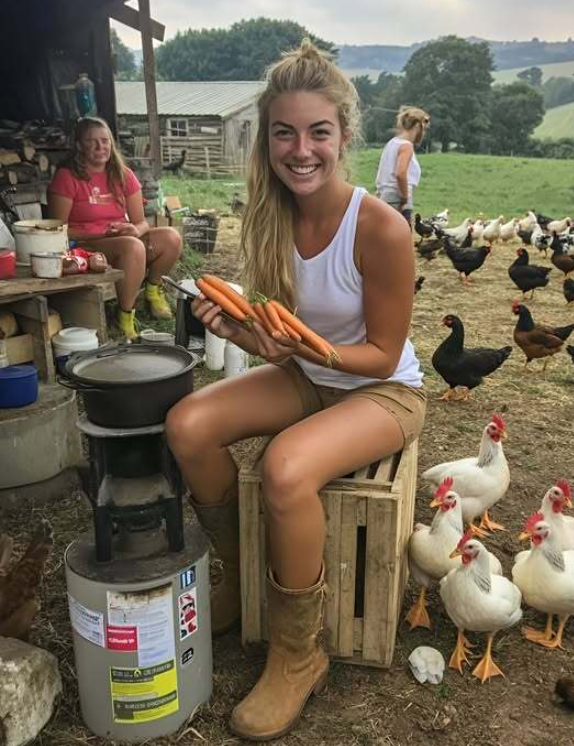
She perched on a wooden crate, a bunch of carrots in her hands, dirt still clinging to their roots. Her white tank top was streaked with soil, her khaki shorts damp from the morning harvest. But her smile was radiant, effortless, the kind that made strangers feel like old friends.
Around her, chickens pecked at the ground, ducks quacked in lazy rhythm, and the scent of rosemary and wood smoke drifted from the outdoor stove nearby. June’s boots were worn, her hands calloused, but her spirit was light. This was her sanctuary.
It hadn’t always been.
Just a year ago, June had been sitting in a sterile office, staring at spreadsheets and wondering when her life had stopped feeling like her own. The city had drained her—its noise, its pace, its endless demands. She had lost her job, her apartment, and her sense of direction all in one season.
So she left.
She packed what she could into her old sedan and drove until the skyline disappeared and the air smelled like rain. She found the farm through a volunteer network—an organic cooperative that offered room and board in exchange for labor. It was supposed to be temporary.
But the land had other plans.
June had arrived in spring, when the soil was soft and the seedlings fragile. She learned to plant, to prune, to listen. She learned that chickens have personalities, that carrots taste sweeter when pulled with your own hands, and that silence can be sacred.
She also learned to heal.
The farm was run by a woman named Marta, a retired teacher with a laugh like thunder and a heart big enough to hold everyone’s stories. Marta had built the place from scratch after losing her husband, turning grief into growth. She welcomed June with no questions, just a pair of gloves and a promise: “The land gives back what you give it.”
June gave everything.
Now, months later, she was no longer a visitor. She was part of the rhythm—waking with the roosters, cooking with the harvest, laughing with the volunteers who came and went like seasons.
Today was special.
It was the farm’s annual Harvest Day, a celebration of abundance and community. Locals came from nearby villages, bringing bread, music, and stories. Children chased ducks, elders shared recipes, and everyone gathered around the long wooden tables set beneath the trees.
June had been asked to lead the vegetable prep. She didn’t hesitate.
She sat on her crate, surrounded by baskets of produce, greeting each passerby with a smile and a carrot. Her joy was contagious. Even the chickens seemed to linger near her, as if drawn to her warmth.
Across the field, Marta watched with pride.
“She’s found her roots,” she said to a visitor. “And she’s helping others find theirs.”
As the day unfolded, June moved from station to station—chopping, stirring, serving. She danced with children, swapped stories with elders, and even sang a folk tune she’d learned from a traveling musician. Her voice was soft, but steady. Like the earth beneath her.
At sunset, the farm glowed with lanterns and laughter. June sat again on her crate, this time with a bowl of stew and a heart full of gratitude. A young girl approached, holding a drawing—a picture of June surrounded by chickens and carrots.
“It’s you,” the girl said shyly.
June blinked back tears. “It’s beautiful.”
The girl smiled. “You look happy.”
June nodded. “I am.”
Later that night, as the stars blinked awake, June walked to the edge of the field and looked out over the land. The rows of vegetables, the coops, the barn—all of it pulsed with life. She thought about the city, the office, the version of herself that had once felt so lost.
She wasn’t lost anymore.
She was planted.
And she was growing.
Reflection
This story honors the quiet transformation that happens when we reconnect with nature, community, and purpose. June’s journey is one of renewal—finding strength not in escape, but in return. The farm becomes a metaphor for healing, and her smile, surrounded by animals and vegetables, is the harvest of hope.
Would you like a companion story from Marta’s perspective, or perhaps a poetic retelling of Harvest Day? I’d love to keep building this world with you.