Title: “The Militia of the Soil”
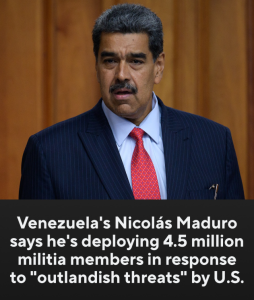
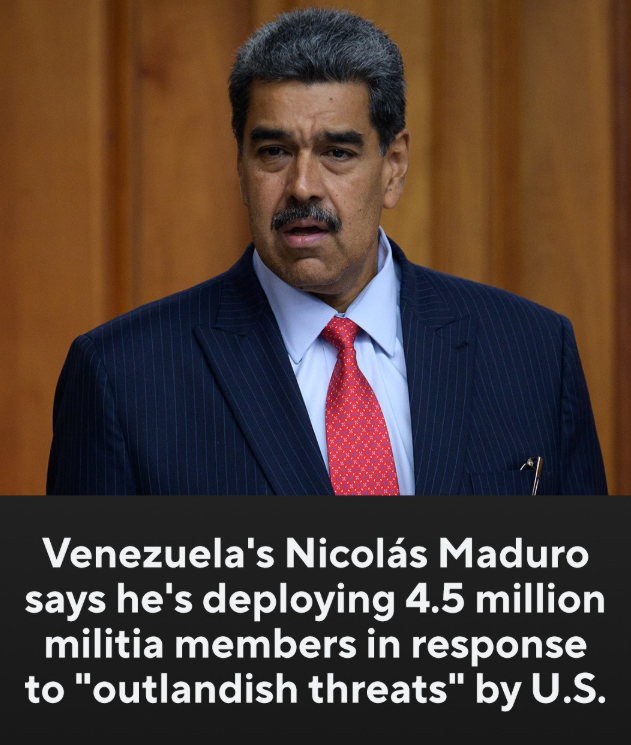
The air in Caracas was thick with heat and uncertainty. On the morning of August 18th, President Nicolás Maduro stood before a sea of red-clad supporters, his voice echoing across the Plaza Bolívar like a drumbeat of defiance.
“We will not be touched,” he declared. “Not by empires. Not by threats. Not by the rotten refrain of foreign aggression.”
Behind him, banners fluttered with the faces of Bolívar and Chávez. Before him, the Bolivarian National Militia—millions strong, according to the government—stood ready to be activated. Farmers, factory workers, teachers, retirees. Not soldiers by trade, but citizens by conviction.
Among them was Rosa Jiménez, a 47-year-old schoolteacher from Barinas. She had joined the militia in 2019, not out of love for politics, but out of fear. Her brother had vanished during a protest. Her students spoke of hunger more often than history. And yet, she believed in sovereignty. In dignity. In the right to defend her soil.
When the announcement came that 4.5 million militia members would be deployed across the country, Rosa didn’t hesitate. She packed a small bag—water, a notebook, a photo of her children—and boarded a bus headed for the capital.
“This is not war,” she told the woman beside her. “This is a warning. We are still here.”
The streets of Caracas buzzed with tension. Rumors swirled: three U.S. Navy destroyers had entered the Caribbean, 4,000 troops deployed nearby. The White House called it an anti-drug operation. The Venezuelan government called it provocation.
Maduro’s face appeared on every screen, every billboard. “Militias prepared, activated, and armed,” he said. “We defend our seas, our skies, our lands.”
In the hills above the city, militia members trained with wooden rifles and outdated maps. Rosa stood among them, sweat dripping down her back, her fingers trembling not from fear, but from the weight of history. She remembered her grandfather’s stories of the 1960s, of resistance and revolution. She wondered what kind of story she was now part of.
Across the border, in Colombia, analysts debated the numbers. Could Venezuela truly mobilize 4.5 million people? Was this a bluff, a show of strength, or a genuine call to arms? The truth was murky. The official militia count hovered near 5 million, but many were inactive, untrained.
Still, the symbolism was clear: Venezuela was drawing a line.
In Washington, Press Secretary Karoline Leavitt repeated the administration’s stance. “President Trump is prepared to use every element of American power to stop drugs from flooding into our country,” she said. The bounty on Maduro’s head had doubled to $50 million. Accusations of narco-terrorism hung in the air like smoke.
But in the barrios of Caracas, the conversation was different.
“We don’t grow coca,” said Luis Ortega, a mechanic and militia volunteer. “We don’t process cocaine. That’s Colombia. That’s Peru. Why are they pointing at us?”
He wasn’t alone. The United Nations Office on Drugs and Crime reported that only 5% of Colombian drugs transit through Venezuela. The country had expelled the DEA in 2005, accusing it of espionage and interference. Many Venezuelans saw the U.S. not as a savior, but as a shadow.
Rosa wrote in her notebook: “They call us a cartel. We call ourselves a people.”
As the week unfolded, militia members were deployed sector by sector. Some guarded factories. Others patrolled coastlines. In the countryside, peasant militias were formed—“missiles and rifles for the working class,” Maduro had said.
But not everyone was convinced.
In the quiet town of Mérida, Father Miguel stood before his congregation and spoke of peace. “We must not become pawns,” he said. “We must not let fear turn us into enemies.”
His words reached Rosa through a crackling radio. She paused, pen in hand, and considered them. Was this truly defense—or was it theater?
She didn’t know. But she knew her students deserved a future. And if standing in a uniform helped protect that future, she would stand.
On August 21st, Maduro addressed the nation again. “The Bolivarian Militia is the people in arms,” he said. “It is the genuine expression of civic-military union.”
Rosa stood in formation, her notebook tucked into her vest. Around her, thousands of others stood too—some proud, some uncertain, all waiting.
The world watched.
Reflection
This fictionalized account draws from real events to explore the emotional and political landscape of Venezuela’s militia mobilization. It’s a story of symbolism, sovereignty, and the blurred lines between defense and defiance. It doesn’t claim to know the truth—it seeks to understand the people caught in its shadow.
Would you like a companion piece from the perspective of a U.S. naval officer, or perhaps a poetic monologue from Rosa’s notebook? I’d love to keep building this world with you.