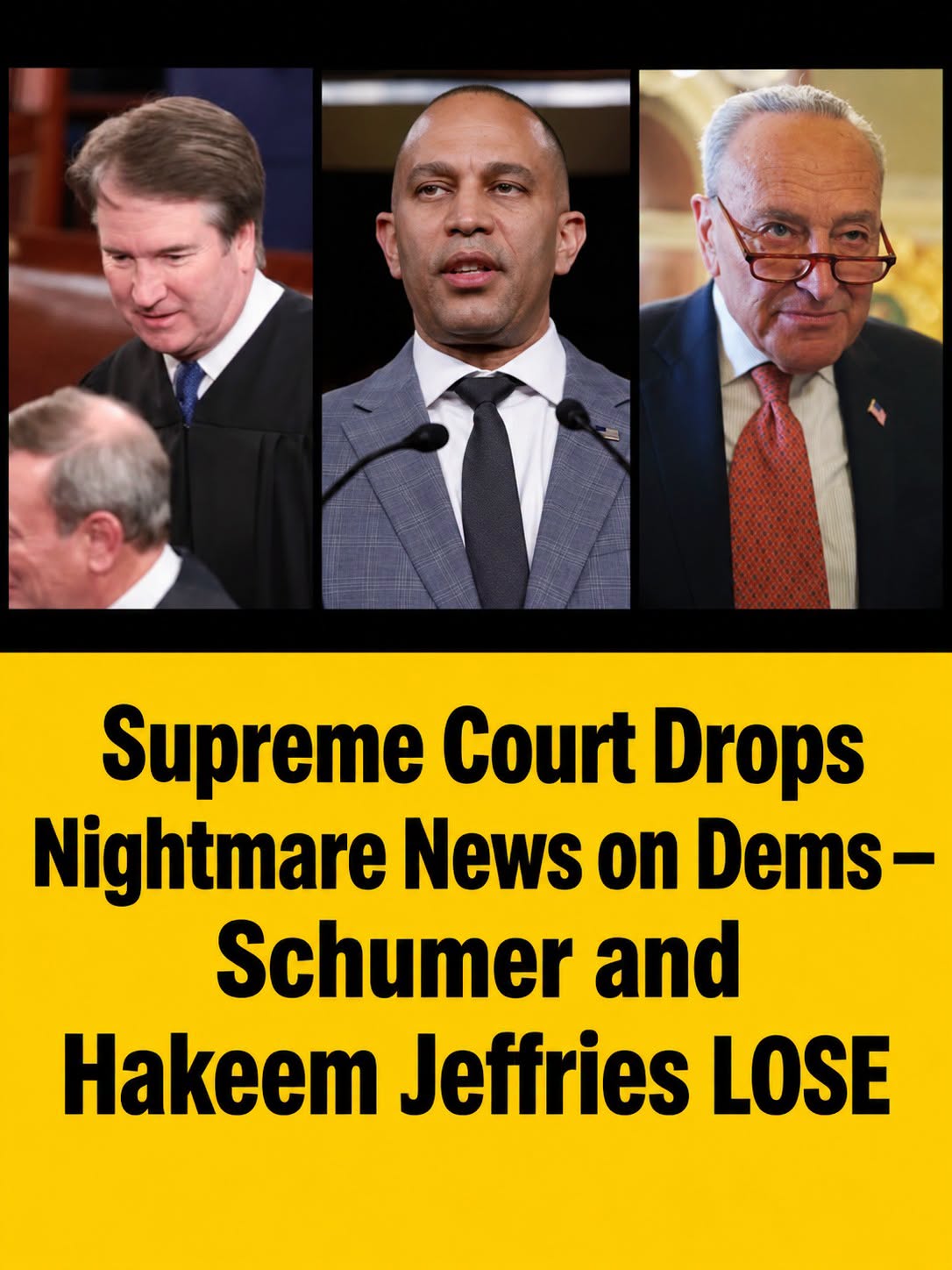
🚨 DEMOCRATS COULD LOSE DOZENS OF CONGRESSIONAL DISTRICTS AT THE SUPREME COURT — MAJOR REDISTRICTING BATTLE ROCKS WASHINGTON! 🇺🇸⚖️
A major legal and political battle is creating fresh uncertainty for Democrats as the U.S. Supreme Court considers questions surrounding congressional district boundaries and the future of voting rights in America.
The stakes are enormous. Depending on how the courts interpret federal voting protections, several states could reconsider their congressional maps, potentially changing the balance of power in the House of Representatives.
Republicans see an opportunity to strengthen their position in Congress, while Democrats warn that changes to voting protections could weaken the political representation of minority communities.
At the center of the controversy is a complicated question: How should states draw congressional districts while complying with the Constitution and the Voting Rights Act?
The answer could influence elections for years to come.
⚖️ The Supreme Court Case Behind the Controversy
The dispute involves Louisiana v. Callais, a major case concerning the relationship between race, voting rights, and congressional redistricting.
Louisiana had created a second majority-Black congressional district following concerns that its original congressional map did not provide Black voters with sufficient electoral representation.
Opponents challenged the map, arguing that the state had relied too heavily on race when drawing district boundaries.
The Supreme Court issued a major 6–3 decision in April 2026, siding with the challengers and narrowing the circumstances in which Section 2 of the Voting Rights Act can be used to require the creation of majority-minority districts.
The decision has significant implications for states that have relied on the law to protect minority voting power.
CalMatters+1
🏛️ Why Democrats Could Face Political Consequences
The ruling has raised concerns among Democratic lawmakers because majority-minority districts have historically played an important role in helping Black and Latino communities elect candidates who represent their interests.
If states determine that certain district boundaries can no longer be legally justified under the Voting Rights Act, they may attempt to redraw those maps.
That could create opportunities for Republican candidates in districts that previously leaned Democratic.
The National Feed’s November 8 headline claims that at least 19 Democratic-held congressional districts could potentially be affected by the legal dispute.
However, that number should be treated as a projection rather than a confirmed list of seats that Republicans will win.
Changing district boundaries does not automatically change election results. Voters still decide who represents them.
🇺🇸 Republicans See an Opportunity
Republican lawmakers and political strategists have welcomed the Supreme Court’s narrower interpretation of federal voting protections.
Their argument is that congressional districts should not be drawn primarily according to racial classifications.
They believe political boundaries should follow constitutional principles and that voters should have equal opportunities to participate regardless of their backgrounds.
Some Republicans also argue that the decision could prevent certain states from using race-conscious districting practices to create electoral advantages for one political party.
For Republicans hoping to maintain or expand their House majority, the potential consequences are significant.
Even a small number of additional competitive districts could influence which party controls the chamber.
🔵 Democrats Warn About Minority Representation
Democrats have strongly criticized the decision.
Their concern is that weakening Section 2 of the Voting Rights Act could make it more difficult for minority communities to challenge district maps that dilute their voting power.
For decades, voting-rights protections have been used to address discriminatory electoral arrangements.
Democratic lawmakers argue that removing or weakening those protections could reverse important progress in political representation.
They also warn that district boundaries can influence whether communities have a meaningful opportunity to elect candidates of their choice.
The disagreement is not simply about which political party benefits.
It is also about how the country protects equal participation in elections.
🗳️ Could More States Redraw Their Congressional Maps?
Yes, the ruling could encourage additional legal and political battles over congressional boundaries.
States that previously relied on majority-minority districts may reconsider how their maps comply with federal law.
Louisiana is particularly important because the original dispute involved its decision to establish a second majority-Black congressional district.
Other states could also examine whether their existing maps would withstand similar legal challenges.
However, each state has its own political circumstances, constitutional requirements, and demographic realities.
The outcome will not necessarily be identical everywhere.
Legal challenges could take months or even years, and courts will have to examine the details of individual maps.
⚖️ What About California and Virginia?
The nationwide redistricting battle has already demonstrated that both parties are willing to fight aggressively over congressional boundaries.
California Democrats approved a new congressional map intended to create additional opportunities for Democratic candidates.
Virginia Democrats also pursued a redistricting effort that could have significantly changed the state’s congressional delegation.
However, the Virginia Supreme Court struck down the redistricting amendment on May 8, 2026, leaving the existing 6–5 Democratic advantage in the state’s congressional delegation in place for the 2026 election.
Virginia Mercury+1
These developments demonstrate how state courts, federal courts, legislatures, and voters can all influence the redistricting process.
📊 Could Democrats Really Lose Dozens of Seats?
This is perhaps the biggest question surrounding the headline.
The possibility of numerous districts becoming more favorable to Republicans has attracted attention from political analysts.
But there is an important distinction between a district being redrawn and a candidate actually winning it.
Even if a new map creates a Republican-leaning district, voters can still elect a Democrat.
Candidates, campaign spending, turnout, economic conditions, presidential approval ratings, and local issues all influence election results.
The Cook Political Report’s September 2026 analysis estimated that redistricting alone was most likely to produce approximately three net Republican seats, while Democrats remained favored to win control of the House.
Cook Political Report
That assessment illustrates why claims about dozens of guaranteed Democratic losses should be approached carefully.
🌍 Why This Battle Matters Beyond Washington
Congressional redistricting affects much more than political campaign strategies.
It determines how communities are grouped together and who gets the opportunity to represent them in the federal government.
The outcome can influence debates over healthcare, immigration, education, taxes, infrastructure, national security, and government spending.
For minority communities, representation can also affect whether their concerns receive sufficient attention in Washington.
For both parties, congressional district boundaries can determine whether a national political victory translates into control of the House.
The stakes are therefore enormous.
🚨 What Happens Next?
The legal debate surrounding Louisiana v. Callais will continue to influence redistricting discussions across the country.
State officials may face pressure to reconsider existing congressional maps, while voting-rights organizations could pursue additional legal challenges.
Republicans will likely continue arguing that the ruling protects constitutional principles.
Democrats will continue emphasizing the importance of preserving meaningful voting protections and minority representation.
Meanwhile, voters will ultimately have their say at the ballot box.
The biggest question is whether the changes resulting from the Supreme Court’s decision will significantly alter the political balance of Congress.
One thing is certain: America’s redistricting battle is far from over.