🏛️ The Loyalty Litmus: Oklahoma’s Controversial Teacher Test Sparks National Debate
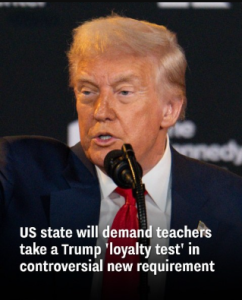
In a move that has ignited fierce debate across the country, Oklahoma has announced a new policy requiring incoming teachers from California and New York to pass an ideological certification exam before being allowed to teach in the state. The test, developed in partnership with conservative media outlet PragerU, is being described by critics as a “MAGA loyalty test”—a political litmus designed to filter out educators deemed too liberal for Oklahoma classrooms.
Supporters say the measure is necessary to protect students from “radical leftist ideology.” Opponents argue it’s a dangerous precedent that politicizes education, deepens teacher shortages, and undermines academic freedom.
🧠 What’s in the Test?
The exam reportedly includes 50 multiple-choice questions focused on American history, civics, and constitutional principles. Sample questions released to the media ask applicants to:
- Identify the first three words of the U.S. Constitution.
- Explain why freedom of religion is “important to America’s identity.”
- Name the two parts of the U.S. Congress.
- State how many U.S. Senators there are.
- Explain why some states have more Representatives than others.
While these questions may appear standard, critics say the test’s underlying purpose is ideological. According to PragerU CEO Marissa Streit, the assessment also addresses “undoing the damage of gender ideology” and aligns with Oklahoma’s revised curriculum, which includes disputed claims about the 2020 election and mandates teaching the Bible and Ten Commandments in public schools.
🧑🏫 Who’s Affected?
The policy applies specifically to teachers relocating from California and New York—two states Oklahoma Superintendent Ryan Walters has repeatedly criticized for promoting “woke indoctrination.” Walters stated:
“As long as I am superintendent, Oklahoma classrooms will be safeguarded from the radical leftist ideology fostered in places like California and New York”.
Teachers from other states are not currently subject to the test, though Walters has hinted that the policy could expand to include additional “blue states” in the future.
📉 The Fallout: Teacher Shortages and Recruitment Challenges
Oklahoma already faces a significant teacher shortage. According to the American Federation of Teachers (AFT), the state ranks near the bottom nationally in education quality and teacher retention. AFT President Randi Weingarten called the new requirement “yet another turnoff for teachers in a state already struggling with a huge shortage”.
John Waldron, chairman of the Oklahoma Democratic Party and a former educator, echoed the concern:
“Teachers are not rushing here from other states to teach. We’ve got an enormous teacher shortage, and it’s not like we have a giant supply of teachers coming in from blue states anyway”.
Critics argue that the test will further discourage qualified educators from applying, especially those who value academic freedom and diversity of thought.
🧬 The PragerU Partnership
PragerU, short for Prager University, is a conservative media organization known for producing videos and educational content that promote right-wing perspectives. Though not an accredited academic institution, PragerU has gained traction in Republican-led states, with its materials now approved for use in public schools in at least ten states.
Oklahoma’s partnership with PragerU marks a significant shift—from using its content as optional resources to institutionalizing it as a gatekeeper for teacher certification. Jonathan Zimmerman, a professor of education history at the University of Pennsylvania, called it a “watershed moment”:
“Prager has become institutionalized as part of the state system. There’s no other way to describe it”.
⚖️ Legal and Constitutional Concerns
Civil liberties groups and education advocates are raising alarms about the legality of the test. Critics argue that it violates the First Amendment by imposing viewpoint discrimination and could be challenged in court.
Tina Ellsworth, president of the National Council for the Social Studies, warned:
“State boards of education should stay true to the values and principles of the U.S. Constitution. Imposing an ideology test undermines that mission”.
The test’s emphasis on “America First” values and its alignment with Trump-era executive orders—such as the 2020 directive to “end racial indoctrination in K-12 schooling”—suggest a broader political agenda. Walters has openly praised Trump and framed the policy as part of a national effort to reshape education in the image of MAGA conservatism.
🧍♀️ The Classroom Consequences
Beyond the politics, the policy has real implications for students. Critics worry that Oklahoma’s curriculum revisions—such as teaching conspiracy theories about the 2020 election and minimizing racial history—will leave students ill-prepared for college and civic life.
College enrollment in Oklahoma has already declined by 20% over the past decade, and only about one-third of high school graduates go on to attend college. Educators fear that politicized teaching standards will further erode academic rigor and critical thinking.
🌍 National Ripple Effects
Oklahoma may be the first state to implement such a test, but it likely won’t be the last. Conservative lawmakers in other states are watching closely, and Walters has positioned himself as a national figure in the education culture wars.
The policy reflects a broader trend of politicizing education—whether through book bans, curriculum mandates, or ideological screening. As the 2026 midterm elections approach, education is poised to remain a battleground issue.
🌟 Final Thoughts: A Test of Values
Oklahoma’s new teacher certification test is more than a hiring requirement—it’s a test of values. It asks whether educators can teach in a system that prioritizes political loyalty over pedagogical integrity. It challenges the notion of education as a space for inquiry, diversity, and growth.
And it forces a national reckoning: What kind of classrooms do we want? What kind of citizens are we raising? And who gets to decide?
As the debate continues, one thing is clear: the future of American education is being shaped not just by curriculum, but by ideology. And in Oklahoma, that future now begins with a test.