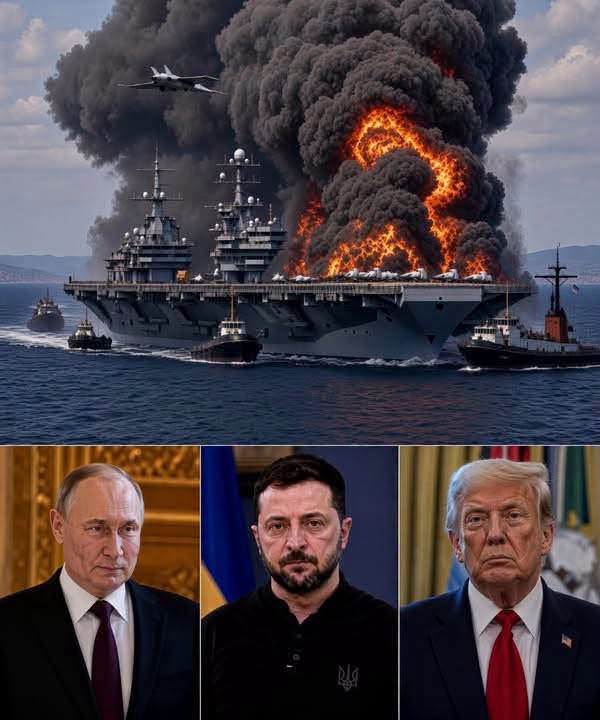
BREAKING: Viral Claim Says Russian Su-57 Pilot Destroyed U.S. Aircraft Carrier Carrying 700
A dramatic claim spreading across social media is capturing attention around the world: “BREAKING — 30 minutes ago: Russian Su-57 pilot destroys U.S. aircraft carrier carrying 700…”
The headline is designed to create immediate shock. It combines one of Russia’s most advanced fighter aircraft with one of the most powerful symbols of American military strength: a U.S. aircraft carrier.
But before readers assume that a major military confrontation has taken place, there is an important question to answer:
Has the incident actually been confirmed?
At this point, the claim should be treated as unverified unless reliable military, government, or independent news sources provide evidence supporting it.
Why the headline is so shocking
A U.S. aircraft carrier is not an ordinary military vessel. Modern carriers operate as floating military bases, capable of supporting aircraft, helicopters, surveillance systems, defensive weapons, and thousands of personnel.
Because of their importance, an attack resulting in the destruction of a U.S. carrier would represent an extraordinary international event.
It would not normally remain confined to a Facebook post or an isolated social-media account.
Such an incident would be expected to generate immediate attention from the U.S. Department of Defense, the White House, military officials, international governments, and major news organizations.
That is one reason extraordinary claims require extraordinary evidence.
The Russian Su-57
The Su-57 is Russia’s advanced multirole fighter aircraft, developed as a modern combat aircraft with a combination of speed, maneuverability, sensors, and reduced radar visibility.
It is frequently featured in Russian military publicity and has become a major part of discussions surrounding modern air warfare.
However, claims involving a single fighter aircraft destroying a major U.S. aircraft carrier should not automatically be accepted simply because the aircraft itself is technologically sophisticated.
An aircraft carrier is heavily defended.
Carrier strike groups are designed to operate with multiple layers of protection, including aircraft, ships, radar systems, electronic warfare capabilities, and defensive weapons.
That does not make a carrier invulnerable. But it does mean that a claim describing a sudden destruction would require substantial evidence.
What does “carrying 700” mean?
The viral headline also creates uncertainty by saying that the carrier was “carrying 700.”
It does not clearly explain whether that number refers to sailors, Marines, passengers, aircraft, or something else.
That ambiguity is another reason readers should be cautious.
A credible report concerning a major military attack would normally identify the ship involved, its location, the circumstances of the incident, and the source of the information.
A vague number without supporting details can be a warning sign that the headline has been designed primarily to generate clicks.
Could such an attack happen without warning?
Modern military operations are extremely complicated.
Aircraft carriers do not operate completely alone. A carrier strike group typically includes multiple ships and aircraft that provide surveillance, defense, communications, and other capabilities.
An aircraft attempting to approach a carrier would potentially encounter several layers of detection and defense.
That does not mean an attack is impossible. Military technology continues to evolve, and modern warfare has demonstrated that even sophisticated systems can face unexpected threats.
But the idea that a single fighter pilot simply appeared and destroyed an American aircraft carrier is a claim that needs to be examined carefully rather than accepted at face value.
Why misinformation spreads during military crises
Military stories are particularly vulnerable to misinformation.
Images from previous exercises can be presented as current combat footage. Old explosions can be described as recent attacks. Computer-generated graphics can be mistaken for real photographs. Headlines can exaggerate legitimate military developments until they become almost unrecognizable.
The speed of social media makes the problem even worse.
One account posts an unverified claim.
Another account copies it.
A third adds the words “BREAKING.”
Soon thousands of people see the story and assume that the number of shares is evidence that the event really happened.
It isn’t.
Virality is not verification.
What would confirm the story?
If a Russian Su-57 had actually destroyed a U.S. aircraft carrier with hundreds of people aboard, there would likely be substantial evidence.
Readers should look for official statements from U.S. military authorities, credible reports from established international news organizations, satellite imagery, verified video, identifiable photographs, and statements from multiple independent sources.
The identity of the alleged carrier would also be extremely important.
Without those details, the headline remains a claim rather than established fact.
The potential consequences would be enormous
If such an attack were genuinely confirmed, the consequences would be far beyond a single naval incident.
A direct attack by Russian forces resulting in the destruction of a U.S. aircraft carrier could trigger a severe international crisis.
Washington would face enormous pressure to respond.
Moscow would face equally intense international scrutiny.
Allied governments would immediately assess their own security situations.
Financial markets could react sharply.
Military forces in Europe and other regions could be placed on heightened alert.
Diplomatic communication would become critically important because the risk of escalation between two nuclear-armed powers would be extraordinarily serious.
That is precisely why readers should be skeptical of sensational reports that appear without supporting evidence.
Social media users should slow down
The phrase “30 minutes ago” creates a powerful sense of urgency.
It makes people feel that they have discovered information before everyone else.
But that urgency can also encourage impulsive sharing.
When dealing with stories about war, military attacks, deaths, or possible international conflict, taking a few minutes to verify information is far more important than being first.
Ask:
Who reported it?
What is the name of the aircraft carrier?
Where did the incident allegedly happen?
Is there an official statement?
Are reputable news organizations reporting the same event?
Is the footage actually from the claimed incident?
If those questions cannot be answered, caution is warranted.
The bigger lesson
The modern information environment makes it possible for anyone to publish a dramatic military headline within seconds.
That can be useful when genuine emergencies occur, but it can also create confusion.
False reports can cause fear among families with relatives serving in the military. They can inflame political arguments and increase hostility between communities. During an international crisis, misinformation can even contribute to dangerous misunderstandings.
That is why responsible reporting matters.
The alleged destruction of a U.S. aircraft carrier by a Russian Su-57 would be an event of historic significance. It should therefore be supported by far more than a sensational headline ending with “See more.”
Final thoughts
The claim that a Russian Su-57 pilot has just destroyed a U.S. aircraft carrier carrying 700 people is an extraordinary allegation.
At present, it should not be treated as confirmed without reliable independent evidence.
The technology involved is real. Russia operates the Su-57, and the United States operates highly sophisticated aircraft carriers. Military competition between major powers is also a genuine and serious subject.
But those facts do not prove that the specific incident described in the viral headline occurred.
Before sharing the story, readers should wait for credible confirmation and look for specific details about the alleged attack.
In an age when sensational military headlines can travel around the world in minutes, the most powerful response is not fear.
It is verification.
If credible authorities confirm the event, the story will become major international news. Until then, treat the viral claim with caution.