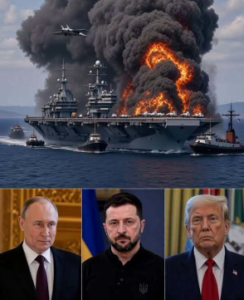
🚨 BREAKING: Russian Su-57 Pilot “Destroys” U.S. Aircraft Carrier Carrying 700 Tanks — What We Actually Know 🚨
A dramatic military headline is spreading rapidly across social media, claiming that a Russian Su-57 pilot has destroyed a U.S. aircraft carrier allegedly carrying 700 tanks.
The wording is designed to sound like an urgent breaking-news event, with phrases such as “30 minutes ago” and “destroys” creating the impression that a major military confrontation has just occurred.
But there is a crucial detail that readers should know before sharing the story: there is currently no credible confirmation that this alleged attack actually happened. Versions of the same claim have circulated repeatedly online during 2026, and searches for the headline lead mainly to sensational websites and social-media posts rather than confirmation from credible military authorities or major international news organizations.
Even more importantly, videos associated with essentially the same headline have been identified as ARMA 3 gameplay and virtual military simulations, not authentic footage of a Russian attack on an American carrier. One of the videos explicitly describes itself as a virtual game simulation.
✈️ The Su-57 Is Real — But the Story Is Not Confirmed
The Russian Su-57 is a real advanced fighter aircraft. Its existence is not in question.
That fact, however, does not establish that a particular Su-57 pilot carried out the attack described in the viral post.
This distinction is extremely important when viewing military content online.
Real aircraft can be placed into fictional scenarios. Real photographs can be combined with unrelated headlines. Computer-generated imagery, movies and video-game footage can also look remarkably realistic.
That appears to be part of what is happening with this particular story.
Videos carrying nearly identical headlines have been posted online while openly identifying the footage as ARMA 3 gameplay.
For someone scrolling quickly through Facebook, TikTok, YouTube or another platform, it can be very easy to mistake simulated combat footage for real battlefield video.
⚓ What About the U.S. Aircraft Carrier?
The claim becomes even more questionable when it says the carrier was carrying 700 tanks.
An aircraft carrier is primarily a naval aviation platform. Its principal purpose is to operate aircraft, support naval aviation operations and serve as a mobile base for a carrier strike group.
It is not normally a giant tank transport ship.
That doesn’t mean U.S. military ships cannot transport armored vehicles. Specialized logistics and amphibious vessels have different roles and can carry vehicles and equipment.
But describing an aircraft carrier as carrying 700 tanks should immediately cause readers to pause and examine the source.
The detail appears to be part of the sensational wording used to make the story sound enormous and catastrophic.
🌊 Why Would the Destruction of a Carrier Be Such a Huge Story?
A U.S. aircraft carrier is not simply an ordinary ship.
A carrier normally operates as part of a larger force, supported by other warships, aircraft, sensors, logistics vessels and defensive systems.
Consequently, the confirmed destruction of a U.S. carrier by a Russian fighter would represent an extraordinarily serious military event.
It would not be the kind of story that could reasonably depend on one anonymous social-media post.
Such an event would be expected to generate extensive international attention, official statements and independent reporting.
That is why the absence of credible confirmation matters.
The current evidence does not establish that a Russian Su-57 destroyed an American aircraft carrier.
🎮 The Video Is a Major Warning Sign
Perhaps the clearest warning comes from the footage circulating alongside the claim.
At least two YouTube uploads using almost identical headlines identify the material as virtual game simulation footage. The descriptions specifically mention ARMA gameplay and state that the video is a simulation.
ARMA 3 is capable of producing highly detailed military scenarios involving aircraft, ships, explosions and combat.
To an unsuspecting viewer, a short clip can therefore look surprisingly realistic.
Someone might see a fighter flying toward a ship, explosions appearing across the water and smoke rising into the sky and immediately assume they are watching genuine battlefield footage.
But realistic-looking footage is not the same thing as authentic footage.
The source matters.
📱 How Viral Military Claims Spread
The wording of this headline illustrates how misinformation can travel.
“BREAKING.”
“30 minutes ago.”
“Russian Su-57.”
“U.S. aircraft carrier.”
“700 tanks.”
Every phrase is designed to increase urgency and emotional reaction.
When people see something this dramatic, many instinctively share it before checking whether it is real.
Then another person sees the same post and assumes that because thousands of people have shared it, it must have been confirmed.
But repetition is not confirmation.
Ten websites copying the same headline do not necessarily represent ten independent sources.
In fact, the exact or nearly identical claim has appeared repeatedly online over a period of months.
That pattern is a warning sign.
🔎 What Should Readers Check?
Whenever a post claims that a major military event happened “minutes ago,” there are several questions worth asking.
Which aircraft carrier was attacked?
A credible report should identify the vessel.
Where did the attack supposedly happen?
A real military incident should have a location or at least a geographic context.
Who confirmed the attack?
Look for statements from credible military authorities and established news organizations.
Where did the video originate?
Determine whether it came from a verified news agency, military source, eyewitness or a gaming channel.
Is the footage labeled as simulation or gameplay?
This is particularly important in this case because related videos explicitly identify themselves as simulations.
Are independent sources reporting the same event?
If the only evidence comes from websites repeating one sensational headline, readers should be extremely cautious.
🌍 Why Verification Matters
False reports about military attacks can cause unnecessary fear.
A fictional report claiming that Russia has destroyed an American aircraft carrier could easily make readers believe that a major confrontation between nuclear-armed powers has begun.
That is why military misinformation is particularly dangerous.
People may not have time to investigate every ordinary internet rumor, but extraordinary claims involving international conflict deserve extra scrutiny.
The responsible approach is simple: stop, check the source and look for independent confirmation before sharing.
⚠️ So, Did This Attack Really Happen?
Based on the available evidence examined for this claim, the alleged attack has not been confirmed.
The Su-57 is real.
U.S. aircraft carriers are real.
Russia and the United States possess powerful military forces.
Military simulations depicting these types of scenarios are also real.
But those facts do not prove that a Russian Su-57 pilot actually destroyed a U.S. aircraft carrier carrying 700 tanks.
The videos associated with the viral headline are especially important because they have been identified as virtual ARMA 3 gameplay rather than authentic combat footage.
So, despite the dramatic “BREAKING” headline, readers should not treat the alleged attack as confirmed news.
The story is a powerful reminder of how quickly fictional military scenarios can be transformed into seemingly real breaking-news stories.
Before sharing a frightening headline, take a moment to ask one simple question:
“Where is the independent evidence?”
In this case, that evidence is missing.
The dramatic video may look convincing. The headline may sound urgent. The claim may be repeated across multiple pages.
But until credible evidence confirms that such an attack actually occurred, the story belongs in the category of unverified viral claims—not confirmed breaking news.
And sometimes, the most important thing you can do when a shocking story appears on your screen is simply to pause before pressing “Share.” 🚨