BREAKING NEWS: Iran Warns of Possible New Attacks as Regional Tensions Remain High
A new warning from Iran has added to already intense concerns across the Middle East, with Iranian officials threatening further attacks if Tehran believes its security is not guaranteed. The warning comes as the United States and Iran remain locked in a tense confrontation while diplomatic efforts continue behind the scenes.
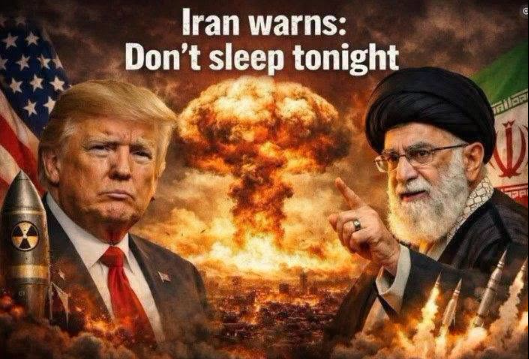
Social media posts are now spreading dramatic claims telling people, “Don’t sleep tonight,” suggesting that a major attack is imminent. However, there is an important distinction between a genuine warning from Iranian officials and an online headline predicting exactly what will happen. There is currently no verified evidence that everyone should expect a specific attack tonight.
What is confirmed is that the rhetoric from Tehran has become increasingly serious.
According to recent reporting, Iranian chief negotiator Mohammad Bagher Ghalibaf warned that infrastructure throughout the region could become a target if Iran’s security concerns were not addressed. The warning came as Tehran awaited a response from Washington concerning an Iranian proposal involving the Strait of Hormuz.
The Strait of Hormuz is particularly important because it is one of the world’s most strategically significant energy routes. Any prolonged disruption there can affect shipping, fuel supplies and energy prices far beyond the Middle East.
A Dangerous Moment
The latest warning arrives after months of fighting involving Iran, the United States and Israel. Although the intensity of some military operations has declined at times, the broader conflict has not been fully resolved.
Recent reports indicate that the two sides are still communicating indirectly through mediators. Iran has proposed a seven-day trust-building process that would include steps toward reopening the Strait of Hormuz, while the United States has been considering its response. Qatar has played an important role in carrying messages between Washington and Tehran.
That diplomatic channel matters because it shows that the situation is not simply moving toward an immediate military confrontation. Negotiations and military pressure are occurring at the same time.
Iran’s Foreign Minister Abbas Araghchi has been involved in those discussions, and Iranian officials have continued pressing for changes to the current situation surrounding the strait and sanctions.
Why People Are Paying Attention
Whenever Iranian officials issue threats against regional infrastructure, governments and markets pay close attention.
The concern is not limited to military facilities. Oil installations, ports, pipelines, shipping routes and other infrastructure can have consequences for ordinary people if they are damaged or disrupted.
The Strait of Hormuz is especially important because large quantities of petroleum products normally pass through the waterway. Recent reporting indicates that shipments through the strait have moved closer to pre-war levels, but uncertainty remains because military tensions continue.
That means even a relatively small escalation can create immediate uncertainty for shipping companies, airlines, energy markets and governments.
For families watching the news, however, it is important not to confuse uncertainty with certainty.
A warning from an official does not automatically mean an attack will happen at a particular hour.
What Does “Don’t Sleep Tonight” Actually Mean?
The phrase has become a powerful social-media hook because it creates fear and curiosity.
But headlines of this type can travel much faster than the underlying facts.
A post claiming that Iran has ordered people to stay awake or that a major attack is guaranteed tonight would require specific evidence from credible authorities. At the moment, available reporting confirms threats of possible additional attacks and continuing military tension, but it does not establish that a specific attack is guaranteed tonight.
That distinction is extremely important.
People should be careful about sharing screenshots, videos or anonymous posts claiming to reveal secret military plans. Old footage can easily be presented as new, while unrelated explosions or military exercises can be falsely connected to current events.
Diplomacy Is Still Happening
One of the most significant developments is that diplomatic efforts have not completely stopped.
Reuters reported on September 30 that Iranian Foreign Minister Abbas Araqchi received U.S. feedback through Qatari mediators regarding Tehran’s proposed seven-day trust-building plan. The proposal includes steps involving the Strait of Hormuz and efforts to reduce tensions.
Other reporting has likewise described ongoing efforts by mediators to bridge disagreements between Washington and Tehran.
This creates a complicated picture.
On one side, Iranian officials are issuing serious military warnings.
On the other, diplomats are still working to find a path toward reducing the conflict.
Both realities can exist at the same time.
The Strait of Hormuz Remains Central
The Strait of Hormuz has become one of the major pressure points in the confrontation.
For Iran, the waterway is geographically crucial. For the global economy, it is a major route for energy shipments.
Any prolonged disruption can affect countries far away from the Middle East.
Recent reporting has indicated that oil shipments through the strait have been recovering, although risks remain. The Washington Post reported that crude shipments have approached pre-war levels, while refined fuel supplies and infrastructure problems continue to create pressure in energy markets.
This is why governments around the world are watching developments closely.
What Should People Do?
For people outside the immediate conflict zone, the most sensible response is to stay informed without panicking.
Follow official government alerts, local emergency-management agencies and reputable news organizations rather than relying exclusively on viral social-media posts.
People who are actually located in areas affected by the conflict should follow instructions from local authorities regarding shelters, travel, evacuation and communications.
And for everyone else, there is no reliable basis for assuming that a dramatic social-media headline automatically represents an imminent attack.
The phrase “don’t sleep tonight” may generate millions of clicks, but clicks are not evidence.
A Situation That Can Change Quickly
The Middle East remains in a highly unstable period, and developments can change rapidly.
Iran has continued to make forceful statements. The United States has maintained pressure on Tehran while also participating in indirect diplomatic discussions. Regional governments are watching developments carefully, particularly because attacks on infrastructure or shipping could have consequences beyond the immediate battlefield.
At the same time, U.S. forces have completed their withdrawal from Iraq, a major change in the regional security environment. The withdrawal was officially completed on September 30, according to U.S. military and Associated Press reporting.
That development is being closely watched because Iran has long sought to reduce American military influence in the region.
The Bottom Line
The latest Iranian warnings are serious and should not simply be dismissed.
But they should also not be transformed into a prediction that a specific attack will definitely happen tonight.
The verified picture is more complicated: Iran has threatened additional attacks if its security demands are not met, tensions remain high, and diplomatic efforts are continuing simultaneously.
For now, the safest approach for readers is to separate confirmed information from viral speculation.
A frightening headline can spread around the world in seconds. A verified fact often takes longer.
As negotiations continue and officials exchange messages through intermediaries, the coming days could be important for determining whether the confrontation moves toward further escalation or toward a diplomatic arrangement.
Until then, people should remain informed, check credible sources and avoid spreading unverified claims.
The warning is real. The uncertainty is real. But a claim that everyone should “not sleep tonight” should not be treated as confirmed news unless credible authorities provide evidence of an imminent threat.