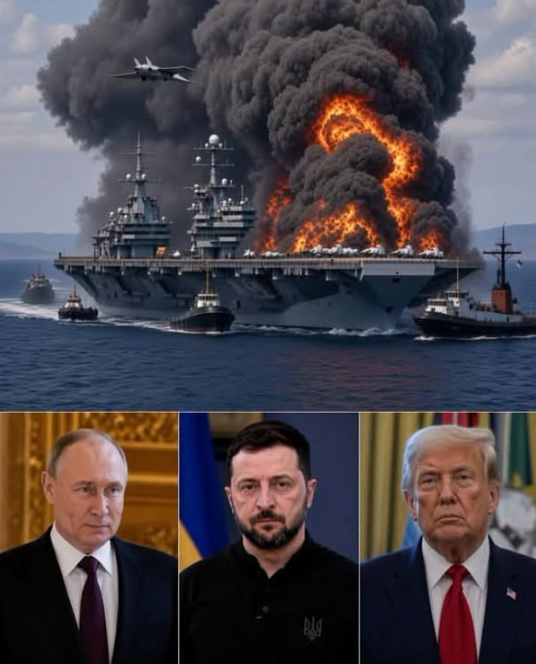
 🚨 BREAKING CLAIM: “30 minutes ago, Russian Su-57 pilot destroys U.S. aircraft carrier carrying 700…” 🚨
A dramatic military headline is spreading rapidly across social media, claiming that a Russian Su-57 fighter pilot has destroyed a U.S. aircraft carrier allegedly carrying hundreds of tanks.
The wording is designed to sound like an immediate breaking-news event, with phrases such as “30 minutes ago” and “destroyed” creating the impression that a major confrontation has just taken place.
But there is an important problem with the story: there is currently no credible confirmation that this attack actually happened.
The claim appears to be part of a recurring series of viral military stories that use dramatic images, simulated combat footage and sensational headlines to attract attention.
The Su-57 is real — but the alleged attack has not been confirmed
Russia’s Su-57 is a real advanced fighter aircraft. Its existence, however, does not prove that a Su-57 recently attacked or destroyed an American aircraft carrier.
That distinction matters.
A genuine military aircraft can easily be used as the subject of fictional scenarios, video-game simulations or computer-generated military stories.
In fact, videos using almost exactly the same headline have been identified online as ARMA 3 military simulations, rather than real footage from an actual battle. One such video explicitly describes itself as a virtual game simulation and warns that the scenario is not real life.
Another video using essentially the same story is also identified as a virtual military simulation.
That means viewers should be extremely careful before assuming that dramatic footage accompanying this headline represents an actual Russian attack.
What about the claim involving 700 tanks?
The “700 tanks” detail is another reason to question the headline.
U.S. aircraft carriers are enormous warships, but their primary purpose is to operate aircraft and support naval aviation. They are not normally used as giant tank-transport ships carrying hundreds of armored vehicles.
Modern American carrier strike groups also do not operate as isolated vessels. A carrier normally operates with supporting warships, aircraft and other elements designed to provide protection and situational awareness.
Recent public reporting from the U.S. Naval Institute shows American carrier strike groups operating in multiple regions during September 2026. Its September 21 fleet tracker listed U.S. carriers and other naval forces operating in areas including the Philippine Sea.
That does not mean military ships are impossible to attack. It means that a claim as extraordinary as the destruction of an American aircraft carrier requires extraordinary evidence.
A real carrier loss would be enormous news
Imagine the consequences if a U.S. aircraft carrier had actually been destroyed by a Russian fighter.
Such an event would not be an ordinary military update.
The identity of the carrier would immediately become important.
Where was it?
How many personnel were aboard?
What happened to the carrier’s aircraft?
Were there casualties?
How did the carrier strike group respond?
Did the U.S. Department of Defense issue a statement?
Did Russia officially claim responsibility?
Were satellite images available?
Were independent journalists and international news organizations reporting the same event?
Those questions would quickly become central to the story.
Instead, the viral headline provides few verifiable details. It does not clearly identify the carrier, location, circumstances or an authoritative source confirming the alleged attack.
That is a major warning sign.
Recent reports show U.S. carriers continuing operations
Recent reporting provides a very different picture from the viral headline.
On September 21, 2026, Stars and Stripes reported that the USS Abraham Lincoln departed Guam following a logistics stop. The report said the carrier had arrived in Guam on September 19 and left the following day after receiving supplies, mail and equipment.
The U.S. Naval Institute’s September 14 fleet tracker likewise documented multiple deployed American naval forces and identified carriers operating in different regions.
These reports do not establish that every U.S. carrier is safe at every moment, but they are important because they demonstrate that recent real-world reporting does not support the dramatic claim being circulated.
Why the video can look convincing
Military simulation software can produce remarkably realistic scenes.
Aircraft can appear to fly toward ships.
Missiles can strike targets.
Explosions can fill the screen with smoke and fire.
Ships can appear to sink.
When those images are combined with a headline saying “BREAKING” or “30 minutes ago,” viewers may naturally assume they are watching genuine combat footage.
But visual realism is not the same thing as authenticity.
The ARMA 3 videos connected with this exact type of headline demonstrate how easily simulated combat can be mistaken for real events when clips are reposted without proper context.
Repetition does not equal confirmation
Another important point is that the same headline can appear on multiple websites.
That may make the story look independently confirmed.
But if several websites are simply copying the same unverified claim, the number of websites does not make the underlying information more reliable.
A genuine breaking-news event should eventually produce independent reporting from credible organizations and, especially for a major military incident, statements or evidence from relevant authorities.
At the moment, the evidence available for this particular story does not reach that standard.
What readers should look for
Whenever a military headline claims something extraordinary happened “minutes ago,” pause before sharing it.
Look for the name of the ship.
Look for the location.
Look for an official statement.
Check whether reputable international news organizations are independently reporting the event.
Look at the original source of the video.
If the video description says “ARMA 3,” “simulation,” “gameplay,” or “virtual battle,” then it should not be presented as real combat footage.
And if a headline contains huge claims but provides no verifiable details, that is another reason to slow down.
The bottom line
The Russian Su-57 is real.
American aircraft carriers are real.
Russia and the United States possess sophisticated military capabilities.
Military simulations depicting battles between Russian aircraft and American ships are also real and widely circulated online.
But the specific claim that a Russian Su-57 pilot 30 minutes ago destroyed a U.S. aircraft carrier carrying 700 tanks has not been credibly confirmed.
The videos associated with the claim include material explicitly identified as simulation gameplay, not authentic battlefield footage.
So before sharing the headline as fact, it is important to separate the dramatic scenario from the evidence.
A burning aircraft carrier on a screen may look frightening.
A fighter jet attacking a ship may look completely realistic.
But without reliable confirmation, neither image proves that the event actually happened.
For now, this story should be treated as an unverified viral claim, not confirmed breaking news.
And that distinction matters — especially when the subject involves a potential confrontation between two major military powers.