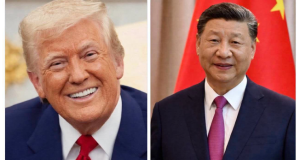
🚨 BREAKING NEWS: Trump Breaks With Tradition to Greet Xi on the Tarmac 🇺🇸🇨🇳
A striking diplomatic scene unfolded Wednesday evening as President Donald Trump personally traveled to Joint Base Andrews in Maryland to welcome Chinese President Xi Jinping as he arrived in the United States for a three-day state visit.
Rather than waiting for the Chinese leader to arrive at the White House, Trump and First Lady Melania Trump were already on the tarmac when Xi and his wife, Peng Liyuan, stepped off their aircraft.
The unusual welcome immediately attracted international attention because U.S. presidents do not ordinarily greet visiting foreign leaders personally at Joint Base Andrews. Recent reporting described the move as a break from the normal protocol for state visits.
And the scene was anything but ordinary.
A long red carpet was placed beside Xi’s aircraft. American service members lined the arrival area, while a military band participated in the ceremony. Trump and Melania greeted Xi and Peng before the delegation moved on to the next stage of the visit.
For viewers watching the images, the message was unmistakable: Washington was treating Xi’s arrival as a major diplomatic occasion.
But what does this unusual greeting actually mean?
The answer is more complicated than a simple handshake.
A Rare Presidential Welcome
According to reporting from Reuters and other news organizations, the tarmac greeting was unusual because visiting heads of state are generally formally received at the White House rather than personally greeted by the president at the airport.
Axios noted that the last comparable presidential welcome of a foreign leader at Joint Base Andrews was in 2015, when President Barack Obama greeted Pope Francis. The tradition of presidents personally greeting foreign leaders at airports has become uncommon in recent decades.
That history helps explain why Trump’s decision generated so much attention.
It was not merely about where the handshake occurred.
The location itself carried diplomatic symbolism.
By traveling to the military base and waiting for Xi’s aircraft, Trump demonstrated that the Chinese president’s arrival was being given unusually high-level attention.
The ceremony also included a military flyover involving two B-1 bombers, adding another striking element to the arrival.
Why Xi’s Visit Matters
Xi’s trip comes at a significant moment in U.S.-China relations.
The two countries remain deeply connected economically while competing over technology, trade, artificial intelligence, strategic influence and security issues.
The three-day visit is expected to include discussions covering trade, technology, Taiwan, Iran and other major international issues.
That makes the ceremony more than just a photo opportunity.
Diplomatic meetings often begin long before leaders sit down behind closed doors. The way a visiting leader is received can communicate respect, seriousness and the importance a host government places on the relationship.
In this case, the visual message was particularly powerful.
Trump was not simply meeting Xi inside a government building.
He was standing outside on the runway, waiting for the Chinese leader’s aircraft to arrive.
A Red Carpet Moment
The red carpet stretched across the tarmac as Xi and Peng descended from their aircraft.
Trump and Melania stood waiting.
The leaders shook hands and exchanged greetings before the formal ceremony continued.
Photographs of the moment quickly spread internationally, turning a brief diplomatic encounter into one of the defining images of the visit’s opening.
The scene also showed how much pageantry can surround a state visit.
Military personnel.
National flags.
A band.
Ceremonial honors.
A red carpet.
And two of the world’s most powerful political leaders meeting face to face.
For ordinary viewers, these images can sometimes appear theatrical.
But diplomatic ceremonies are designed to communicate precisely this kind of symbolism.
More Than Ceremony
Behind the smiles and handshakes are difficult policy questions.
The United States and China have major disagreements involving trade and technology.
The two governments have also been negotiating economic arrangements designed to prevent tensions from escalating further.
On Wednesday, Treasury Secretary Scott Bessent announced that Washington and Beijing had agreed to extend their trade truce, providing another important backdrop to Xi’s visit.
That development makes the timing of the state visit particularly significant.
A diplomatic relationship does not depend entirely on friendly photographs.
The more consequential questions will be what happens during the meetings themselves.
Will the two governments reach agreements?
Will existing trade tensions ease?
Will they make progress on technology issues?
Will discussions about artificial intelligence produce concrete cooperation?
And will the leaders find areas where their governments can communicate despite continuing disagreements?
Those questions will matter long after the cameras are gone.
Why the Gesture Is Being Discussed
Trump’s tarmac greeting has attracted attention partly because it differs from the normal pattern of presidential protocol.
Reuters described it as a break with normal protocol, while Axios characterized it as a rare gesture.
That does not mean Trump ignored all diplomatic procedures.
There was still a formal arrival ceremony, military participation and a carefully organized welcome.
Rather, the unusual part was the president’s decision to personally be present at the airport rather than wait for Xi’s arrival at the White House.
That distinction is important.
Calling it a “protocol break” does not mean the visit was informal.
Quite the opposite.
The ceremony was highly formal.
It was simply being conducted in an unusual location.
A Symbolic Beginning
Xi’s arrival marks his first state visit to Washington in more than a decade, according to reports.
That alone gives the visit historical significance.
The United States and China have enormous economic relationships, but they also face serious strategic disagreements.
A meeting between their leaders therefore attracts attention far beyond Washington and Beijing.
Financial markets watch for developments.
Businesses watch trade policy.
Technology companies watch artificial intelligence and semiconductor discussions.
Allied governments watch the diplomatic signals.
And ordinary citizens watch because decisions made between Washington and Beijing can affect prices, jobs, technology and international security.
What Happens Next?
The tarmac greeting was only the beginning.
The two leaders are expected to continue their discussions during Xi’s three-day visit.
The biggest questions will involve what emerges from those meetings.
A handshake can create a powerful image, but diplomacy ultimately depends on what governments do afterward.
For now, however, the opening scene has already captured worldwide attention.
Trump standing on the tarmac.
Xi walking down the aircraft stairs.
Melania greeting Peng.
The red carpet stretching across the military base.
American and Chinese flags standing side by side.
And cameras recording every moment.
It was a scene that would have been difficult to imagine during some of the most tense periods of U.S.-China relations.
Yet diplomacy often involves precisely these kinds of contradictions.
Countries can compete intensely while their leaders still meet.
Governments can disagree while maintaining communication.
And rivals can sometimes find areas where cooperation is possible.
The Bigger Picture
The most important part of this visit will not necessarily be the handshake.
It will be what follows.
Will the two governments reduce tensions?
Will trade discussions produce new agreements?
Will they establish clearer rules around emerging technologies?
Will they improve communication on security issues?
Those answers will take time.
But the opening ceremony has already provided a remarkable image for history.
Trump chose to personally welcome Xi at Joint Base Andrews, departing from the more typical practice of receiving a visiting foreign leader at the White House.
Whether viewers interpret the gesture as simply ceremonial or as a deliberate diplomatic signal, one fact is clear:
The world was watching.
The handshake lasted only moments.
The ceremony lasted only a short time.
But the significance of a presidential welcome involving the leaders of the United States and China reaches far beyond the runway.
Now the attention turns to the meetings behind closed doors—and to whether the carefully staged welcome will be followed by equally significant diplomatic results.
🇺🇸🇨🇳 One handshake. Two world powers. One highly watched visit.
And the real story is only beginning.