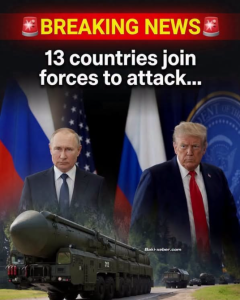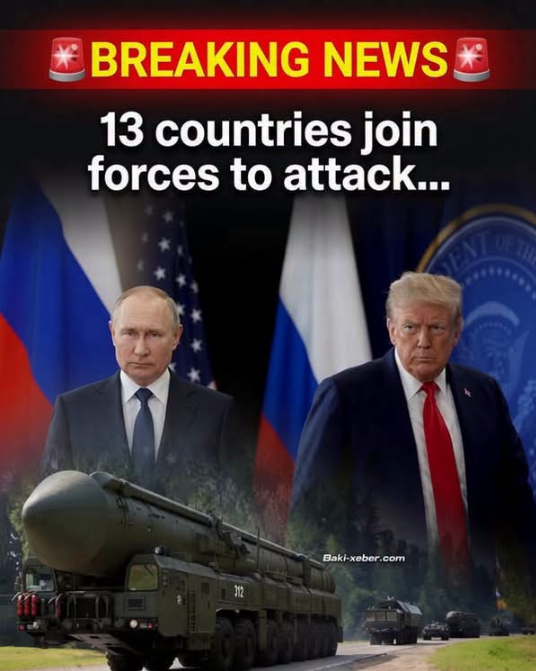
🚨 BREAKING NEWS: 13 COUNTRIES JOIN FORCES — BUT WHAT IS REALLY HAPPENING? 🌍⚠️
A dramatic headline claiming that 13 countries have joined forces to attack has been spreading rapidly online, leaving many people asking the same question: Has a new multinational war officially begun?
The answer is more complicated than the headline suggests.
There really has been a major multinational military development involving 13 countries. However, available reporting does not establish that these countries formed a coalition specifically to launch an attack on another nation.
Instead, the 13 countries are connected to a Saudi-led maritime defense coalition created to protect shipping and freedom of navigation around some of the world’s most strategically important waterways.
And that distinction matters.
🌊 WHY THE NUMBER 13 IS MAKING HEADLINES
In July 2026, Saudi Arabia announced plans for a multinational maritime defense alliance focused on the Bab al-Mandab Strait, the Red Sea and the Gulf of Aden.
The purpose announced by the participating governments was to strengthen maritime security, protect international trade and safeguard important energy and shipping routes. The coalition was described as defensive rather than an alliance created to attack a particular country.
The countries involved include Saudi Arabia, Türkiye, Kuwait, Bahrain, Qatar, Jordan, Egypt, Pakistan, Djibouti, Somalia, Bangladesh, Yemen, Sudan and the Comoros. Reporting in August said 13 countries had completed the procedures necessary to formally join, while additional countries could potentially participate later.
That is very different from saying that 13 governments have simultaneously declared war.
🚢 WHY THE RED SEA MATTERS
The region is strategically important because enormous quantities of commercial goods move through the Red Sea and nearby waterways.
The Bab al-Mandab Strait connects the Red Sea with the Gulf of Aden. From there, ships can travel toward the Arabian Sea and the wider Indian Ocean.
Any serious disruption can create consequences far beyond the Middle East.
Ships may have to take longer alternative routes. Insurance costs can rise. Delivery schedules can be affected. Energy markets can react to fears about transportation disruptions.
That is why governments are paying such close attention to maritime security.
⚠️ THE REGION IS ALREADY UNDER PRESSURE
The new coalition comes during a period of intense regional instability.
Attacks involving commercial shipping and armed groups operating around Yemen have increased concerns about the safety of vessels traveling through the region.
Saudi Arabia and its partners therefore have strong economic and security reasons to coordinate their maritime policies.
The alliance is intended to provide a framework for cooperation rather than automatically meaning that every participating country has committed troops to an offensive operation.
This distinction is frequently lost when complex geopolitical developments are reduced to a few words on social media.
🚨 “JOIN FORCES TO ATTACK” IS A VERY DIFFERENT CLAIM
When people see a headline saying “13 countries join forces to attack,” they may understandably believe that 13 governments have agreed to launch a massive coordinated assault.
The available reporting does not support that interpretation.
The coalition’s stated purpose is maritime defense and protection of navigation.
An international military coalition can conduct patrols, exchange intelligence, coordinate security efforts and protect commercial vessels without automatically becoming an offensive alliance.
That difference is crucial.
It is also why readers should be careful when sharing dramatic headlines without checking what governments actually announced.
🌍 COULD THE SITUATION STILL ESCALATE?
The fact that the coalition is described as defensive does not mean the region is calm.
Far from it.
The Middle East remains an area where military incidents can develop quickly. A single attack on a ship, military base or strategically important facility can produce a chain of diplomatic and military reactions.
That is why governments are strengthening coordination.
The goal of maritime defense is partly to prevent attacks from disrupting international commerce and to make it more difficult for armed groups to threaten important shipping routes.
But whenever military forces from numerous countries operate in the same region, careful coordination becomes extremely important.
A misunderstanding or unexpected confrontation could create additional risks.
🛳️ WHAT THIS MEANS FOR ORDINARY PEOPLE
Someone thousands of miles away might wonder why a military coalition in the Red Sea should matter to them.
The answer is global trade.
Modern economies depend on enormous international supply chains.
Consumer products, industrial equipment, food, fuel and raw materials frequently travel across oceans before reaching their final destinations.
When an important maritime route becomes dangerous, companies may have to redirect ships.
Longer routes can mean higher fuel consumption, increased insurance expenses and longer delivery times.
Those costs can eventually move through the global economy.
This is one reason why governments treat major shipping lanes as strategic assets.
📱 WHY SOCIAL MEDIA HEADLINES CAN BE MISLEADING
The phrase “13 countries join forces” is based on a genuine multinational development.
But adding the words “to attack” can dramatically change how readers understand the story.
This is an important lesson when consuming breaking news.
A headline may contain one accurate detail while presenting the overall situation in a misleading way.
Before sharing a dramatic post, readers should ask:
Which countries are actually involved?
What did their governments officially announce?
Is the alliance defensive or offensive?
Who is the alleged target?
When did the announcement happen?
Are independent news organizations reporting the same thing?
These questions can prevent misinformation from spreading.
🌐 A DEVELOPING STORY
The creation of the multinational maritime coalition is nevertheless a significant development.
It demonstrates how seriously governments are treating threats to shipping in the Red Sea, Gulf of Aden and Bab al-Mandab region.
It also shows how regional security problems can bring together countries with different political interests.
The coalition’s members have their own national priorities, and participation does not necessarily mean that every government will respond to future incidents in exactly the same way.
Military cooperation can take many forms.
Some countries may contribute naval forces.
Others may provide intelligence, logistical support, diplomatic assistance or other capabilities.
The precise level of participation can change as circumstances develop.
🔎 THE BIGGER PICTURE
So, has a 13-country attack force officially been created?
That is not what the available evidence shows.
What has been established is the creation and activation of a multinational maritime defense framework involving 13 countries, centered on protecting freedom of navigation and important shipping routes.
That is still an important development—but it should not automatically be described as 13 nations declaring war.
The difference between defense and offense is enormous.
And in an already tense region, accurate information matters.
The coming months could bring additional military deployments, diplomatic negotiations, changes to the coalition or new incidents at sea. Governments will be watching closely, and so will shipping companies, financial markets and millions of people whose daily lives depend on global trade.
For now, the most important message is simple:
🚨 The “13 countries” headline has a real basis, but the claim that they have joined together specifically to launch an attack is not supported by the available reporting.
The story is about a multinational maritime defense coalition formed amid serious regional security concerns—not confirmation that 13 countries have collectively declared a new war.
As always with breaking news, check the source, check the date and look beyond the headline before sharing.
Because sometimes the most important part of a breaking story is not the dramatic phrase at the top—it is the detail hidden underneath it. 🌍🚢⚠️