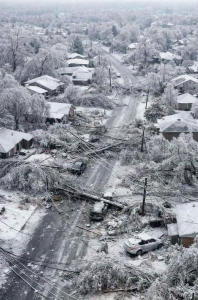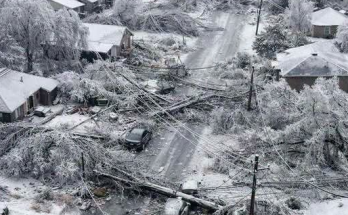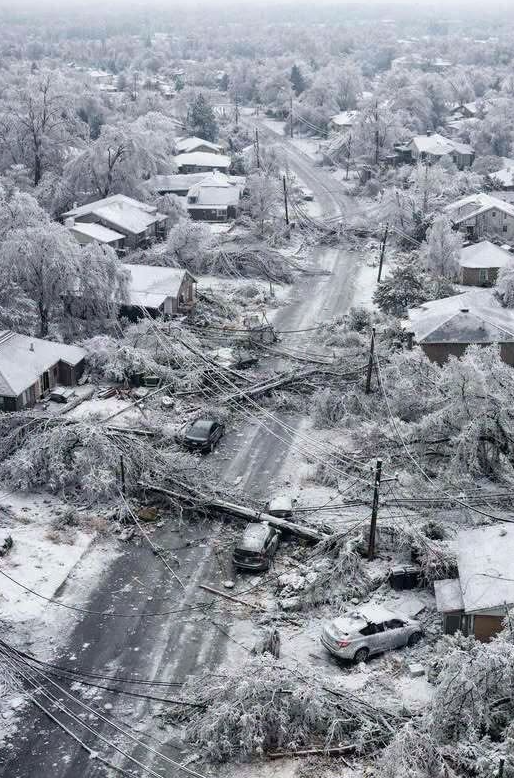
🚨 BREAKING: FREEZING RAIN SLAMS PARTS OF THE REGION — ROADS, SIDEWALKS AND POWER LINES COULD BECOME DANGEROUS
A dramatic weather headline is spreading online claiming that freezing rain is slamming a large area, raising concerns about icy roads, difficult travel, falling branches and possible power disruptions.
Freezing rain is one of the most dangerous forms of winter precipitation because it may look like ordinary rain when it falls, but it can quickly turn roads, bridges, sidewalks and other exposed surfaces into sheets of ice when it touches surfaces that are at or below freezing.
The timing and location of any freezing-rain event are critical, however. Weather conditions can vary dramatically from one town to the next, particularly during borderline temperature situations. A location several miles away may receive ordinary rain while another community at a slightly higher elevation experiences sleet or freezing rain.
The National Weather Service’s Weather Prediction Center maintains forecasts specifically for the potential for accumulating freezing rain, including forecasts for amounts greater than one-quarter inch.
❄️ WHAT EXACTLY IS FREEZING RAIN?
Freezing rain begins as precipitation that forms high in the atmosphere. The precipitation can initially fall as snow, but if it passes through a layer of warmer air above the surface, the snow melts into liquid rain.
If temperatures near the ground remain at or below freezing, those raindrops can become supercooled.
When they hit a cold surface, they freeze almost immediately.
That creates a thin layer of ice.
As more freezing rain falls, that layer can grow thicker.
Roads become slick.
Trees become coated.
Power lines accumulate ice.
Vehicles can lose traction.
And ordinary outdoor activities can suddenly become hazardous.
🚗 WHY DRIVING CAN BECOME SO DANGEROUS
One of the biggest dangers during freezing rain is transportation.
Drivers may see wet pavement and assume the road is simply covered with rainwater. In reality, the surface may be coated with nearly invisible ice.
Bridges and overpasses can become especially dangerous because cold air surrounds them from above and below, allowing them to freeze faster than ordinary road surfaces.
Intersections can also become hazardous as vehicles repeatedly brake and accelerate on icy pavement.
Even vehicles equipped with four-wheel drive or all-wheel drive cannot eliminate the danger. Those systems can help with traction when accelerating, but they do not guarantee that a vehicle can stop safely on ice.
For that reason, drivers should slow down significantly when freezing rain is occurring, increase following distance and avoid unnecessary travel when authorities recommend staying off the roads.
🌳 TREES AND POWER LINES ARE ALSO AT RISK
Freezing rain doesn’t only affect transportation.
Ice can accumulate on branches and power lines.
A relatively small amount of ice can add substantial weight to structures that normally support only their own weight. When combined with strong winds, that additional load can contribute to broken branches and damaged utility lines.
That can lead to scattered power outages.
People should never approach a fallen power line. A wire that appears inactive may still be energized and can present a potentially fatal electrical hazard.
Instead, stay well away from the area and report the problem to the appropriate utility or emergency authorities.
🏠 WHAT HOMEOWNERS SHOULD WATCH FOR
Freezing rain can also create problems around the home.
Steps, porches, driveways and sidewalks can become extremely slippery. Even a thin layer of transparent ice can cause someone to lose their footing.
People heading outside should use appropriate footwear, move slowly and use handrails whenever possible.
Older adults and anyone with difficulty maintaining balance should take particular care during icy conditions.
Pets can also struggle on icy surfaces, and salt or other ice-melting products can irritate paws. Pet owners should check their animals’ feet after walks and follow local guidance concerning products used around animals.
⚠️ NOT EVERY “BREAKING” WEATHER POST IS ACCURATE
One important point deserves attention.
Social-media weather posts often use words such as “BREAKING,” “EMERGENCY,” “SLAMS,” and “DEADLY STORM” to attract attention.
Those descriptions do not necessarily tell you how serious the actual weather threat is.
The most useful information comes from official weather agencies and local authorities.
The National Weather Service’s forecast products specifically track the potential for accumulating freezing rain, snow and other winter hazards.
At the time of the current forecast information reviewed for this post, winter-weather conditions are not uniform across the country. For example, the National Weather Service office serving the Charleston, West Virginia region reported that no winter weather warnings, watches or advisories were issued there at the time of its latest briefing, while continuing to provide ice-accumulation forecast products.
That illustrates why a national headline should not automatically be interpreted as meaning that every state or city is experiencing freezing rain.
🌡️ TEMPERATURE MAKES ALL THE DIFFERENCE
Freezing rain is particularly sensitive to small temperature changes.
A temperature just above freezing can mean ordinary rain.
A temperature just below freezing can mean ice.
And a few degrees of difference between the ground and the air can determine whether precipitation falls as rain, sleet, snow or freezing rain.
Elevation also matters.
Valleys, hills and mountain communities can experience different conditions at the same time.
That is why residents should check forecasts for their specific location rather than relying on a generalized social-media headline.
🧊 WHAT SHOULD YOU DO IF FREEZING RAIN IS FORECAST?
If freezing rain is expected in your area, several simple precautions can reduce risk.
First, prepare before the precipitation begins.
Charge phones and essential devices.
Make sure flashlights are available.
Keep necessary medications accessible.
Check that heating systems are working properly.
If you have an emergency kit, make sure it is ready.
If you need to travel, check road conditions before leaving.
And if officials advise against unnecessary travel, take that recommendation seriously.
During an ice event, conditions can deteriorate rapidly.
A road that was merely wet an hour earlier can become hazardous after temperatures fall.
🕯️ THE MOST IMPORTANT MESSAGE
The phrase “freezing rain slams…” may sound like a dramatic headline, but the real issue is much more practical.
Ice can be difficult to see.
It can make roads slippery.
It can bring down branches.
It can damage utility lines.
And it can make ordinary activities unexpectedly dangerous.
That is why preparation and accurate information matter.
Do not share an alarming weather claim simply because it has a dramatic headline. Check the National Weather Service, your local emergency-management agency and your local transportation department for information specific to your area.
And remember that weather can change quickly.
For example, the current New York forecast does not indicate freezing rain in the city today; the forecast instead calls for mild conditions, while a wetter and windier pattern is possible later in the week.
So if you see a post claiming that freezing rain is “slamming” your area, check your local forecast before assuming the headline applies to you.
Stay alert.
Drive carefully when conditions require it.
Keep away from downed power lines.
Watch for ice on sidewalks and steps.
And above all, rely on verified weather information rather than viral rumors.
🌧️❄️ Weather can change quickly. Stay informed, stay prepared, and stay safe.