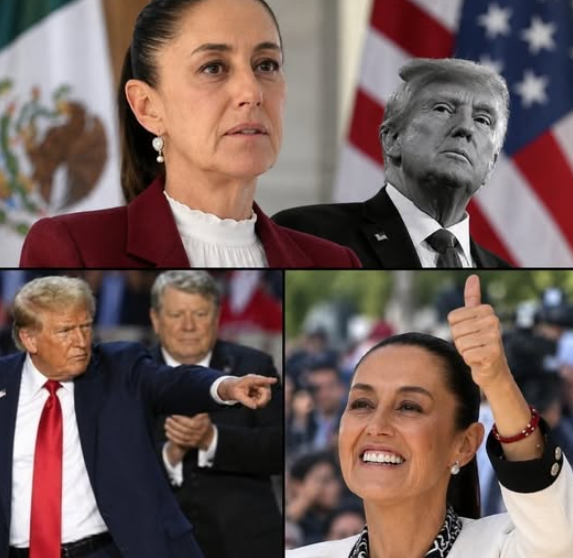
MEXICAN PRESIDENT SAYS THAT TRUMP IS NOT… SEE MORE 🚨
A new development involving Mexican President Claudia Sheinbaum and U.S. President Donald Trump is attracting attention as the two governments continue dealing with major issues involving trade, tariffs, security, immigration, and relations between the two neighboring countries.
The headline spreading online is incomplete, leaving many people wondering what exactly the Mexican president said about Trump.
But the verified story is more complicated than a dramatic social-media headline might suggest.
In recent weeks, Sheinbaum and Trump have continued communicating directly while their governments work on trade negotiations and other bilateral issues.
On September 18, Reuters reported that Sheinbaum said Mexico was working toward a new trade agreement with the United States after what she described as a productive telephone conversation with Trump. She said the two sides had reached some agreements, although she did not publicly disclose all of the details.
The development comes during a period of considerable tension between Washington and Mexico City.
Trade has become one of the central issues.
The United States and Mexico are reviewing their North American trade arrangements, while Washington has pushed for changes involving tariffs and the trade balance. Mexico, meanwhile, has sought better treatment for important Mexican exports, including automobiles, steel, and aluminum.
Sheinbaum has repeatedly emphasized that Mexico wants a productive relationship with the United States while maintaining Mexican sovereignty.
That distinction has become particularly important.
Earlier this month, Trump shared an unusual map on social media depicting Mexico and other territories under the U.S. flag. The post did not include an explanation of what the map was intended to mean.
Sheinbaum responded by emphasizing that Mexico is an independent and sovereign nation and said it would not become a colony or protectorate of another country.
Her response quickly became part of a wider discussion about the relationship between the two countries.
Mexico and the United States share an enormous border, extensive economic ties, and millions of personal and family connections.
Their economies are deeply connected through manufacturing, agriculture, energy, transportation, tourism, and cross-border trade.
That means decisions made in Washington or Mexico City can have consequences on both sides of the border.
A disagreement between the two governments can therefore attract enormous attention.
But disagreement does not necessarily mean that diplomatic relations have broken down.
In fact, the recent communications between Sheinbaum and Trump demonstrate the opposite.
The two governments continue talking.
Officials from both countries remain involved in negotiations.
And Sheinbaum has said repeatedly that Mexico wants a good relationship with the United States while defending its national interests.
In a September 2 press conference, Sheinbaum described the relationship with the United States as complicated and discussed previous disputes involving tariffs on Mexican products. She also said Mexico was continuing negotiations concerning trade and other issues.
She has also stressed the principle of nonintervention.
In another September statement, Sheinbaum said Mexico and the United States should each handle their own elections and that the countries should cooperate without one subordinating itself to the other.
Those comments help explain why headlines about Sheinbaum and Trump can sometimes appear contradictory.
One headline may emphasize cooperation.
Another may highlight disagreement.
Both can reflect different parts of the same relationship.
The two countries can negotiate a trade agreement while disagreeing about security.
They can cooperate against organized crime while disagreeing about how that cooperation should happen.
They can communicate directly while publicly defending different positions.
That is normal for relations between sovereign governments.
Another major issue is security.
Trump has repeatedly focused on drug cartels and organized crime in Mexico, while Sheinbaum’s government has insisted that Mexico will handle security matters within its own constitutional and sovereign framework.
Sheinbaum has also argued that responsibility for drug-related problems crosses borders and that the United States has responsibilities of its own, including addressing drug consumption, money laundering, and the movement of weapons into Mexico.
In a September 17 response to criticism from Trump, Sheinbaum said Mexico did not need to be judged from outside and pointed to the importance of addressing organized crime as a shared problem.
That exchange illustrates the complicated nature of the relationship.
Washington has its concerns.
Mexico City has its own concerns.
Both governments have political pressures at home.
And both have strong economic incentives to keep negotiating.
Trade may ultimately become one of the most important areas of cooperation.
Reuters reported that Mexico was considering increasing imports from the United States as part of the ongoing review of the United States-Mexico-Canada Agreement, commonly known as USMCA. Sheinbaum said Mexico wants to respond to U.S. concerns about the trade deficit while also protecting Mexican economic interests.
Meanwhile, negotiations continue over tariffs affecting Mexican products.
Mexico has specifically sought reductions in U.S. tariffs affecting sectors such as steel, aluminum, and automobiles.
For businesses, workers, farmers, manufacturers, and consumers, these discussions are much more than political headlines.
Trade policies can influence prices, investment decisions, supply chains, jobs, and the movement of goods across the border.
That is why every major statement from either president receives such intense attention.
Still, it is important to be careful with viral posts.
A headline such as:
“Mexican president says that Trump is not…”
does not tell readers what was actually said.
The missing words could completely change the meaning.
Was she discussing Trump’s policies?
His position on Mexico?
A specific statement?
A trade negotiation?
Or something else entirely?
Without the original quotation or source, readers should not assume that the headline accurately represents her words.
The verified record shows that Sheinbaum has both criticized aspects of U.S. policy and continued direct negotiations with Trump.
That is a more complicated picture than a simple “Mexico versus Trump” storyline.
On one hand, Sheinbaum has defended Mexico’s sovereignty and rejected the idea of foreign intervention.
On the other hand, she has maintained communication with Trump and described recent conversations as productive.
Those two positions can exist at the same time.
Diplomacy often involves disagreement and cooperation simultaneously.
As the two governments continue negotiations, the relationship will remain closely watched.
The United States and Mexico are neighbors.
They share a border of nearly 2,000 miles.
They conduct enormous amounts of trade.
Millions of people have family, cultural, professional, and economic connections across the border.
What happens between the two governments therefore matters well beyond Washington and Mexico City.
For now, the confirmed developments show that Sheinbaum and Trump remain engaged in negotiations, particularly over trade, while continuing to disagree publicly on several issues involving sovereignty, security, tariffs, and organized crime.
So when you see a dramatic post claiming:
🚨 “MEXICAN PRESIDENT SAYS TRUMP IS NOT…”
take a moment before sharing it.
Look for the complete quote.
Check when it was made.
Find out what question the president was answering.
And most importantly, check whether reputable news organizations are reporting the same thing.
The relationship between Mexico and the United States is too important to reduce to a few sensational words.
🇲🇽🇺🇸 Two neighboring countries can disagree strongly while still negotiating, cooperating, and communicating.
And right now, that appears to be the reality.
The next major development could involve tariffs, trade negotiations, border security, organized crime, or another issue affecting both nations.
For millions of people on both sides of the border, the outcome of those discussions will matter far more than any viral headline.
Stay informed. Read beyond the “See more.” And always check the full story before treating an unfinished social-media headline as a confirmed statement. 🚨🇲🇽🇺🇸