🎯 The Setup: Three People, One Sack
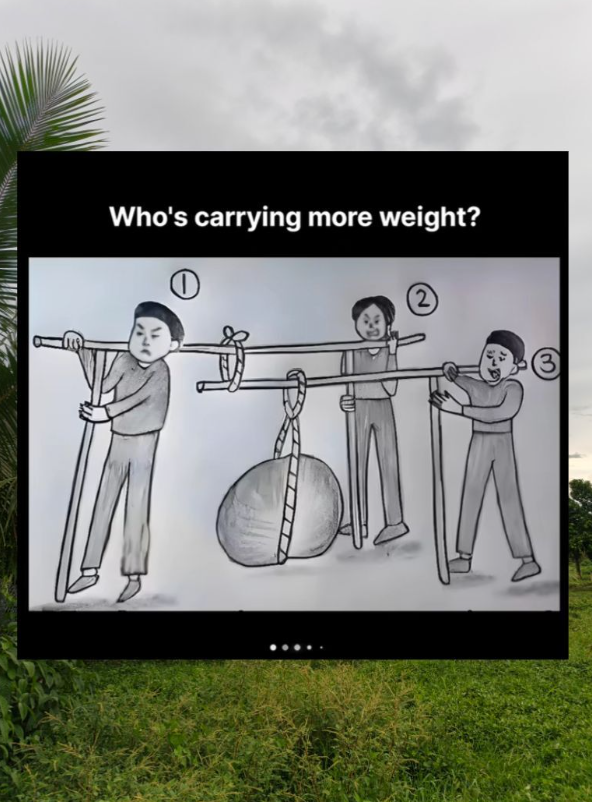
We’re looking at a drawing of three individuals—labeled 1, 2, and 3—holding a horizontal pole. Suspended from that pole is a heavy sack, hanging by ropes. The sack is positioned between individuals 1 and 2, while individual 3 is holding the far end of the pole, with no direct load beneath them.
At first glance, it might seem like all three are sharing the weight equally. After all, they’re all holding the same pole, right? But physics has a way of humbling our assumptions.
⚖️ The Physics of Load Distribution
To understand who’s carrying more weight, we need to talk about torque and force distribution.
- Torque is the rotational force around a pivot point. The farther a load is from you, the more torque you feel.
- Force distribution depends on where the load is placed relative to each person.
In this case, the sack is hanging between person 1 and person 2. That means the weight of the sack is primarily supported by the pole between those two individuals. Person 3, who is farther from the sack, is essentially holding up a part of the pole that isn’t directly bearing the load.
So who’s carrying the most?
- Person 1 and Person 2 are doing the heavy lifting. The sack is between them, so they’re absorbing most of the downward force.
- Person 3 is carrying significantly less. They’re holding the pole, yes, but the torque and weight are distributed away from them.
If we were to measure the force each person feels in their arms, person 3 might be holding just the weight of the pole itself, while person 1 and 2 are holding the pole plus the sack.
🧠 Why This Feels So Relatable
This image isn’t just a physics problem—it’s a metaphor for life.
Think about group projects, family responsibilities, or emotional labor. Often, the person closest to the “load” carries the most weight, while others—though present—may not feel the same burden.
- In a workplace, the person closest to the deadline or client might feel the pressure more intensely.
- In a family, the caregiver or emotional anchor often bears the invisible weight of everyone’s well-being.
- In friendships, the one who listens, supports, and shows up consistently may be carrying more than meets the eye.
This image hits hard because it reflects a truth we all feel: not all burdens are shared equally, even when they appear to be.
🧮 Let’s Do the Math (Just a Little)
Imagine the sack weighs 60 kg and the pole is 3 meters long.
- If the sack hangs 1 meter from person 1 and 2 meters from person 3, the forces are not evenly split.
- Using basic statics, we can calculate the reaction forces at each hand. Person 1 might be supporting 40 kg, person 2 around 20 kg, and person 3… maybe 5 kg or less, depending on the pole’s weight.
This isn’t exact without more data, but the takeaway is clear: proximity to the load matters.
🧘♀️ The Emotional Weight of Being “Person 1”
Let’s talk about the emotional side of this.
If you’re person 1, you might feel:
- Overwhelmed
- Unseen
- Frustrated that others aren’t helping more
If you’re person 3, you might feel:
- Detached
- Confused about why person 1 is upset
- Unaware of how little you’re actually contributing
This dynamic plays out in relationships all the time. One person feels like they’re holding everything together, while another thinks they’re “helping” just by being present.
🧩 The Hidden Complexity
Here’s what makes this image brilliant: it’s not just about who’s carrying more—it’s about how we perceive effort.
- Person 3 might genuinely believe they’re helping.
- Person 2 might feel stuck in the middle, unsure whether to lean toward person 1 or 3.
- Person 1 might be silently screaming, “Can someone PLEASE take some of this weight?”
And the sack? It could represent anything: a shared goal, a family crisis, a looming deadline, or even a secret no one wants to talk about.
🗣️ What This Teaches Us About Leadership
Leaders often find themselves in the position of person 1. They’re closest to the problem, most responsible for the outcome, and often the last to ask for help.
But good leadership means redistributing the load:
- Communicate clearly: “This is heavier than it looks.”
- Ask for help: “Can you move closer to the sack?”
- Reposition the team: “Let’s all shift so the weight is more balanced.”
🧭 How to Be a Better Teammate
If you’re person 3, here’s how to step up:
- Move closer to the load.
- Ask what you can do.
- Don’t assume equal effort means equal impact.
If you’re person 2, be the bridge. You’re in a unique position to support both sides and help redistribute the weight.
If you’re person 1, speak up. Your strength is admirable, but silence doesn’t lighten the load.
🧠 Final Reflection: The Invisible Math of Life
This image is a masterclass in hidden dynamics. It reminds us that:
- Effort isn’t always visible.
- Support isn’t always equal.
- And sometimes, the person who looks fine is actually carrying the most.
So next time you’re in a group—whether at work, home, or anywhere—ask yourself: Where’s the sack? Who’s closest to it? And how can I help carry the weight?
Because real teamwork isn’t about holding the pole—it’s about holding each other.