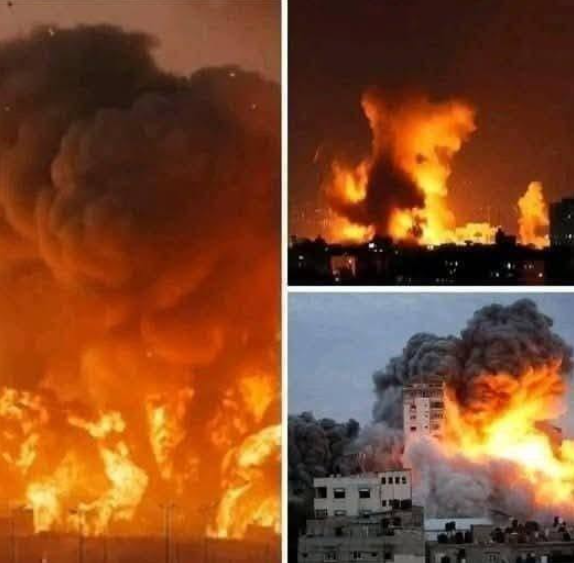
🚨🌍 BREAKING NEWS: MAXIMUM WORLDWIDE ALERT — THE WAR BEGINS… SEE MORE 🌍🚨
A dramatic message spreading across social media is warning of a “maximum worldwide alert” and claiming that “the war begins.”
But the reality is more complicated — and already extremely serious.
The Middle East is experiencing a major military conflict involving Israel, Iran, the United States and armed groups across the region. The fighting did not suddenly begin today. Instead, the conflict has continued for months, while new developments are now raising fresh concerns about whether the violence could spread even further.
And on September 19, 2026, another alarming development emerged.
Saudi Arabia issued emergency alerts warning of a hostile aerial threat over parts of the country, including Riyadh.
The alert was followed by reports of explosions and thick smoke near King Khalid International Airport. Yemen’s Houthi movement claimed it had attacked targets in the Saudi capital with missiles and drones. Saudi authorities subsequently issued an all-clear.
For people watching the events unfold, the images and reports are deeply unsettling.
🚨 THE SITUATION IS ALREADY WIDESPREAD
The phrase “the war begins” may sound as though a brand-new conflict has started.
But that is not what current reporting shows.
The U.S.-Israel war with Iran has already been underway for months. The conflict has involved attacks, retaliation, military operations and disruptions affecting multiple countries.
The consequences have extended beyond the immediate battlefield.
Shipping routes have been affected.
Energy markets have been disrupted.
Military forces have been placed on heightened alert.
And governments across the region have had to prepare for the possibility that attacks could reach their territory.
The Strait of Hormuz has become a particularly important part of the crisis because it is one of the world’s most important energy corridors.
CBS News reported on September 19 that the U.S. military said it had escorted more than 2,000 commercial vessels and approximately one billion barrels of oil through the Strait of Hormuz during the previous two months.
That illustrates just how much the conflict has affected international commerce.
🇸🇦 RIYADH UNDER ALERT
The latest Saudi developments have attracted enormous attention.
Saudi authorities issued emergency warnings after detecting what they described as a hostile aerial threat.
Reports then emerged of explosions in and around Riyadh.
Reuters reported that smoke and flames were seen near the city’s main airport, while the Houthis claimed responsibility for attacks on what they described as sensitive sites.
The reports were particularly significant because Riyadh had not experienced this type of emergency warning during the renewed phase of the Yemen conflict.
The situation also affected aviation.
Reports indicated disruptions around the airport as authorities responded to the threat and investigated the incidents.
For ordinary residents, moments like these can transform an ordinary night into one filled with uncertainty.
Sirens sound.
Phones receive emergency notifications.
People look toward the sky.
Airports begin changing operations.
And families wait for official information.
🇾🇪 THE YEMEN CONNECTION
The developments in Saudi Arabia are closely connected to the fighting in Yemen.
The Houthis, an Iran-aligned armed movement based in Yemen, have been involved in the broader regional conflict.
Recent fighting has intensified around Yemen’s Red Sea coast, increasing concerns about the security of the Bab al-Mandab Strait and nearby shipping routes.
The Houthis have claimed responsibility for attacks against Saudi targets, while Saudi Arabia has carried out military operations in Yemen.
This creates another dangerous layer to an already complicated regional conflict.
A conflict that begins in one location can quickly affect another.
A missile launched from Yemen can trigger an alert in Saudi Arabia.
A strike in Lebanon can produce retaliation from Israel.
An attack on shipping can affect global energy prices.
And diplomatic decisions in Washington, Tehran or Jerusalem can influence events thousands of miles away.
🇮🇱 ISRAEL REMAINS INVOLVED
Israel is also continuing military operations.
Current reporting indicates that Israeli forces have carried out strikes in Gaza and Lebanon.
The Jerusalem Post’s September 19 live coverage reported that two Israeli soldiers were lightly injured by an explosion in southern Lebanon and that Israel subsequently struck Hezbollah positions.
In Gaza, Reuters reported that Israeli strikes killed at least three Palestinians on September 19, according to Palestinian medical officials. Israeli authorities said militants were among the intended targets.
These developments demonstrate why the phrase “worldwide alert” can be emotionally powerful but also potentially misleading.
There is no verified announcement that the entire world has entered a new global war today.
Instead, there is an existing regional war with multiple fronts and the possibility of further escalation.
🇮🇷 IRAN REMAINS AT THE CENTER
Iran remains one of the central players in the conflict.
On September 19, Reuters reported that Iran executed a man convicted of espionage for Israel. Iranian authorities accused him of providing information about missile sites.
At the same time, diplomatic efforts have not completely disappeared.
Al Jazeera reported that Iranian officials said diplomatic efforts to resolve issues with the United States were continuing.
That creates a striking contrast.
On one side, military activity continues.
On the other, diplomatic channels remain open.
That means the situation cannot simply be described as a straightforward march toward one predetermined outcome.
Wars can intensify and de-escalate at the same time.
🌍 WHY THE WORLD IS WATCHING
The international concern is understandable.
The Middle East is strategically important to the global economy.
Millions of barrels of oil move through regional waterways.
Major international shipping routes pass through the Red Sea and Persian Gulf.
Military bases belonging to the United States and other countries are located throughout the region.
And several governments have security relationships with countries involved in the conflict.
This means a new attack can have consequences far beyond the location where it occurs.
Fuel prices can move.
Shipping costs can increase.
Airlines can reroute flights.
Insurance costs can rise.
Governments can issue travel warnings.
And financial markets can react to fears about future disruptions.
The consequences are therefore not limited to soldiers and political leaders.
Ordinary families around the world can eventually feel the effects.
⚠️ BE CAREFUL WITH “MAXIMUM ALERT” POSTS
Social media makes breaking news incredibly fast.
But speed can also create confusion.
A post saying “MAXIMUM WORLDWIDE ALERT” does not automatically mean that governments have declared a global emergency.
A headline saying “THE WAR BEGINS” does not necessarily mean a new war has started that day.
And the words “SEE MORE” are often designed to encourage people to click before they have seen the complete story.
During a rapidly changing conflict, readers should check the source, date and exact wording.
Old footage can be presented as new.
Unverified casualty figures can spread within minutes.
Military claims can be repeated before independent confirmation.
And dramatic headlines can turn a complicated regional crisis into a simple sentence.
🚨 WHAT WE KNOW RIGHT NOW
The verified picture is already serious.
The Middle East remains in an active and dangerous military conflict.
Israel continues military operations.
Iran remains directly involved.
The United States remains deeply involved.
Fighting involving the Houthis has intensified in Yemen.
Saudi Arabia has issued emergency alerts over aerial threats.
Explosions and smoke have been reported near Riyadh’s airport.
And attacks involving shipping and energy infrastructure continue to create international concern.
But that is different from saying that a completely new worldwide war officially began today.
🙏 A WORLD WAITING FOR THE NEXT UPDATE
For millions of people across the Middle East, these are not simply headlines.
They are real warnings.
Real explosions.
Real uncertainty.
Real families waiting for loved ones to return home.
And real communities trying to continue everyday life while the situation around them changes.
The coming hours and days will be closely watched by governments, military officials, diplomats and civilians around the world.
Will the fighting spread further?
Will diplomatic efforts produce a pause?
Will attacks on shipping continue?
Will additional countries become directly involved?
Those questions remain unanswered.
For now, the most accurate description is not that a brand-new world war suddenly began today, but that an already major regional conflict remains active while new attacks and alerts are increasing concerns about further escalation.
🚨 Stay informed. Check the source. Verify the date. And don’t mistake a dramatic social-media headline for confirmation of an event that has not been independently verified.
The situation remains fluid, and further developments could emerge at any moment.