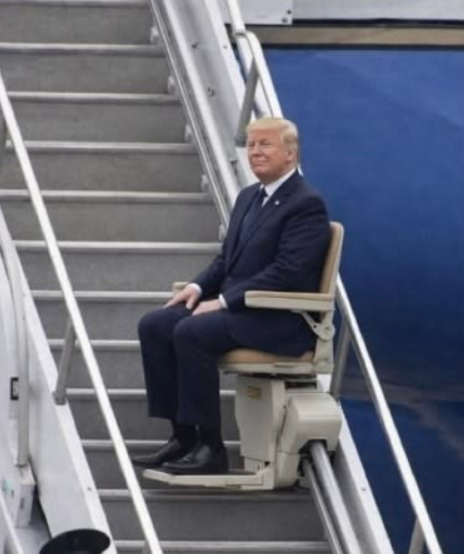
🚨 TRUMP FALLS AGAIN? — VIRAL CLAIM ABOUT THE PRESIDENT’S HEALTH SPARKS FRESH QUESTIONS 🚨
A dramatic headline has once again spread across social media:
“Trump FALLS AGAIN! — White House Doctor Breaks Silence!”
The wording immediately grabs attention.
People see the words “BREAKING NEWS,” “FALLS AGAIN,” and “DOCTOR BREAKS SILENCE,” and many naturally assume that a serious new medical emergency has occurred.
But there is an important detail that should not be overlooked.
The viral claim has previously been connected to manipulated footage, and there is no verified evidence establishing that President Donald Trump suffered the dramatic fall described in the circulating post. Reporting on the viral video found that the footage had been altered and that the original footage did not show Trump collapsing.
That distinction matters.
When a headline involves the health of a sitting president, accuracy is especially important.
Trump’s health has received considerable public attention throughout 2026, partly because photographs and videos of the president at public events have prompted questions online.
Some images have shown bruising on his hands, swelling around his ankles, or moments in which he appeared tired.
Those observations have generated intense discussion, but photographs and short clips cannot by themselves establish a medical diagnosis.
That is why official medical information is important.
In May, Trump underwent a physical examination at Walter Reed National Military Medical Center.
The White House subsequently released a memorandum from the physician to the president, Captain Sean P. Barbabella.
The report stated that Trump remained in “excellent health” and described strong cardiac, pulmonary, neurological and overall physical function.
The examination reportedly involved 22 specialty providers, making it an unusually extensive evaluation.
That official assessment is very different from the dramatic message appearing in viral social-media posts.
So what is behind the latest “Trump falls again” headline?
According to reporting published after the video began circulating, the footage was manipulated.
The video reportedly used authentic footage of Trump but altered it to make it appear as though he stumbled or collapsed.
A fabricated television-style breaking-news graphic was then added, creating the appearance of an emergency news report.
This is an increasingly common problem in the social-media era.
A video does not necessarily have to be completely fabricated to become misleading.
Sometimes real footage is taken from one event and edited to suggest something entirely different.
A caption is added.
A dramatic banner appears across the screen.
Music or sound effects increase the sense of urgency.
Then the altered video is reposted thousands of times.
Eventually, people who encounter it may have no idea where it originated.
They simply see a president apparently falling and a headline claiming that a White House doctor has revealed something shocking.
That is why viewers should be cautious.
A dramatic video is not automatically evidence.
And a headline is not automatically a medical report.
The phrase “White House doctor breaks silence” is particularly powerful because it suggests that an official medical revelation has occurred.
But the available evidence does not establish that a White House physician made the dramatic disclosure implied by the viral headline.
The president’s actual physician has issued formal medical information, including the May report.
That document is considerably more useful than anonymous social-media claims because it comes from an identified White House medical official and provides specific information about the examination.
At the same time, official reports do not mean that every question about a president’s health disappears.
The public naturally pays attention to the physical condition of a president because the president has demanding responsibilities.
A president travels extensively.
Presidents attend long meetings.
They speak publicly.
They make decisions involving national security, foreign policy and the federal government.
They may work extremely long hours.
For that reason, questions about presidential health are not unusual.
But there is an important difference between asking questions and declaring an unverified medical event as fact.
That difference becomes even more important when artificial intelligence and sophisticated video editing are involved.
Modern technology makes it easier than ever to create convincing-looking material.
A person can see something with their own eyes and still be looking at something that has been altered.
That means people need to evaluate the source as carefully as they evaluate the image itself.
Who posted it?
When was it posted?
Where did the original video come from?
Has the White House confirmed the event?
Has the president’s physician issued a statement?
Are major news organizations independently reporting the same incident?
These questions can help separate genuine breaking news from viral misinformation.
There is another reason this matters.
False claims about a president’s health can spread incredibly quickly because people understand the importance of presidential continuity.
A rumor about a celebrity may generate curiosity.
A rumor about the president can generate concern about the government itself.
People may begin asking whether the president can continue performing his duties.
They may speculate about succession.
They may begin sharing additional rumors.
One unverified video can therefore trigger an entire chain of misinformation.
That is why responsible readers should avoid contributing to that cycle.
If a post says Trump has fallen, look for confirmation.
If it says his doctor has revealed a serious diagnosis, look for the actual statement.
If it provides no source, be skeptical.
If it uses an old video, check the date.
And if the headline is dramatically different from what reputable news organizations are reporting, stop before sharing.
The most important point is that the viral “Trump FALLS AGAIN” story should not be treated as confirmed simply because the video looks convincing.
Available reporting indicates that the circulating video was manipulated and did not document the dramatic fall claimed by the headline.
Meanwhile, the White House’s published medical memorandum from May described Trump as being in excellent health following his examination.
That does not mean people are forbidden from discussing the president’s health.
It means those discussions should be based on evidence.
As of the latest reporting today, Trump has also been appearing publicly in Ireland, including at the Irish Open, where he presented the championship trophy to Shane Lowry.
That public appearance is another reason to be cautious about treating an old or manipulated clip as a new emergency.
The internet never stops moving.
A video from weeks ago can suddenly become viral again.
An old headline can be reposted as though it happened today.
A manipulated clip can receive millions of views before anyone checks its origin.
And by the time a correction appears, the false version may already be everywhere.
So before believing the next shocking headline, remember:
🚨 BREAKING does not always mean verified.
🚨 A viral video is not automatically authentic.
🚨 A photograph cannot establish a medical diagnosis.
🚨 “White House doctor” claims should be checked against official statements.
🚨 Old footage can be presented as new.
The responsibility ultimately falls on all of us.
We can choose to share immediately, or we can take a moment to verify.
We can contribute to confusion, or we can help prevent it.
The headline “Trump FALLS AGAIN!” is certainly designed to make people stop scrolling.
But the facts require something more valuable than a quick click:
They require verification.
Until credible evidence confirms a new incident, the viral claim should be treated as unverified rather than as established fact.
In a world where manipulated videos can look remarkably convincing, sometimes the most responsible response to a shocking headline is simply to pause and ask:
“Where is the evidence?”
That one question can make the difference between understanding the news and becoming part of the rumor. 🚨