🚨 TRUMP “FALLS AGAIN”? — WHAT THE VIRAL CLAIM REALLY SHOWS
A dramatic headline is spreading across social media:
“Trump FALLS AGAIN! — White House Doctor Breaks Silence!”
The wording immediately grabs attention. Within minutes, people begin asking questions. Did President Donald Trump really fall? Was he injured? Did his doctor reveal something serious? Why would the White House suddenly need to address his health?
But before sharing a frightening headline, there is an important fact that readers need to know.
The viral claim is not supported by reliable evidence.
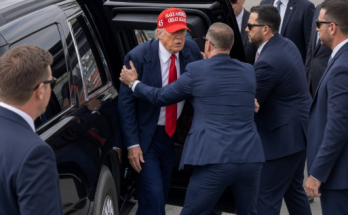
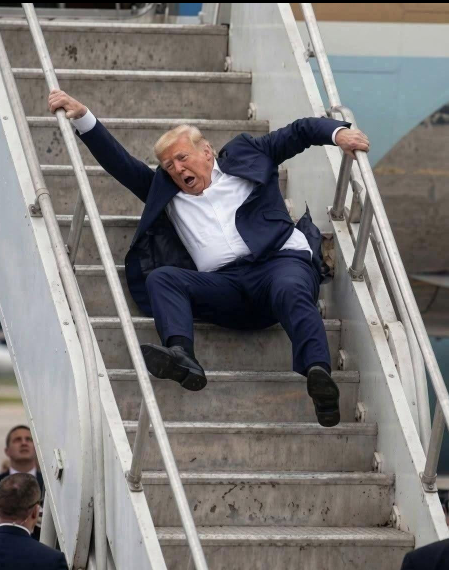
A video circulating online has been presented as evidence that Trump fell, but fact-checking reported that the footage was manipulated with artificial intelligence. The original footage did not show the dramatic collapse portrayed in the viral version.
Another website carrying essentially the same headline explicitly described its story as fictional rather than a report of a real event.
That distinction matters.
In today’s social-media environment, a dramatic video can appear convincing even when it has been digitally altered. A breaking-news banner, television-style graphics and urgent wording can make fabricated footage look like authentic journalism.
And once thousands of people begin sharing it, the claim can become difficult to separate from reality.
What do we actually know about Trump’s health?
There has been legitimate public reporting about Trump’s health this year.
On May 26, 2026, Trump underwent his annual medical examination at Walter Reed National Military Medical Center. The White House physician, Dr. Sean Barbabella, issued a memorandum describing the examination and saying Trump was in excellent health and remained fit to serve. The examination included extensive testing and consultations with 22 specialists.
The medical report does not prove that nothing could ever happen to him.
No medical examination can guarantee that a person will never experience an accident or health problem.
But it does mean that the viral claim about a dramatic new fall should not simply be accepted without evidence.
There is another important reason for caution.
Trump’s health has been the subject of intense public attention. Photographs and videos showing him walking, boarding aircraft, descending stairs or standing at public events can quickly become material for speculation.
A moment that looks unusual can produce thousands of comments.
Some people interpret it as evidence of illness.
Others insist there is nothing wrong.
But neither conclusion should be drawn from a short video alone.
The danger of viral health rumors
Health rumors involving public figures are particularly powerful because people naturally want to know whether someone is okay.
When a headline says “doctor breaks silence,” readers assume that an official medical statement has been released.
That wording creates authority.
But an article using the phrase does not necessarily mean a real doctor has made such a statement.
This is why readers should look for the actual source.
Is there an official White House statement?
Is there a medical report?
Did the president’s physician speak publicly?
Did multiple established news organizations independently confirm the event?
If those things are missing, the headline should be treated with caution.
AI has made the problem worse
Artificial intelligence has made it easier than ever to manipulate video.
A person’s movements can be altered.
Audio can be fabricated.
Faces can be modified.
Entire scenes can be generated.
Sometimes the result can look surprisingly realistic.
That creates a serious challenge for everyone who consumes news online.
A video is no longer automatically proof that something happened.
The viral Trump video illustrates exactly why verification matters. Fact-checking found that the footage circulating with the dramatic “Trump falls again” claim had been manipulated, while the underlying footage came from an earlier event.
That means people who shared the video believing they were sharing breaking news may actually have been spreading altered content.
What about the White House doctor?
The headline suggests that Trump’s physician revealed a shocking medical diagnosis.
There is no credible evidence in the reporting I found that the White House physician made such a revelation in connection with this alleged fall.
In fact, the most recent major presidential medical report available from the White House physician described Trump as being in excellent health and fully fit to carry out his duties.
That does not mean every health concern or question surrounding a president should be ignored.
Presidential health is legitimately important because the president has enormous responsibilities.
But legitimate concern requires legitimate evidence.
It should not be based on manipulated video or anonymous social-media posts.
Why these stories spread so quickly
The formula is simple.
Start with a famous person.
Add the word BREAKING.
Add an alarming claim.
Mention a doctor.
Then end the headline with:
“See more…”
The reader is left with an unanswered question.
What happened?
What did the doctor say?
Was there a diagnosis?
Is the president seriously ill?
Curiosity drives clicks.
Clicks drive shares.
Shares make the story appear more credible because people see thousands of others discussing it.
But popularity is not proof.
A million people can share something that is still false.
The importance of waiting for confirmation
When a major political figure is involved in an alleged medical emergency, responsible reporting takes time.
Authorities need to confirm what happened.
Medical professionals need to determine whether treatment is necessary.
News organizations need to verify the information.
Only then can the public receive a reliable account.
That process may feel slow compared with social media.
But accuracy is more important than being first.
A false report can cause unnecessary fear and can unfairly affect public discussion.
The bigger lesson
The story surrounding the “Trump falls again” headline is ultimately about something larger than one politician.
It is about the changing nature of information.
We live in a world where a fabricated video can look authentic, a misleading headline can look official, and an old photograph can be presented as breaking news.
That means everyone has to become more careful.
Before sharing a shocking political story, stop and ask:
Where did this come from?
When was the footage recorded?
Has the event been independently confirmed?
Is there an official statement?
Could the video have been edited or generated?
Those few seconds of caution can prevent misinformation from spreading to thousands—or millions—of people.
So, despite the dramatic headline, there is currently no reliable evidence establishing that Trump suffered the new fall described in the viral post or that his White House physician “broke silence” to announce a hidden diagnosis. The viral video associated with the claim has been reported as manipulated.
The safest conclusion is therefore simple:
Don’t mistake a viral headline for a verified medical report.
In an age of AI-generated videos and instant social-media sharing, checking the facts isn’t optional anymore.
It is one of the most important things we can do before pressing Share.