🔴 BREAKING NEWS: Rising Middle East Tensions Spark Fears of a Wider Regional Conflict
A new wave of military tension in the Middle East is raising fears that an already dangerous confrontation could expand into a much larger regional crisis.
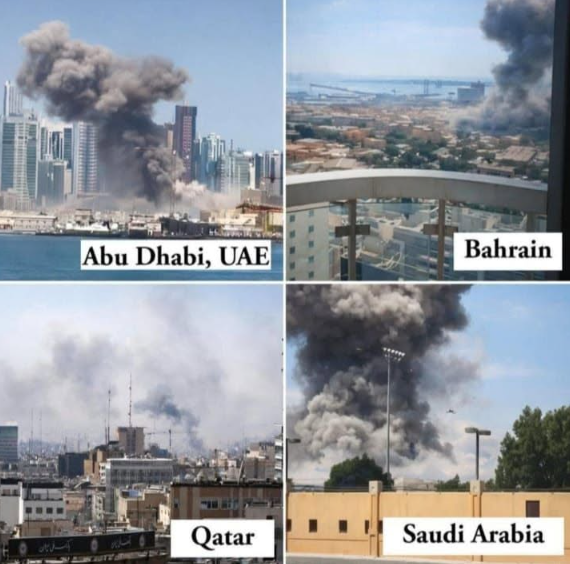
Viral posts circulating online have claimed that four countries have joined forces to launch a major attack. However, the exact claim circulating on social media has not been independently verified. What is confirmed is that tensions involving the United States and Iran have intensified, with competing claims about attacks on military facilities and continuing threats of retaliation.
The rapidly changing situation has governments, military officials, and civilians watching closely as the possibility of further escalation remains a major concern.
According to current reporting, Iran has claimed that it launched attacks against locations used by U.S. forces in Kuwait and the United Arab Emirates. Iranian officials said the attacks were carried out in retaliation for American strikes.
However, those claims have not been fully independently confirmed.
That distinction is extremely important during a fast-moving military crisis.
When explosions, missile launches, drone attacks, or military movements are reported, information can spread across social media within minutes. Initial reports may contain incomplete information, conflicting accounts, or claims made by governments involved in the conflict.
For ordinary people following events from home, it can therefore be difficult to determine what is actually happening.
The latest developments have nevertheless demonstrated how quickly the conflict could affect countries beyond the immediate battlefield.
Kuwait, Bahrain, the United Arab Emirates, Jordan, Iraq, and other countries in the region have important strategic relationships with the United States. American military personnel and facilities are located throughout the region, meaning that an escalation involving Iran could create risks far beyond the borders of Iran and Israel.
Iran has previously demonstrated its ability and willingness to target regional military infrastructure when it believes its interests are under attack.
At the same time, the United States has warned that it is prepared to respond to attacks against American personnel and facilities.
That creates a dangerous cycle.
One side launches an attack.
The other side promises retaliation.
Another strike follows.
Then another response.
Each step increases the possibility that a situation that began as a limited confrontation could become something much larger.
This is why governments around the world are closely watching diplomatic developments alongside military movements.
The question is no longer simply what happens during a single attack.
The bigger question is whether leaders can prevent the situation from developing into a prolonged regional war.
Recent reporting has described growing pressure on Gulf countries as they attempt to balance their relationships with Washington while also dealing with threats from Tehran. Gulf states have significant economic interests that could be affected by prolonged military conflict, particularly because the region is central to global energy supplies and shipping routes.
The potential economic consequences are enormous.
Oil prices can react quickly to fears that energy infrastructure or major shipping routes could be disrupted. Airlines may alter routes to avoid dangerous airspace. Businesses can face higher insurance and transportation costs. Governments may be forced to spend more on security and emergency preparedness.
For civilians, however, the consequences are much more personal.
Families living near military installations may fear incoming missiles or drones.
Parents may worry about children.
Workers may be unable to reach their jobs.
Travelers may find flights canceled or rerouted.
Communities can experience anxiety even when they are hundreds of miles away from the immediate fighting.
That human dimension is sometimes lost when headlines focus exclusively on military equipment and political statements.
Every missile represents the possibility of someone losing a home, a livelihood, or a loved one.
Every escalation creates another reason for civilians to fear what could happen next.
The international community therefore faces an enormous challenge.
Diplomacy becomes increasingly important when military actions begin happening faster than political negotiations.
Countries that maintain relationships with both sides can potentially help create channels for communication. International organizations can encourage restraint and support humanitarian efforts.
But diplomacy becomes harder when governments believe that military action is necessary for their security.
The current crisis also demonstrates why readers should be cautious with sensational social-media headlines.
A phrase such as “FOUR COUNTRIES HAVE JOINED FORCES TO ATTACK” can attract enormous attention. It can generate thousands of shares before journalists have had time to verify the details.
Sometimes such headlines are based on a real event but dramatically exaggerate what happened.
Other times, an old photograph or video is presented as if it were new.
Military footage from previous conflicts can also be reposted without context.
That is why responsible reporting requires checking the date, location, source, and independent confirmation before treating a dramatic claim as fact.
The situation remains fluid, and new developments could emerge quickly.
The most important information for the public is therefore not simply whether a dramatic headline is trending.
It is whether credible authorities and independent news organizations have confirmed the underlying event.
At present, the broader picture is clear: tensions are extremely serious, military exchanges and threats have continued, and there is genuine concern about further escalation. But the specific viral claim that four countries have suddenly formed a new alliance and launched a coordinated attack should not be treated as confirmed without additional evidence.
For people watching the news, the coming hours and days may be critical.
Military commanders will be watching for further attacks.
Governments will be weighing possible responses.
Diplomats will be looking for opportunities to prevent escalation.
And millions of civilians will simply be hoping that the fighting does not spread.
History has repeatedly demonstrated how quickly regional conflicts can become international crises.
That is why restraint matters.
One decision can prevent escalation.
One miscalculation can accelerate it.
One diplomatic breakthrough can change the direction of events.
As the world waits for clearer information, the most responsible response is vigilance without panic.
Follow credible reporting.
Check claims before sharing them.
Avoid spreading unverified videos or dramatic headlines.
And remember that behind every breaking-news alert are real people whose lives can be profoundly affected by decisions made far away.
The current situation is serious, but sensational claims should not be allowed to create additional confusion.
The world is watching.
Governments are preparing.
Diplomats are working.
And millions of people are hoping that the next headline will be about de-escalation rather than another attack.