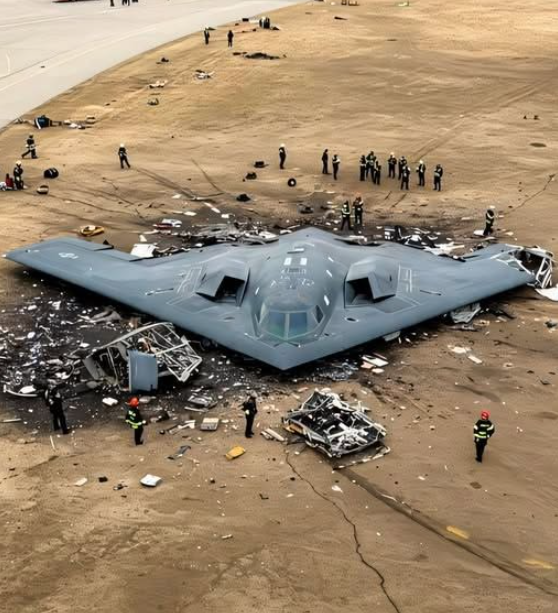
BREAKING NEWS: Was a B-2 Spirit Really Shot Down? Here’s What the Evidence Shows
A dramatic claim has been spreading online: “BREAKING NEWS: B-2 Spirit was shot down…” The headline has attracted attention because the B-2 Spirit is one of the most recognizable and sophisticated aircraft in the U.S. military.
But before sharing a post like this, there is an important question to answer:
Did a B-2 Spirit actually get shot down?
Based on the available credible reporting and fact-checking, there is no verified evidence that an American B-2 Spirit was shot down by enemy fire. Several images and videos circulating online have made exactly that claim, but fact-checkers have determined that some of the material is AI-generated or otherwise fabricated.
That distinction matters.
The Viral Claim
The story began circulating through social media posts featuring dramatic footage or photographs supposedly showing a damaged or destroyed B-2 bomber.
Some posts claimed the aircraft had been attacked and brought down during military operations involving Iran.
Others went even further, claiming that American personnel had been captured after the alleged incident.
Because the B-2 is a highly advanced aircraft and because tensions in the Middle East have generated a constant stream of dramatic videos online, the claims quickly attracted attention.
But an eye-catching photograph is not automatically proof that an event happened.
In fact, one widely circulated image allegedly showing a B-2 that had been shot down by Iran was examined by Full Fact. Investigators concluded that the image was fake and identified several signs of manipulation, including visual inconsistencies and an AI-related watermark.
Another video claiming to show a captured B-2 being transported through Iran was also examined. Lead Stories reported that the footage showed characteristics consistent with AI generation, including problems with the aircraft’s scale and how it appeared within the surrounding environment.
Why the B-2 Story Sounds Believable
The B-2 Spirit is a real aircraft with an extraordinary history.
It is a long-range stealth bomber designed to penetrate sophisticated air-defense systems. Its distinctive flying-wing design makes it instantly recognizable to aviation enthusiasts.
That reputation can also make false stories about the aircraft especially effective.
When people see an image of what appears to be a damaged B-2, they may assume the picture must be genuine simply because the aircraft itself is real.
But there is an important difference between a real aircraft and a real photograph of that aircraft being destroyed.
Artificial intelligence has made that distinction increasingly difficult for ordinary social-media users.
Modern AI tools can generate convincing-looking aircraft, military personnel, smoke, explosions and battle scenes. A viewer who isn’t familiar with aircraft dimensions or military operations may have difficulty spotting the mistakes.
The Clues Hidden in the Images
In one fake image, investigators noticed details that did not make sense.
Full Fact pointed out that the B-2 is operated by a two-person crew, while the supposedly authentic image appeared to show three U.S. servicemen. Investigators also identified other visual irregularities, including problems with hands and flags.
These details might seem insignificant at first.
But they can be extremely important when determining whether an image is authentic.
AI-generated pictures frequently contain strange hands, distorted objects, incorrect proportions and inconsistent lighting.
The same principle applies to aircraft.
A B-2 Spirit has a wingspan of approximately 172 feet, or about 52 meters. Lead Stories noted that the aircraft shown in one viral video was dramatically inconsistent with the scale of a real B-2.
That kind of error can reveal an otherwise convincing fake.
What About the Real B-2?
The B-2 Spirit has been used in real military operations, including operations involving Iran.
That fact is important because it provides a genuine event around which misinformation can grow.
A real military operation happens.
Real aircraft are involved.
Real photographs and videos may emerge.
Then fabricated material can be added to the story.
Before long, people may be unable to distinguish between authentic footage and manufactured content.
Thai PBS Verify investigated a video claiming to show a B-2 being hit over Bahrain and reported that the footage was AI-generated. Its investigation found no credible news reports confirming that Iran had successfully shot down a B-2.
This is why extraordinary claims require extraordinary evidence.
A photograph posted by an anonymous social-media account isn’t enough to establish that an American stealth bomber has been destroyed.
Don’t Confuse the B-2 With the Recent B-52 Crash
There is another important detail that may contribute to confusion.
In June 2026, a B-52 Stratofortress crashed shortly after takeoff at Edwards Air Force Base in California during a routine test mission. Eight people aboard were killed, according to military officials and major news organizations.
That was a real and tragic event.
But the aircraft involved was a B-52, not a B-2.
The cause of that crash was still under investigation in the initial reporting, and there was no indication that the aircraft had been shot down by an enemy.
The similarity in the names—B-2 and B-52—can make online headlines particularly confusing.
They are completely different aircraft.
Why Social Media Makes These Stories Spread
A headline beginning with “BREAKING NEWS” creates urgency.
The words encourage people to click immediately rather than stop and investigate.
Add a dramatic photograph, an alarming claim and the phrase “see more,” and the post becomes even more likely to attract attention.
People may share the post before reading beyond the headline.
Then someone else sees the share and assumes the original poster verified it.
Soon, hundreds or thousands of people may believe something that began with an unverified image.
This doesn’t necessarily mean everyone sharing it is deliberately spreading misinformation.
Many people simply believe they are passing along important information.
That’s why checking the source is so important.
What Should You Look For?
When you see a dramatic military story online, ask several questions:
Who first published the claim?
Is there confirmation from a credible news organization?
Has the U.S. military acknowledged the incident?
Are multiple independent sources reporting the same event?
Does the photograph contain obvious visual inconsistencies?
Could the image or video have been generated by AI?
And perhaps most importantly:
Is the headline more dramatic than the evidence?
If the answer is yes, take a step back before sharing.
The Bottom Line
The claim that a B-2 Spirit was shot down should not be presented as confirmed breaking news.
The evidence currently available points instead to a series of false, manipulated or AI-generated images and videos that have circulated online. Fact-checkers have specifically investigated several of these claims and found them to be false.
The B-2 is real.
U.S. military operations involving B-2 aircraft are real.
The online images claiming that one was shot down, however, are a different matter.
And that distinction is exactly why readers should be careful with viral “breaking news” posts.
Before you share a shocking photograph, stop for a moment and verify it. In the age of AI-generated images, seeing is no longer always believing