What Could Cause Skin to Look Like This? Understanding a Rash With Small Bumps
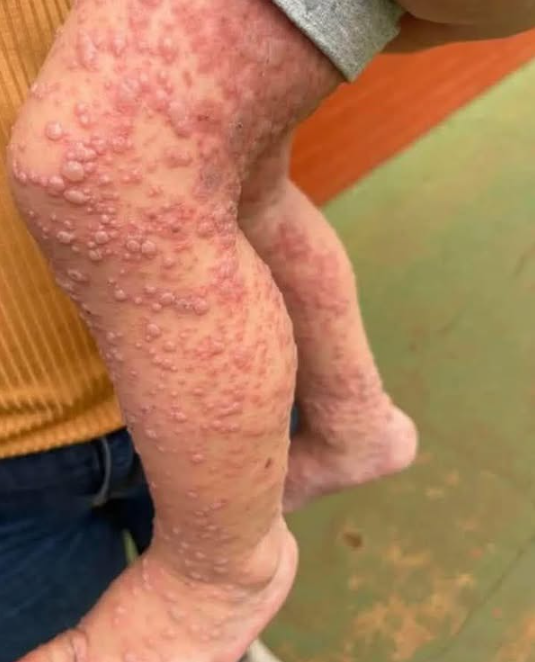
A photograph showing a child’s legs covered with numerous red spots and raised bumps can be alarming. At first glance, the skin appears irritated, inflamed, and covered with small, rounded lesions of different sizes. Images like this often circulate online with dramatic claims about what the condition “must” be, but a photograph alone cannot provide a reliable diagnosis.
There are many reasons skin can develop redness, swelling, and bumps. Some are temporary and relatively harmless, while others require prompt medical attention. The most important lesson is that appearance alone is not enough to determine the cause.
What Can Be Seen in the Photograph?
The visible skin appears to have widespread redness accompanied by numerous raised bumps. Some areas seem more densely affected than others, and several of the bumps appear relatively large compared with the surrounding spots.
There also appears to be irritation extending across significant portions of the legs.
However, a photograph cannot tell us several important things that a healthcare professional would need to know. For example, we cannot determine from the image alone whether the affected areas are painful, itchy, warm, tender, blistering, or producing fluid.
Those details can be extremely important when evaluating a rash.
Why Can Skin Develop So Many Bumps?
The skin is the body’s largest organ and reacts to many different environmental and internal factors.
A rash can occur after exposure to an irritant, an allergen, an insect bite, an infection, heat, friction, medication, or another trigger.
Some rashes involve the hair follicles. Others affect the superficial layers of skin or involve an inflammatory response.
For that reason, two rashes can look surprisingly similar while having completely different causes.
This is one reason internet photographs should not be used as a substitute for professional evaluation.
Possible Causes of a Raised Rash
One possibility with clusters of itchy or raised bumps is an insect-bite reaction. Certain bites can produce multiple swollen spots, sometimes appearing in groups or lines.
Another possibility is an allergic or hypersensitivity reaction. Hives, for example, can create raised areas of skin that vary considerably in size and may appear suddenly. They can also move or change over time.
Contact dermatitis is another common possibility. This occurs when the skin reacts to something it has contacted, such as certain soaps, detergents, plants, cosmetics, or other substances.
There are also infectious causes of rashes, including some viral and bacterial illnesses. Certain skin infections can produce bumps, redness, crusting, or other changes.
The photograph itself cannot establish which explanation applies.
Don’t Assume the Worst
One of the problems with viral health posts is that they often attach a frightening diagnosis to a photograph without providing reliable context.
A caption might claim that a particular image proves someone has a dangerous disease. Such claims can spread quickly because people naturally become concerned when they see dramatic skin changes.
But medical diagnosis requires more than visual resemblance.
A clinician may need to ask when the rash appeared, whether it is spreading, whether the person has a fever, whether there was a recent illness, whether new medications or personal-care products were introduced, and whether anyone else in the household has similar symptoms.
The patient’s age and medical history may also matter.
What Questions Should You Ask?
If someone develops a rash resembling the one shown, several questions can help determine how urgently medical attention is needed.
When did it begin?
A rash that appeared suddenly within minutes or hours may have a different explanation from one that developed gradually over several days.
Is it itchy or painful?
Itching is common with allergic reactions and many other skin conditions, while significant pain can sometimes indicate a different process.
Is it spreading?
A rapidly expanding rash deserves attention, particularly if other symptoms are appearing.
Is there fever or unusual tiredness?
A rash accompanied by fever or a child who appears significantly unwell should be evaluated by a healthcare professional.
Are there blisters, open sores, or drainage?
These findings can provide important clues and may require medical assessment.
Has anything changed recently?
New foods, medications, detergents, soaps, plants, pets, travel, outdoor activities, or possible insect exposure may all be relevant.
When Should You Seek Medical Help?
Many rashes are not emergencies, but certain symptoms should never be ignored.
Seek urgent medical attention if a rash is accompanied by difficulty breathing, swelling of the lips or tongue, fainting, severe weakness, or other signs of a serious allergic reaction.
A rapidly spreading rash accompanied by a high fever or a person who appears seriously ill also warrants prompt medical evaluation.
Another concerning feature is a rash consisting of spots that do not fade when pressed, particularly when accompanied by fever or significant illness. This can sometimes occur with serious infections and should be assessed urgently.
Parents and caregivers should trust their judgment if a child appears unusually sick, lethargic, confused, or difficult to wake.
Avoid Random Treatments
When people see an alarming rash, they may immediately search for a cream or medication online.
That can sometimes make the situation worse.
Applying multiple products at once can irritate already inflamed skin and make it more difficult for a healthcare professional to determine what happened.
Unless a healthcare professional has recommended a specific treatment, it is generally better to avoid experimenting with strong creams or medications.
Keeping the affected skin clean and avoiding suspected irritants may be reasonable while seeking appropriate advice, but treatment depends on the underlying cause.
Why Children Need Extra Attention
The photograph appears to show a young person, which makes proper evaluation particularly important.
Children can develop many of the same skin conditions as adults, but certain childhood illnesses can produce distinctive rashes. In addition, children may have difficulty explaining whether something hurts, burns, or feels unusual.
Parents or caregivers should therefore pay attention not only to the skin but also to the child’s overall condition.
Is the child eating and drinking normally?
Are they behaving normally?
Do they have a fever?
Are they sleeping unusually much?
Are they complaining about pain or severe itching?
These details may be more informative than the appearance of the rash alone.
The Importance of Context
A single photograph freezes one moment.
A healthcare professional, by contrast, can examine how the rash feels, whether it blanches under pressure, whether the bumps are firm or soft, and whether other areas of the body are affected.
They can also take a medical history and determine whether additional testing is necessary.
That is why photographs can be useful for starting a conversation with a clinician but should not be treated as definitive evidence of a particular disease.
The Bottom Line
The image shows significant redness and numerous raised bumps on the legs, but there is no responsible way to determine the exact cause from the photograph alone.
Possible explanations for a rash like this can include allergic reactions, insect bites, irritation, dermatitis, infections, and other skin conditions. The correct diagnosis depends on symptoms, timing, medical history, physical examination, and sometimes testing.
So if you encounter this image online accompanied by a claim such as “this is definitely caused by ___,” be cautious.
A photograph is a clue, not a diagnosis.
If someone actually has a rash that looks this extensive—especially a child—the safest approach is to have them evaluated by a qualified healthcare professional, particularly if the rash is rapidly worsening or accompanied by fever, breathing problems, swelling, severe pain, unusual sleepiness, or other concerning symptoms.
And that is the real takeaway: don’t panic based on a picture, but don’t ignore significant or rapidly changing skin symptoms either