🚨 BREAKING NEWS: “13 Countries Join Forces to Attack” — What We Actually Know
A dramatic headline is spreading rapidly across social media:
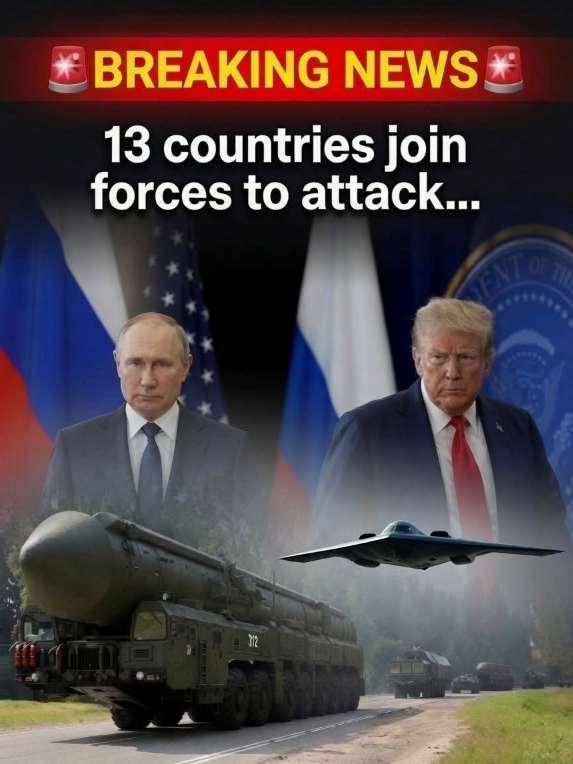
“🚨 Breaking News: 13 countries join forces to attack… See more.”
The wording is enough to make anyone stop scrolling. A claim involving 13 countries, military forces and a possible coordinated attack naturally raises frightening questions: Who is being targeted? Has a new war begun? Are multiple nations preparing for a major military confrontation?
But there is an important distinction between a viral headline and a confirmed event.
Based on the information currently available, there is no reliable evidence confirming that 13 countries have suddenly joined together to launch a coordinated attack under the circumstances suggested by the viral post. Similar versions of this headline have circulated online for months, often presenting defensive military cooperation as though it were an offensive declaration of war.
That distinction matters enormously.
The headline is more dramatic than the verified information
Several websites have published versions of the “13 countries” story. Some describe a multinational security or defense arrangement, while others use dramatic images of missiles, military vehicles and political leaders to create the impression that a massive attack is imminent.
One recent version specifically describes a multinational maritime defense effort involving countries working to protect important shipping routes around the Red Sea, Gulf of Aden and Bab al-Mandab region. That is a very different situation from 13 nations formally declaring that they are going to attack another country.
The difference between defense and offense can easily disappear in social-media headlines.
A military alliance may involve joint exercises, intelligence sharing, maritime patrols, air-defense systems, logistical cooperation or preparations designed to discourage an adversary from attacking.
None of those things automatically means that the participating nations have decided to begin a war.
Why are people paying attention?
The reason the story sounds believable is that international security tensions remain extremely serious.
The Middle East has experienced repeated military confrontations, attacks on shipping, threats against military installations and increasing concern about the possibility of conflicts spreading across national borders.
The Red Sea and Gulf of Aden are particularly important because they are major international transportation routes. Ships traveling between Asia, the Middle East and Europe can depend on these waterways, meaning that instability in the region can have consequences far beyond the countries directly involved.
When shipping routes become dangerous, vessels may have to take longer routes.
That can increase transportation times, insurance costs and fuel consumption.
Eventually, those increases can affect businesses and consumers around the world.
So while the viral “13 countries attack” headline is not supported by sufficient evidence, the broader security concerns behind it are very real.
Military cooperation does not necessarily mean war
This is perhaps the most important point for readers to understand.
Countries regularly conduct military exercises and form security partnerships.
Sometimes they do this because they share concerns about piracy. Sometimes the goal is protecting commercial shipping. Sometimes the objective is air defense or border security. In other cases, countries want to demonstrate that they can respond together if one of their members is threatened.
A defensive alliance can therefore become extremely powerful without actually launching an offensive.
The distinction is especially important when dramatic photographs accompany social-media posts.
A photograph showing missiles, soldiers or military vehicles may be genuine while still having nothing to do with the event described in the headline.
That technique can make an old photograph appear to be evidence of a new crisis.
The danger of “See More” headlines
There is another warning sign in this story: the phrase “See more.”
This style of headline is extremely common on social media.
Instead of providing the basic facts — who, what, when, where and why — the post gives readers a shocking statement and encourages them to click.
The more frightened or curious people become, the more likely they are to open the article, watch the video or share the post.
That creates a cycle.
One person shares an alarming headline.
Another person sees hundreds of people sharing it and assumes it must be true.
Then that person shares it again.
Within hours, thousands of people may believe something that was never properly confirmed.
A recent example of the viral “13 countries” claim similarly acknowledged that there was no reliable confirmation of 13 nations launching a coordinated attack, despite the dramatic wording used by the post.
What should readers look for?
When a breaking-news story involves war, missiles or multiple countries, there are several simple questions that can help separate fact from exaggeration.
First: Which countries are involved?
A legitimate report should identify them.
Second: Who is being attacked?
A headline that refuses to name the target is immediately incomplete.
Third: When did the alleged attack happen?
A precise date and location should be provided.
Fourth: Which government or military authority confirmed it?
Major military operations normally generate official statements.
Fifth: Are established international news organizations reporting the same event?
One obscure website repeating another obscure website does not create independent confirmation.
These questions can prevent people from accidentally spreading misinformation.
The bigger geopolitical picture
The world is already experiencing a period of heightened geopolitical uncertainty.
The war in Ukraine continues to influence European security policy. Tensions involving Iran, Israel, the United States and regional actors continue to affect the Middle East. Maritime security remains a major concern in strategically important waterways.
At the same time, governments are increasing defense spending, conducting military exercises and strengthening alliances.
That does not necessarily mean a global war is about to begin.
In fact, one purpose of military alliances is often deterrence — convincing potential adversaries that an attack would be too costly.
The irony is that preparations intended to prevent war can sometimes look frightening from the outside.
A military exercise may look like preparation for invasion.
A defensive missile system may look like preparation for an attack.
A multinational security agreement may be presented online as a declaration of war.
Context is therefore essential.
Why accuracy matters
Stories about war are not ordinary pieces of internet gossip.
They involve real people.
Behind every military headline are soldiers, families, civilians, emergency workers, journalists and communities whose lives can be dramatically affected by conflict.
False reports can create unnecessary fear.
They can also contribute to panic, political hostility and confusion at precisely the moment when accurate information is most important.
That is why responsible readers should resist the temptation to immediately share the most frightening version of a story.
It is perfectly reasonable to be concerned about international tensions.
But concern should be based on verified information rather than an attention-grabbing headline.
What happens next?
The situation surrounding international military alliances and regional security can change quickly.
A new attack, diplomatic agreement, military deployment or ceasefire could dramatically alter the picture.
For that reason, people should continue watching credible sources for confirmed developments rather than relying on recycled social-media posts.
At this point, the phrase “13 countries join forces to attack” should not be treated as confirmation that 13 nations have launched a coordinated military offensive.
Available reporting points instead toward complicated defense and security cooperation amid serious geopolitical tensions.
And that distinction is crucial.
The real lesson
The internet moves faster than traditional news ever could.
That speed can be valuable during emergencies, but it also allows misleading stories to spread before the facts are known.
So when you see a giant red 🚨 BREAKING NEWS banner followed by “See more,” take a breath.
Don’t panic.
Don’t immediately share it.
Look for the countries involved. Look for the date. Look for official confirmation. Compare multiple credible reports.
Because sometimes the most important part of a breaking-news story isn’t the dramatic headline.
It’s what the headline leaves out.
And in a world already filled with genuine geopolitical dangers, knowing the difference between a real military attack and a sensationalized description of defensive cooperation is more important than ever.