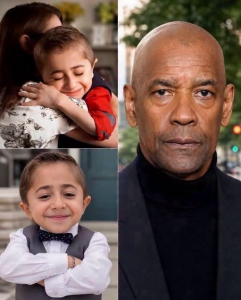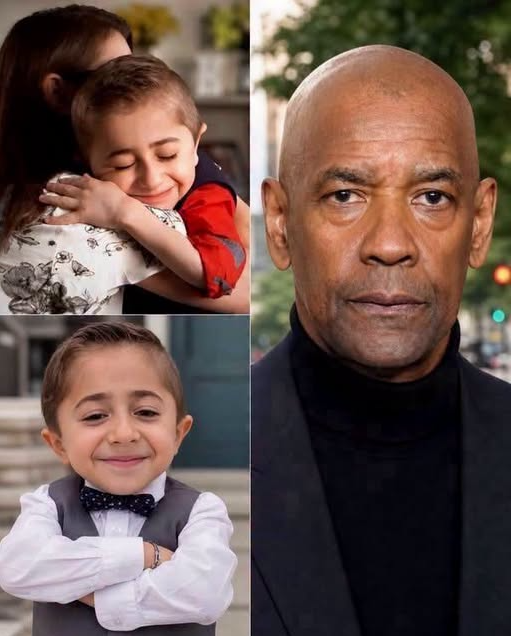
The Truth Behind the Viral Kaleb Story and the Young Man Who Inspired Thousands
A heartbreaking story circulating online has left thousands of people emotional. It tells of a young boy named Kaleb, a child known for his bright smile, quiet confidence and extraordinary courage, and claims that he recently died after a lifetime of battling osteogenesis imperfecta, commonly known as brittle bone disease.
The story goes even further, claiming that legendary actor Denzel Washington was devastated by Kaleb’s death and prayed for him during his final moments. According to the viral version, Washington supposedly sent the young boy a desperate and haunting message before his death.
It is the kind of story that naturally pulls at the heart.
But there is a crucial problem.
The central claim is not supported by credible evidence.
In fact, Shriners Children’s, the organization with which Kaleb is associated, published an official fact-check in March 2026 specifically addressing rumors about Kaleb’s death. The organization stated that Kaleb is alive and well and remains an important member of the Shriners Children’s community.
That clarification changes the story completely.
A Child Who Faced More Than Most Could Imagine
The real story of Kaleb is already remarkable enough without adding an invented tragedy.
Kaleb was born with osteogenesis imperfecta, a rare genetic disorder that affects the body’s ability to develop strong bones. Shriners Children’s explains that the condition can cause bones to break easily and may be accompanied by other challenges involving growth, muscles, the spine, hearing and overall physical development.
For Kaleb, the condition meant an extraordinary number of medical challenges from the very beginning.
According to Shriners Children’s, Kaleb underwent his first surgery when he was only seven days old. Over the course of his childhood, he experienced more than 200 fractures and underwent 11 surgeries.
For many people, even imagining such a childhood is difficult.
A broken bone is normally associated with a temporary setback. A cast goes on, the injury heals, and life eventually returns to normal.
For a child with severe osteogenesis imperfecta, however, a fracture can be part of everyday life.
Yet Kaleb’s story has never been defined solely by those fractures.
Instead, he became known for his determination.
More Than a Medical Diagnosis
One of the most powerful aspects of Kaleb’s story is the way he refused to allow his medical condition to become his entire identity.
Shriners Children’s has highlighted his optimism repeatedly.
In a 2024 profile, the organization described Kaleb as becoming stronger and learning to stand and walk despite everything he had experienced.
His own words reveal an attitude that is difficult not to admire.
Kaleb explained that he had been born with brittle bone disease but had not allowed it to stop him from pursuing the things he wanted to do.
That attitude eventually made him an ambassador for other children and families facing serious medical challenges.
Rather than allowing people to see only his illness, Kaleb gave them something else to see: possibility.
A Message of Resilience
In May 2025, Shriners Children’s featured Kaleb in an interview with young journalist Emmy Eaton.
At the time, Kaleb was 16 and continued receiving treatment through Shriners Children’s. The organization described him as a beloved patient ambassador who had maintained an impressively positive outlook despite frequent fractures, surgeries and physical therapy.
During that conversation, Kaleb offered a remarkably simple philosophy about facing difficult circumstances.
He said that in life, people essentially have a choice between giving up and facing their challenges.
It was not the statement of someone who wanted sympathy.
It was the statement of someone who wanted to keep moving forward.
Kaleb also talked about his interests, including reading, gaming and collectible trading card games. He shared hopes of pursuing communications and media arts in the future.
Those details matter because they remind us that behind the medical terminology is simply a young person with dreams.
The Denzel Washington Claim
That is where the viral story becomes especially problematic.
Posts circulating online claim that Denzel Washington was personally involved in Kaleb’s final moments and sent him a desperate message before his supposed death.
There is no credible evidence establishing that claim.
No verified statement from Washington has been found confirming such a message, and Shriners Children’s official information directly contradicts the claim that Kaleb died.
Stories involving famous actors and critically ill children can spread extremely quickly because they combine celebrity, tragedy and emotion. Once thousands of people begin sharing the same headline, the repetition itself can make an unsupported story appear legitimate.
But repetition is not proof.
And when the subject is a real child, accuracy becomes especially important.
This Isn’t the First False Death Rumor
There is another reason people should be cautious.
False rumors about Kaleb have circulated before.
In 2021, PolitiFact investigated claims that Kaleb, then known as a Shriners Hospitals spokesperson, had died. The report concluded that the claim was false and noted that Shriners had confirmed he was doing well.
Years later, the same basic misinformation pattern resurfaced.
In March 2026, Shriners Children’s again had to reassure the public that Kaleb was alive and well. The organization specifically warned that inaccurate social-media posts had caused understandable concern about Kaleb and another young ambassador, Alec.
The lesson is simple: a heartbreaking post is not automatically a truthful post.
The Real Story Is More Powerful
Perhaps the most important point is that Kaleb does not need a fabricated final chapter to inspire people.
His real story is already extraordinary.
He endured more than 200 fractures.
He underwent numerous surgeries.
He spent years navigating medical treatment and physical therapy.
And instead of allowing those experiences to erase his dreams, he continued looking toward the future.
Shriners Children’s says his care began when he was only seven days old, and he has described his medical team as being like family.
That is the story worth remembering.
Not a fictional farewell.
Not an invented celebrity confession.
Not an unsupported claim about a final message.
The real Kaleb represents something much more meaningful: resilience in the face of circumstances that would challenge almost anyone.
A Reminder to Verify Before Sharing
The internet has made it easier than ever for emotional stories to travel around the world within minutes.
But it has also made misinformation incredibly powerful.
A photograph can be real while the caption attached to it is false. A child’s actual medical history can be combined with an invented death announcement. A celebrity’s name can be added to a story to make it appear more important or believable.
That is why stories like this deserve careful verification before being shared.
In Kaleb’s case, the most reliable source is the organization that has documented his journey for years.
And according to Shriners Children’s, the young man whose smile inspired so many people is alive and well.
His journey is continuing.
His challenges are real.
His accomplishments are real.
And his message of perseverance is real.
Sometimes the truth does not need a tragic ending to be powerful.
Sometimes the most emotional story is simply a young person choosing, again and again, to keep moving forward.