🔴 BREAKING NEWS: Tensions Explode as U.S.–Iran Conflict Raises Fresh Fears — What’s Really Happening Behind the Viral Image?
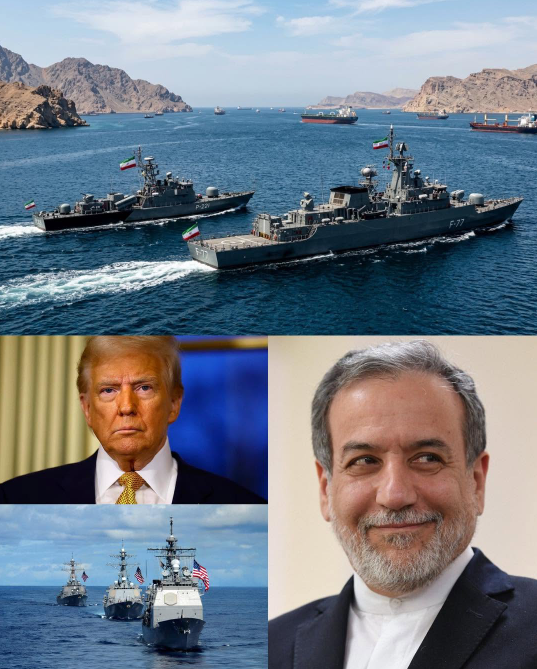
A dramatic image circulating online is attracting enormous attention, accompanied by the message: “BREAKING NEWS!!!…30 minutes ago in New York…See more.” The photograph appears to show Iranian naval vessels moving through the waters of the Persian Gulf, alongside images of U.S. President Donald Trump and Iranian Foreign Minister Abbas Araghchi.
But while the picture is designed to create the impression of an immediate breaking-news announcement in New York, the image itself does not establish that a new event occurred in New York 30 minutes ago. Instead, it appears to combine imagery associated with the much wider and increasingly dangerous confrontation between the United States and Iran.
And that confrontation is very real.
According to reporting published September 2, 2026, U.S. and Iranian forces have exchanged attacks as tensions surrounding the strategically important Strait of Hormuz have intensified. Reuters reported that the U.S. military said it had carried out strikes against Iranian air defenses, radar systems, maritime assets, mine-laying capabilities and communications facilities. Iran subsequently launched retaliatory attacks against U.S. and allied positions around the region.
The developments have placed the Strait of Hormuz at the center of international attention.
The Strait at the Heart of the Crisis
The waterway shown in the viral photograph is particularly important because the Strait of Hormuz is one of the world’s most strategically significant maritime passages.
Huge quantities of oil and other energy products normally pass through the region. Any prolonged disruption can therefore affect not only countries in the Middle East but also consumers and businesses around the world.
Recent shipping data indicates that commercial traffic through the strait has fallen sharply amid the fighting. Reuters reported that only four commodity vessels passed through the waterway on Tuesday, compared with a 10-day average of approximately 13. The publication also noted that ships sometimes switch off their tracking systems, meaning the figures can change as additional information becomes available.
That decline demonstrates why events in the region are being watched so closely by governments, shipping companies and energy markets.
The photograph’s Iranian vessels therefore have an important connection to the current story—but that does not mean the photograph proves those ships were involved in a specific incident in New York.
Trump and the Growing Confrontation
President Donald Trump has taken an increasingly forceful position regarding Iran and the Strait of Hormuz.
Recent reporting says Trump has maintained that the United States has control over the strategic waterway, while Iran disputes that claim. Trump has also warned that American forces remain prepared to act against threats in the region.
The confrontation has already moved beyond political statements.
U.S. forces have conducted military operations against Iranian targets, while Iran has responded with attacks against American and allied positions. Reuters reported that the latest U.S. strikes included maritime-related targets and mine-laying capabilities.
The situation has consequently become much more complicated than a simple dispute between two governments.
Military decisions in the Gulf can affect commercial shipping, energy prices, regional security and international diplomacy almost immediately.
The Iranian Diplomatic Dimension
The second major figure shown in the viral image is Abbas Araghchi, Iran’s foreign minister.
Araghchi has previously been a central figure in diplomatic efforts involving Washington and Tehran, including negotiations over Iran’s nuclear program. His presence in the image reinforces the political dimension of the crisis: even as military forces confront one another, diplomatic channels remain an important part of the story.
The contrast is striking.
On one side are warships, missiles, aircraft and maritime operations. On the other are diplomats attempting to find a path away from escalation.
That tension between military confrontation and diplomacy is likely to remain one of the defining features of the crisis.
Why New York Is Mentioned
The phrase “30 minutes ago in New York” is particularly important to examine.
New York is home to the United Nations and is frequently used in viral social-media posts to make international stories sound immediate or locally connected. But the current reporting available does not establish that the Iranian ships pictured in the image suddenly appeared in New York or that a specific incident involving Trump, Araghchi and Iranian naval forces occurred there.
The actual military developments being reported are centered primarily on Iran, the Persian Gulf, the Strait of Hormuz and surrounding Middle Eastern countries, not New York.
That distinction matters.
A dramatic headline can make an old or unrelated photograph appear to be evidence of a brand-new event. Social-media users should therefore avoid treating the text attached to an image as proof of what the image represents.
A Crisis With Global Consequences
Even if the viral “30 minutes ago in New York” wording is misleading, the underlying international crisis is serious.
Reuters reported that Iran has expanded a blacklist of vessels prohibited from passing through the Strait of Hormuz. The list reportedly reached 56 ships after 11 additional vessels were added. The affected vessels include oil tankers and other commercial carriers.
The restrictions come at a particularly sensitive moment.
Commercial shipping companies are already facing difficult decisions about whether vessels should attempt to travel through the waterway. Every additional military incident can increase insurance costs, delay deliveries and place crews at greater risk.
The economic effects can extend far beyond the Middle East.
Oil prices, transportation costs, manufacturing expenses and household energy bills can all be influenced by expectations about whether supplies will continue moving safely.
That is why images of military vessels in the Gulf can generate enormous interest around the world.
Civilian Concerns
The latest escalation has also produced growing concern about civilian casualties.
Associated Press reported that a U.S. strike in the southern Iranian town of Kuhestak reportedly hit a home during a wedding celebration, killing four people, including two children, according to Iranian state media and rights groups. The U.S. military said it does not target civilians and was reviewing reports surrounding the incident.
Such incidents illustrate the human consequences behind the military maps and political statements.
For people living near military installations, ports and strategic infrastructure, the conflict is not an abstract geopolitical contest. It can mean fear, displacement, destroyed property and loss of life.
What Happens Next?
The biggest question now is whether the latest exchange of attacks becomes a longer and broader confrontation—or whether diplomatic pressure can eventually bring the sides back toward negotiations.
Regional governments have urged restraint, while countries including Egypt, Qatar, Pakistan and China have been involved in diplomatic efforts aimed at reducing tensions.
For the moment, however, the situation remains extremely unstable.
The viral image may be dramatic, but the reality behind it is even more significant: the United States and Iran are locked in a dangerous confrontation in and around one of the world’s most important maritime corridors.
So before sharing the headline “BREAKING NEWS!!!…30 minutes ago in New York,” it is worth separating the verified facts from the sensational caption.
The photograph is not proof of a sudden event in New York. But the military confrontation between the United States and Iran—and the struggle over security in the Strait of Hormuz—is a genuine and rapidly developing international crisis.
As governments watch the situation, markets react and ships navigate increasingly dangerous waters, the world is waiting to see whether the next development will bring further escalation—or an unexpected opening for diplomacy