A Mother’s Cells, a Son’s Fight, and a Family’s Hope for a Miracle
For Nichole Blevins, motherhood has always meant doing whatever she could to protect her children. But today, that instinct is taking on a meaning far beyond anything she could have imagined.
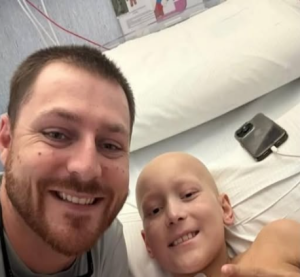
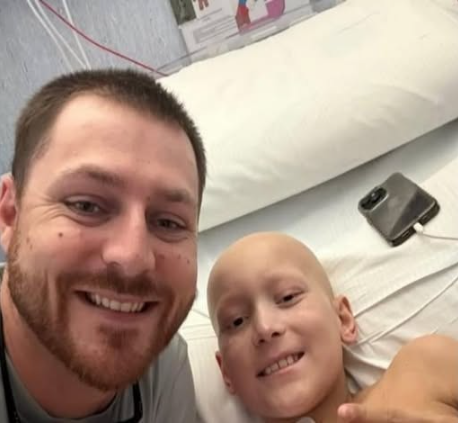
Her 11-year-old son, Branson, is fighting a rare and devastating form of leukemia. After enduring treatment after treatment, his family now faces another difficult chapter—one that carries both enormous risks and a possibility they desperately want to believe in.
Nichole is preparing to donate her own immune cells to help her son fight his disease.
For the family, these are more than simply cells being collected for an experimental therapy. They represent a mother’s willingness to give her child another chance.
They represent hope.
And, above all, they represent love.
A Childhood Interrupted
At just 11 years old, Branson should be worrying about ordinary childhood things—school, friends, games, hobbies, birthdays and what he wants to do when he grows up.
Instead, much of his young life has been shaped by hospitals, medical appointments, treatments and uncertainty.
Leukemia is a cancer of the blood-forming tissues, including the bone marrow. While many forms of leukemia can be treated successfully, some rare and aggressive forms can be extraordinarily difficult to control.
For Branson and his family, the battle has meant enduring difficult treatments and watching closely for signs that the disease might respond.
Every treatment brings its own challenges. There can be exhaustion, fear, painful side effects and long stretches of uncertainty.
And for parents, there is another burden that can be even harder to describe: the helpless feeling of watching your child suffer while desperately wishing you could take the pain away.
Nichole, however, has found one way she can help.
She can give him something from herself.
A Mother Gives More Than Blood
The experimental therapy Branson is facing involves using immune cells donated by his mother.
The concept behind cell-based cancer treatments is powerful. Instead of relying only on traditional medicines to attack cancer, doctors can sometimes use immune cells to recognize and attack abnormal cells.
In some therapies, immune cells are collected, processed or modified, and then given to a patient with the goal of helping the immune system target the disease.
For Branson’s family, the idea carries an especially profound meaning because the cells are coming from his own mother.
Nichole has referred to them affectionately as her “mama cells.”
The phrase captures something deeply emotional about the moment.
She isn’t simply contributing biological material to a medical procedure. She is offering another piece of herself in the hope that it can help her son survive.
But experimental medicine also comes with uncertainty.
There are no guarantees.
The treatment may not work as doctors hope. There can be serious complications, and the medical team must carefully balance potential benefits against significant risks.
That uncertainty makes the family’s journey even more difficult.
“Please Pray for a Miracle”
Nichole understands the seriousness of what lies ahead.
She also understands that hope does not mean pretending the risks aren’t there.
Her request is simple: “Please pray for a miracle.”
Those words reveal the emotional reality of families facing devastating illnesses.
When conventional treatments have been exhausted or have not produced the desired results, experimental therapies can become a source of cautious hope.
Families may find themselves living between two worlds.
One is grounded in medical facts, statistics, possible complications and careful planning.
The other is built on faith, love and the belief that something unexpected might happen.
For Nichole and her family, both are present.
They are trusting the doctors and the science while also holding tightly to their faith.
The Emotional Moment of Cell Collection
The process of collecting immune cells can be lengthy and physically demanding. But for Nichole, the discomfort has a much larger purpose.
Every moment of the procedure carries the same thought:
Could these cells help Branson?
Could they give him another opportunity to fight?
Could they become part of a treatment that changes the direction of his illness?
Those questions make the experience deeply personal.
A mother who might otherwise fear a medical procedure can find extraordinary strength when her child is the reason for it.
Parents often say they would do anything for their children.
Nichole is showing exactly what those words can mean.
She is putting herself through the process because her son needs her.
More Than One Family’s Story
There is another reason this treatment matters.
Experimental therapies are not only about the individual patient receiving them. When researchers and physicians learn from new approaches, that knowledge can potentially contribute to future treatments for other patients.
That possibility gives Branson’s situation an additional dimension.
His family is hoping for a breakthrough for him first and foremost. But they also recognize that medical progress often depends on courageous patients and families willing to participate in difficult and uncertain treatments.
Every successful advance in medicine begins somewhere.
Sometimes it begins with a patient whose family simply refuses to give up.
That does not make the risks any smaller.
It does, however, give the family another reason to hope.
The Strength of an 11-Year-Old
Perhaps the most remarkable part of Branson’s story is that, despite everything he has experienced, he remains a child.
An 11-year-old facing leukemia has had to confront realities that many adults struggle to comprehend.
Hospital rooms can replace playgrounds.
Medical tests can replace ordinary school days.
Treatment schedules can dictate family routines.
Yet children can demonstrate extraordinary resilience.
They can find reasons to smile even during difficult days. They can focus on small victories. They can look toward tomorrow even when adults around them are frightened.
Branson’s journey is ultimately about more than his illness.
It is about his determination to keep fighting.
And surrounding him is a family determined to keep fighting alongside him.
A Family Waiting and Believing
As Nichole’s cells are collected, the Blevins family waits.
There is no simple way to describe that waiting.
Hope can be exhausting.
Every phone call from the medical team can bring a rush of fear and anticipation. Every test result can feel enormously important. Every new development can change the family’s emotional landscape.
Yet hope remains.
They hope the treatment works.
They hope Branson’s body responds.
They hope the cancer retreats.
They hope he gets the opportunity to return to the ordinary childhood experiences that illness has taken from him.
And they hope that one day this chapter will become something they remember rather than something they are still living through.
A Mother’s Love in Action
Nichole’s decision to donate her immune cells demonstrates one of the most powerful aspects of parenthood: the instinct to protect a child can survive even in the face of overwhelming fear.
She cannot control the disease.
She cannot guarantee the outcome.
She cannot promise her son that everything will be okay.
But she can stand beside him.
She can give what she has.
And she can keep believing.
Her “mama cells” have become a symbol of that commitment.
They represent science and medicine, but they also represent something deeply human—the bond between a mother and her child.
Waiting for the Miracle
For now, the Blevins family is waiting.
They know the road ahead may be difficult.
They know experimental treatment carries uncertainty.
They know there are no promises.
But they also know that giving up is not an option they are ready to accept.
Nichole’s plea for prayers is ultimately a plea for hope—for her son, for her family and perhaps for other children who may one day benefit from advances in cancer treatment.
Branson’s story reminds us that behind every diagnosis is a person.
Behind every medical procedure is a family.
And behind every treatment is a hope that tomorrow might be different from today.
As Nichole gives her “mama cells” for her son’s fight, she is giving something that cannot be measured in a laboratory alone.
She is giving courage.
She is giving love.
She is giving hope.
And while the family waits to see whether this experimental therapy can make a difference, they continue to hold onto the possibility they have carried throughout this journey:
A miracle may still be possible.
For Branson, his family and everyone praying beside them, that hope means everything.