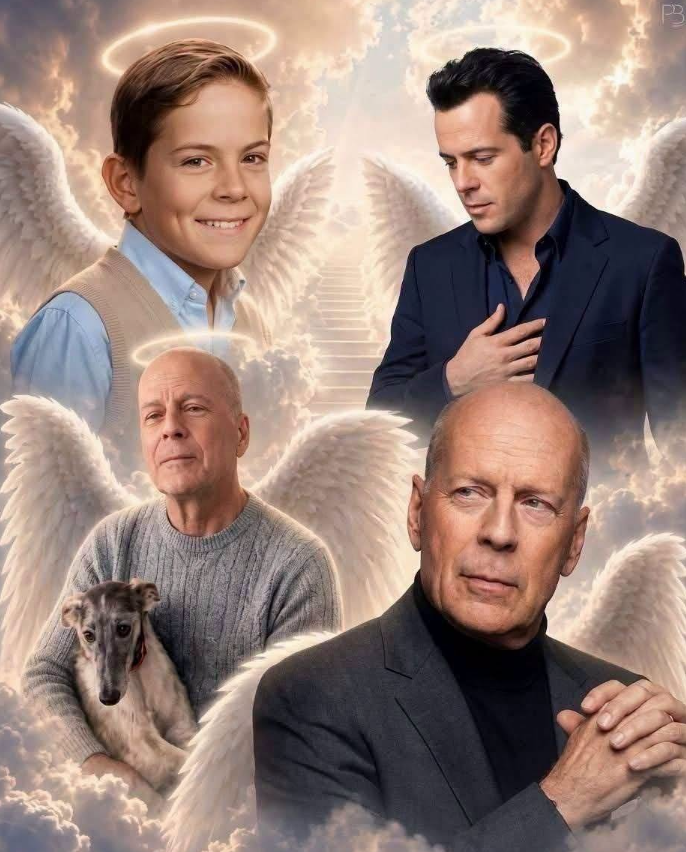
Goodbye to a Legend? The Emotional Story of Bruce Willis, His Legacy, and the Family Standing Beside Him
For generations of movie fans, the name Bruce Willis has represented courage, determination, humor, and one of Hollywood’s most recognizable action heroes.
From Die Hard to Pulp Fiction, The Sixth Sense, Armageddon, The Fifth Element, Unbreakable, and countless other films, Willis built a career that transformed him from a television star into one of the most familiar faces in American cinema.
Today, however, conversations about Bruce Willis are no longer focused primarily on box-office numbers or movie premieres. They are increasingly about family, love, memory, and the difficult reality of his health journey.
And despite dramatic social-media headlines suggesting otherwise, Bruce Willis has not died. Recent reports continue to describe him as living with frontotemporal dementia, while his family remains closely involved in his care.
A Career That Became Part of Hollywood History
Bruce Willis first became widely known for his role as David Addison on the television series Moonlighting. His combination of humor, charisma, and toughness made him stand out immediately.
Then came the role that changed everything.
In 1988, Willis appeared as John McClane in Die Hard. Unlike many traditional action heroes of the era, McClane was not presented as an unstoppable superhero. He was vulnerable, sarcastic, frightened, and often injured — but he kept going.
That character became one of the defining action heroes of modern cinema.
Willis continued to demonstrate his range in films that went far beyond action movies. His performance in Pulp Fiction showed a different side of his acting ability, while The Sixth Sense introduced him to a new generation of viewers.
Over more than four decades, he appeared in more than 100 films, leaving behind an enormous body of work.
The News That Changed Everything
In 2022, Willis’s family announced that he was stepping away from acting after being diagnosed with aphasia, a condition that can affect communication.
The following year, his family announced a more specific diagnosis: frontotemporal dementia, commonly known as FTD.
The announcement was heartbreaking for fans who had spent decades watching Willis portray characters who always seemed capable of overcoming impossible circumstances.
But dementia does not follow the rules of a Hollywood action movie.
There is no dramatic final scene in which the hero simply defeats the enemy. Instead, families face a long and complicated journey filled with difficult days, small victories, uncertainty, and moments of profound love.
His Family Has Become His Greatest Support
One of the most moving parts of Willis’s story has been the way his family has remained united around him.
His wife, Emma Heming Willis, has spoken openly about the realities of caring for someone with dementia and has worked to raise awareness about the condition.
His daughters have also shared glimpses of their relationship with their father.
Rumer Willis, his eldest daughter with Demi Moore, has recently offered especially emotional updates.
In an August 2026 interview, Rumer described her father as happy and said that when she visits him with her daughter Louetta, Bruce recognizes them and smiles. She emphasized the love and tenderness that remain within their relationship.
Those moments may appear small to outsiders.
For a family, however, they can mean everything.
A Rare Public Appearance
In August 2026, Bruce Willis made a rare public appearance at the wedding of his daughter Tallulah Willis.
The appearance attracted enormous attention because Willis has largely stayed away from the public spotlight since his diagnosis.
Photographs from the wedding showed him alongside his family, providing fans with a brief glimpse of the beloved actor.
For longtime admirers, seeing Willis at such an important family celebration was deeply emotional.
It was not a movie premiere.
There was no red carpet.
There were no cameras waiting for a performance.
It was simply a father supporting his daughter on one of the most important days of her life.
That made the moment particularly meaningful.
What “Goodbye” Really Means
The phrase “goodbye to a legend” can be especially powerful when discussing someone whose career has already become part of cultural history.
But in Bruce Willis’s case, it should not be interpreted as an announcement of his death.
Instead, it can represent saying goodbye to an era.
The era of seeing Willis regularly appear on movie posters, television interviews, premieres, and award shows has largely passed.
The action star who once ran through explosions and battled villains on screen is now living a much quieter life surrounded by the people who love him.
That transition is painful for fans.
Yet there is also something beautiful about it.
A person’s value does not disappear when they stop working.
Bruce Willis does not need another blockbuster movie to prove his importance.
His legacy has already been established.
More Than John McClane
For millions of fans, Willis will forever be John McClane.
But his legacy is much larger than one character.
He helped redefine what an action hero could look like. He brought humor and vulnerability into roles that could otherwise have been one-dimensional.
He also demonstrated that an actor could move between genres successfully, appearing in dramas, comedies, thrillers, science-fiction films, and action movies.
His performances became part of people’s lives.
Some fans remember watching Die Hard with their parents.
Others discovered The Sixth Sense as teenagers.
Some grew up quoting lines from his movies or watching his films during family movie nights.
That is the true meaning of a Hollywood legacy.
It is not simply the number of films someone made.
It is the memories those films created.
A Different Kind of Strength
There is an irony in Bruce Willis’s story.
For much of his career, he played men who refused to give up.
His characters were often beaten, injured, exhausted, and pushed to their limits — yet they continued moving forward.
Now, his real-life story has revealed a different kind of strength.
It is the strength of accepting circumstances that cannot simply be defeated.
It is the strength of family members who continue showing up.
It is the strength of finding happiness in a smile, a visit, a familiar face, or a family celebration.
And it is the strength of allowing someone to remain loved even when life changes dramatically.
His Legacy Lives On
Bruce Willis’s condition has changed his life, but it cannot erase the decades of work that came before it.
His movies remain.
His performances remain.
His characters remain.
And the memories created by those performances remain with audiences around the world.
At the same time, his family’s recent updates remind people that there is still a person behind the legend — a father, husband, grandfather, and loved one.
That is perhaps the most important part of the story.
Bruce Willis is not simply an action hero frozen forever on a movie screen.
He is a real person experiencing a difficult chapter of life.
And while fans may mourn the end of his Hollywood career, there is no reason to write his final goodbye while he is still here.
For now, the most appropriate message is not farewell.
It is gratitude.
Thank you for the movies.
Thank you for the laughter.
Thank you for the unforgettable characters.
And most importantly, thank you for reminding generations of fans that sometimes the greatest legacy is not the fame someone leaves behind — but the love that remains around them when the spotlight fades.