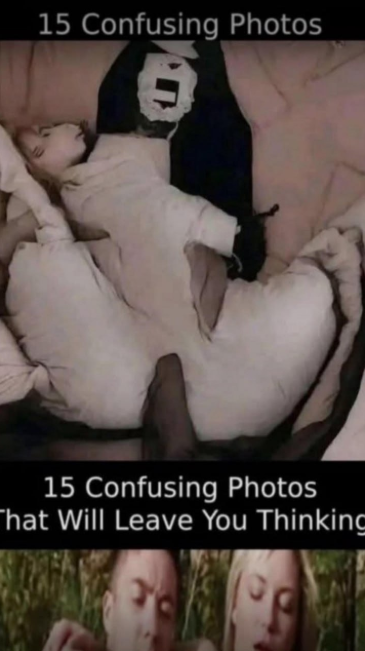
15 Brain-Confusing Photos That Need to Be Analyzed
Some photographs are easy to understand the moment you see them. You look at the picture, recognize what is happening, and move on.
Then there are those rare photographs that make you stop completely.
You stare at the screen.
You zoom in.
You turn your head.
You look again.
And eventually, you realize that your brain simply interpreted the image incorrectly.
Photography can capture an unusual moment, an unexpected angle, a strange reflection, or a perfectly timed coincidence. When several of these elements come together, the result can be incredibly confusing. The photograph itself may be completely ordinary, but the way it was captured creates an optical puzzle.
Here are 15 types of brain-confusing photographs that prove you should never trust your first impression.
1. The Floating Person
Imagine seeing someone apparently floating several feet above the ground.
At first glance, it looks impossible.
But the explanation is usually much simpler. The person may be standing on a platform hidden by the camera angle, or their feet may be positioned behind an object that creates the illusion of empty space underneath them.
Our brains naturally try to establish where objects are positioned in relation to the ground. When that information is blocked, the brain fills in the missing details—and sometimes gets the answer completely wrong.
2. The Giant Dog
Perspective can transform an ordinary pet into what appears to be a gigantic animal.
A dog standing close to the camera can look enormous compared with a person or building in the background. The viewer may initially think the animal is unusually large.
Of course, nothing strange is happening.
It is simply a matter of distance.
Objects closer to the camera appear larger than objects farther away. When the photograph removes obvious depth cues, our brains can struggle to judge the actual scale of everything in the scene.
3. Is That a Person or a Statue?
Sometimes a person standing perfectly still can look remarkably similar to a statue.
Clothing, lighting, posture, and facial expression can all contribute to the confusion. If the person happens to be standing near an actual sculpture, the effect becomes even stronger.
The human brain is remarkably good at recognizing faces and bodies, but it also relies heavily on movement and context. Remove those clues, and even a living person can temporarily look like part of the scenery.
4. The Disappearing Legs
One of the most common photographic illusions happens when someone’s legs appear to disappear.
Two people may be sitting next to each other, wearing similarly colored clothing. Their bodies overlap in just the right way, creating the appearance that one person’s legs belong to the other.
Nothing has actually disappeared.
The clothing simply creates a visual connection that tricks the brain into grouping separate body parts together.
Once you figure out the positioning, the photograph suddenly makes perfect sense.
5. The Headless Person
A perfectly timed photograph can make someone appear to have no head.
This usually happens when an object, another person’s body, or a structural feature lines up exactly with the subject’s neck.
The result can look bizarre at first.
But this is an excellent example of how photography freezes a single moment. If the photographer had moved just a few inches to either side, the illusion would probably have disappeared instantly.
6. The Mysterious Reflection
Reflections are another reliable source of confusion.
Windows, mirrors, puddles, polished surfaces, and even sunglasses can create images that seem to contradict reality.
A reflection may make it appear as though an object exists in a different location. Sometimes two separate scenes overlap in one photograph, forcing the viewer to figure out which elements are real and which are reflections.
The brain usually assumes that light behaves in familiar ways, so unusual reflections can be surprisingly difficult to interpret.
7. The Impossible Shadow
Shadows provide important information about where objects are located.
That’s why an unusual shadow can completely confuse us.
A photograph might show a shadow that seems to belong to an object positioned somewhere else. The explanation may involve multiple light sources, unusual architecture, or simply an unexpected angle.
Because we instinctively use shadows to understand depth and direction, a strange shadow can make the entire photograph feel wrong.
8. The Person With an Enormous Head
Sometimes perspective produces a hilarious illusion in which someone’s head appears dramatically larger than their body.
This can happen when a person leans toward the camera while their body remains farther away.
The camera captures the head at a much larger apparent scale than the rest of the body.
Our brains know that human proportions are relatively consistent, so the image immediately looks strange.
It is not the person who has unusual proportions.
It is the photograph.
9. The Animal With a Human Face
Animals can occasionally appear to have human characteristics because of their facial markings, posture, or position.
A dog looking sideways might appear to have a human-like expression. A cat’s markings may create the impression of eyebrows or another face.
These images take advantage of a phenomenon known as pareidolia—the tendency of humans to recognize familiar patterns, particularly faces, in random shapes and objects.
That is why people see faces in clouds, buildings, trees, and even pieces of toast.
10. The Door That Doesn’t Make Sense
Architecture can create some spectacular visual puzzles.
A doorway photographed from an unusual angle may appear to lead somewhere impossible. A staircase can seem to bend in the wrong direction. A narrow hallway may look dramatically longer than it actually is.
Lines and perspective are responsible for much of the confusion.
When photographs remove the surrounding context, the viewer has fewer clues for understanding the actual geometry of the scene.
11. The Tiny Person
Just as perspective can make objects look enormous, it can also make people appear incredibly small.
A person standing far away from the camera may appear miniature when positioned next to a nearby object.
If the background provides few clues about distance, the effect can be remarkably convincing.
It is another reminder that photographs flatten a three-dimensional world into a two-dimensional image.
12. The Clothing Illusion
Sometimes clothing creates the most confusing part of a photograph.
Two people wearing similar colors may appear connected. A patterned shirt can seem like part of the background. A person’s arm can appear to belong to someone else.
These illusions are especially common in crowded photographs because multiple bodies overlap.
The brain tries to organize the visual information quickly, grouping objects according to color, shape, and proximity.
Sometimes that shortcut produces a completely incorrect interpretation.
13. The Upside-Down World
An image taken upside down—or one containing an unusual orientation—can make an ordinary scene seem completely bizarre.
Buildings, people, furniture, and landscapes all depend on familiar orientation cues.
When those cues are reversed, the brain needs additional time to understand what it is seeing.
An ordinary room can suddenly look like an impossible architectural space.
14. The Perfectly Timed Moment
Timing is perhaps the most entertaining source of photographic confusion.
A ball can appear frozen inches from someone’s face. A bird can seem to sit perfectly on someone’s head. A splash can form an impossible shape. Someone jumping can appear to be floating.
These moments may last only a fraction of a second.
The photographer simply happened to press the shutter at exactly the right—or wrong—moment.
The resulting picture captures something the human eye might barely have noticed in real time.
15. The Photograph That Makes You Look Twice
Finally, there are photographs that combine several confusing elements at once.
Perhaps someone is positioned behind another person. A reflection overlaps the background. An object appears to float. Perspective changes the apparent size of everything.
At first glance, the image looks impossible.
Then you begin analyzing it.
You follow the outlines.
You identify individual people.
You trace shadows.
You look for reflections.
You examine the background.
Eventually, the mystery begins to unravel.
And that’s what makes these photographs so entertaining.
Why Our Brains Get Fooled
The human brain is designed to process enormous amounts of visual information quickly. Most of the time, this works extremely well.
We don’t consciously analyze every shadow, distance, shape, and perspective line around us. Instead, the brain makes rapid predictions based on experience.
Photography can exploit those shortcuts.
A camera freezes a moment that the brain would normally experience as movement. It compresses three dimensions into two. It can remove context, distort perspective, capture reflections, and combine objects that would normally be separated by motion.
The result is a visual puzzle.
The most confusing photographs aren’t necessarily edited or manipulated. Sometimes reality itself provides everything necessary to fool us.
That’s why these images are so fascinating.
They remind us that seeing something isn’t always the same as understanding it.
So the next time you encounter a photograph that looks completely impossible, don’t immediately assume it has been edited.
Look again.
Zoom in.
Follow the shadows.
Check the reflections.
Study the background.
Look at where everyone’s hands and feet are positioned.
There is often a perfectly ordinary explanation hiding inside an extraordinary-looking image.
And sometimes, discovering that explanation is even more satisfying than seeing the photograph in the first place.
After all, the best optical illusions don’t require special effects.
They only require one perfectly timed moment, one unusual perspective, and a brain that is just a little too confident about what it thinks it sees.