
This Photo Looks Completely Impossible at First — But There’s a Clever Reason Your Brain Gets Fooled
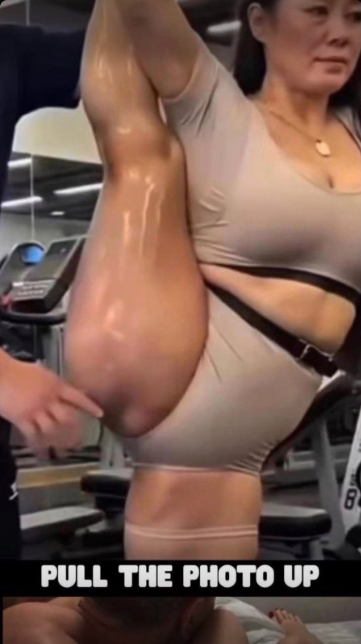
At first glance, the photograph appears to show a woman in a gym performing an extraordinarily flexible movement. Her raised leg dominates the foreground, creating an unusual shape that seems almost disconnected from the rest of her body. The composition is so unexpected that many viewers may immediately wonder whether the image has been edited, manipulated, or somehow captured from an impossible angle.
That reaction is exactly what makes the photograph so interesting.
Rather than focusing on the woman’s appearance, the real story behind an image like this is perspective. Photography can make ordinary physical arrangements look extraordinary because a camera turns a three-dimensional environment into a flat, two-dimensional frame. Our brains normally use numerous depth cues to understand what is close, what is far away, and how large objects really are. A photograph can remove or distort some of those cues, creating a visual puzzle.
The First Look Is Misleading
When people encounter a strange photograph, they naturally try to interpret it as quickly as possible.
The brain does not carefully measure every line, angle, distance, and object before deciding what it sees. Instead, it uses familiar patterns and visual shortcuts. This is useful in everyday life because humans need to recognize objects and understand their surroundings almost instantly.
But those shortcuts can occasionally work against us.
In the photograph, the unusual positioning of the woman’s body, the camera angle, and the surrounding gym equipment combine to create an image that initially looks far more confusing than the real-life scene probably was.
The foreground appears disproportionately large because it is much closer to the camera than other parts of the scene. When an object or body part is close to a camera, it can occupy a surprisingly large portion of the frame.
At the same time, elements farther away appear smaller.
That difference in scale can dramatically change the way a photograph is interpreted.
Why Perspective Matters So Much
Perspective is one of the most important tools photographers use to create the appearance of depth.
In the real world, we have two eyes working together, along with movement, shadows, familiar object sizes, overlapping shapes, and other clues that help us estimate distance. A conventional photograph, however, records the scene from a single viewpoint and compresses the three-dimensional world into two dimensions.
That compression can produce some fascinating results.
Forced perspective is a well-known photographic technique that deliberately manipulates the relationship between objects and the camera so that something appears larger, smaller, closer, or farther away than it really is.
The classic examples are familiar: someone appears to hold up the Leaning Tower of Pisa, pinch the sun between their fingers, or hold another person in the palm of their hand.
The objects aren’t actually interacting in the way the photograph suggests.
The camera simply captures them from a particular angle.
The Gym Makes the Effect Even More Interesting
A gym is actually an excellent setting for unusual perspective photographs.
There are mirrors, machines, benches, cables, weights, flooring patterns, and other objects arranged at different distances from the camera. These elements create numerous lines and shapes that can either clarify or confuse the viewer’s understanding of depth.
In this particular photograph, the equipment in the background provides context while the subject in the foreground dominates the frame.
That contrast makes the unusual pose appear even more dramatic.
The viewer may instinctively compare the foreground shape with the size of the woman’s torso and the objects behind her. Because those elements are at different distances, however, their apparent sizes cannot be compared as though they were sitting on the same plane.
That’s one reason the image can produce such a strong “wait, what?” reaction.
Why the Brain Needs a Second Look
The funniest thing about optical illusions is that knowing something is an illusion does not necessarily make it disappear.
You can understand the trick and still experience the strange visual effect.
That’s because perception happens automatically.
The brain receives information from the eyes and attempts to construct a coherent explanation. When the available information is ambiguous, it chooses the interpretation that seems most likely.
Photographers can exploit this tendency by arranging objects in ways that make one interpretation appear more convincing than another.
Forced perspective specifically takes advantage of the fact that a photograph provides fewer depth cues than direct observation. When the visual information is carefully arranged, the brain may initially assume that objects are closer together—or differently proportioned—than they actually are.
Camera Position Can Change Everything
One of the most important details in an image like this is the camera’s position.
Move the camera a few inches and the entire illusion can change.
Move it higher, and the relationship between the foreground and background changes.
Move it lower, and different parts of the body or equipment may overlap.
Move it sideways, and shapes that previously appeared connected may suddenly separate.
This is why perspective photography often requires experimentation. A photographer may take several images before finding the one position where everything lines up perfectly.
The final photograph can look spontaneous even when the composition required considerable trial and error.
It’s Not Necessarily About Digital Editing
When people see an impossible-looking photograph, one of their first assumptions is often Photoshop.
Sometimes that assumption is correct. Digital editing can certainly alter photographs in extraordinary ways.
But not every strange image has been digitally manipulated.
Many optical illusions can be created entirely in-camera through positioning, lighting, camera height, focal length, and timing. Photography guides describe forced perspective as a technique that can produce these effects without requiring elaborate digital manipulation.
That distinction is important.
A photograph can be completely authentic as a record of what the camera captured while still presenting a misleading impression of what actually happened in three-dimensional space.
In other words, the picture can be real while the first interpretation is wrong.
Why These Images Go Viral
There’s another reason photographs like this attract attention: curiosity.
A normal photograph can be appreciated in a second and then forgotten.
An optical illusion demands another look.
People zoom in.
They rotate their phones.
They examine the background.
They look for reflections.
They compare different parts of the image.
Then they send the photograph to someone else and ask, “Can you figure this out?”
That simple interaction makes illusion photographs particularly effective on social media.
They encourage participation rather than passive viewing.
Instead of merely looking at the picture, viewers become investigators.
The Caption Can Make It Even More Confusing
Short captions often add another layer to these viral images.
A phrase such as “pull the photo up” encourages viewers to manipulate the image or look more carefully at its lower portion. The instruction itself creates anticipation, making the viewer expect a hidden detail or second perspective.
That technique is common in viral content because it turns an ordinary photograph into a mini-puzzle.
The viewer isn’t simply being shown an image.
They’re being challenged to solve it.
The Bigger Lesson
The photograph is a good reminder that seeing is not always the same as understanding.
Our eyes collect visual information, but our brains interpret that information. Perspective, scale, shadows, overlapping objects, and camera position all influence that interpretation.
Photography can exploit those mechanisms to create images that appear impossible.
The next time a photograph makes you stop and say, “There is no way that’s real,” it may be worth taking a second look before reaching for an explanation.
Look at the background.
Look at the edges of objects.
Look at where the camera appears to be positioned.
Look for changes in scale.
Notice which objects overlap.
Often, the answer is hiding in plain sight.
And that’s what makes photographs like this so entertaining. They don’t necessarily require elaborate special effects or complicated technology. Sometimes, all it takes is an unusual pose, a carefully chosen camera angle, and the remarkable ability of human perception to fill in the gaps.
What initially appears impossible may simply be perspective doing what perspective does best: turning an ordinary three-dimensional moment into a two-dimensional mystery.
