Trump Clashes With CNN Reporter as Heated White House Exchange Sparks Debate Over Press Freedom
A tense confrontation between President Donald Trump and CNN correspondent Kristen Holmes has renewed a familiar debate in Washington: how far can a president go when challenging a reporter, and where should the line be drawn between political criticism and personal attacks?
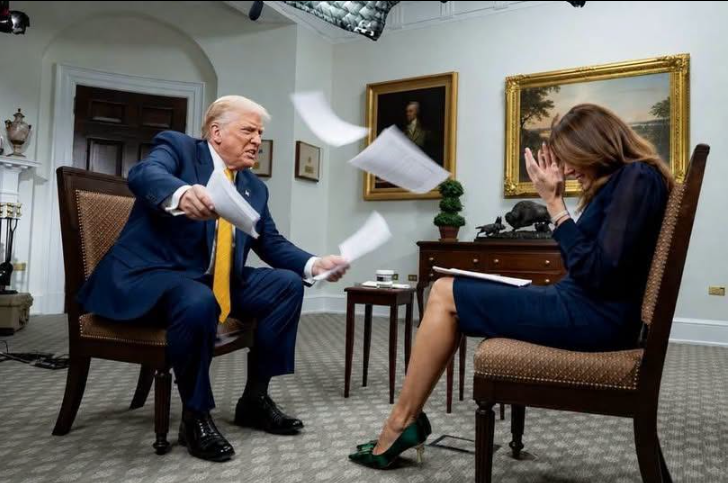
The incident occurred during an Oval Office appearance on August 17, 2026, when Holmes attempted to question Trump about remarks made by Democratic Sen. Jon Ossoff concerning one of the president’s aides, Natalie Harp. Rather than engaging directly with the question, Trump interrupted Holmes and told her to stop speaking, calling her a “fake reporter” and accusing her of spreading “fake news.”
The exchange quickly attracted attention because it was not simply another disagreement between a politician and a journalist. It became part of a broader argument over the increasingly combative relationship between the Trump administration and major news organizations.
According to reports, Holmes asked Trump about Ossoff’s criticism involving Harp. The president responded sharply, objecting to the framing of the question and directing his criticism at the reporter herself. The confrontation was captured during the Oval Office event and subsequently circulated widely.
Trump has a long history of criticizing CNN and other news organizations. Throughout his political career, he has frequently accused major media outlets of unfair coverage and has used terms such as “fake news” to describe reporting he believes is hostile to him.
The latest confrontation therefore did not occur in isolation. Instead, it reflected a political style that has become one of the defining features of Trump’s relationship with the press.
The White House subsequently intensified its criticism of Holmes. A White House-linked social media account attacked the reporter after the exchange and even invoked her children, prompting further criticism from CNN and others. The Washington Post reported that the official account suggested Holmes’s children would be embarrassed by her conduct.
That development transformed what might otherwise have been a brief presidential exchange into a larger controversy.
CNN defended Holmes, describing the personal attacks as inappropriate and arguing that journalists should be able to ask difficult questions without becoming targets of attacks directed at their families. The Guardian similarly reported that CNN characterized the White House response as beneath the dignity expected from the presidential office.
Supporters of Trump, however, have offered a very different interpretation.
They argue that journalists covering the president should expect strong pushback when they ask questions that Trump considers unfair, provocative or based on partisan criticism. From this perspective, Trump’s aggressive response is part of his broader willingness to challenge media organizations he believes are biased against him.
Critics see the situation differently.
They argue that the president possesses an extraordinary platform and therefore has a responsibility to distinguish between criticizing a reporter’s work and attacking the reporter personally. When criticism expands to include a journalist’s family, opponents say, the dispute crosses a significant line.
The controversy also highlights the difficult position faced by White House correspondents.
Reporters such as Holmes work in an environment where they must ask questions directly and sometimes confrontationally. Their responsibility is not necessarily to make the president comfortable. Their role is to seek information, challenge claims and press officials for answers on behalf of the public.
That can inevitably create conflict.
Presidents, meanwhile, have their own responsibilities. They are expected to communicate their positions clearly, defend their policies and respond to criticism. Trump has consistently argued that traditional media organizations often portray him unfairly, and his confrontations with journalists have become a recognizable part of his political identity.
The latest clash therefore represents two competing views of the media’s role in American democracy.
One side sees aggressive questioning as essential to accountability. The other sees certain questions as evidence of media bias and believes public officials have every right to push back.
The argument becomes particularly complicated when the president himself becomes part of the story.
A presidential confrontation with a reporter can dominate news coverage, sometimes pushing the original policy question into the background. Instead of discussing the substance of an issue, audiences end up debating whether the president was justified in criticizing the journalist.
That dynamic can benefit both sides politically. Trump can demonstrate to supporters that he is willing to confront news organizations directly, while media organizations can highlight what they view as an example of presidential hostility toward journalism.
The public is then left to decide which interpretation is more convincing.
The controversy surrounding Holmes also comes amid increased attention to the White House communications operation. Recent reporting has described the administration’s press strategy as unusually confrontational, with officials frequently engaging reporters and critics through social media.
That strategy reflects the changing nature of political communication.
Presidents no longer rely exclusively on traditional press conferences, newspapers or television interviews. Social media allows administrations to respond almost instantly to criticism, sometimes turning a dispute with an individual reporter into a national political story within minutes.
The downside is that such rapid responses can escalate conflicts before there is time for reflection.
In the Holmes case, the original question concerned political criticism of a presidential aide. Within hours, the story had become a debate about presidential rhetoric, journalism, family members and the broader relationship between the White House and the press.
That transformation demonstrates how quickly political controversies can grow in the modern media environment.
It is also important to separate verified facts from exaggerated versions of viral headlines. Social-media posts frequently turn confrontations into sensational claims, sometimes suggesting that a reporter accused a president of something far more serious than what actually occurred. In this case, available reporting describes Holmes questioning Trump about comments involving Natalie Harp and Trump responding angrily; it does not establish the dramatic accusation implied by some abbreviated viral headlines.
That distinction matters.
A headline designed to provoke an emotional reaction can spread much faster than a carefully reported account. Readers may encounter a short phrase suggesting that Trump was accused of “killing” someone or being responsible for a death, even when the underlying event involved a completely different subject.
The safest approach is therefore to examine what the reporter actually asked, what the president actually said, and what was subsequently reported by established news organizations.
The confrontation between Trump and Holmes nevertheless remains significant because it illustrates the continuing tension between the presidency and the press.
Trump’s supporters are likely to view his response as another example of a president refusing to be intimidated by journalists. His critics are likely to see it as evidence that the administration is becoming increasingly hostile toward independent reporting.
Both interpretations are likely to remain part of the political conversation.
Ultimately, the larger question goes beyond one president, one reporter or one television network.
A healthy democracy requires journalists who are willing to ask difficult questions and public officials who are willing to answer them. Disagreement is inevitable. Sharp exchanges are sometimes unavoidable. But the quality of democratic debate depends on whether those disagreements remain focused on facts, policies and public accountability rather than becoming personal battles.
The Trump-Holmes confrontation has once again placed that question under a national spotlight.
For now, the episode stands as another chapter in the unusually contentious relationship between Donald Trump and the American news media. It also serves as a reminder that in an era of instant social-media reactions and increasingly polarized politics, a few seconds of confrontation in the Oval Office can become a national controversy almost immediately.
And as long as presidents and journalists continue to challenge one another in front of the cameras, debates over where legitimate criticism ends and personal attacks begin are unlikely to disappear.