South Korea Surrenders? The Viral Claim About America, North Korea, and a Possible Push for Peace
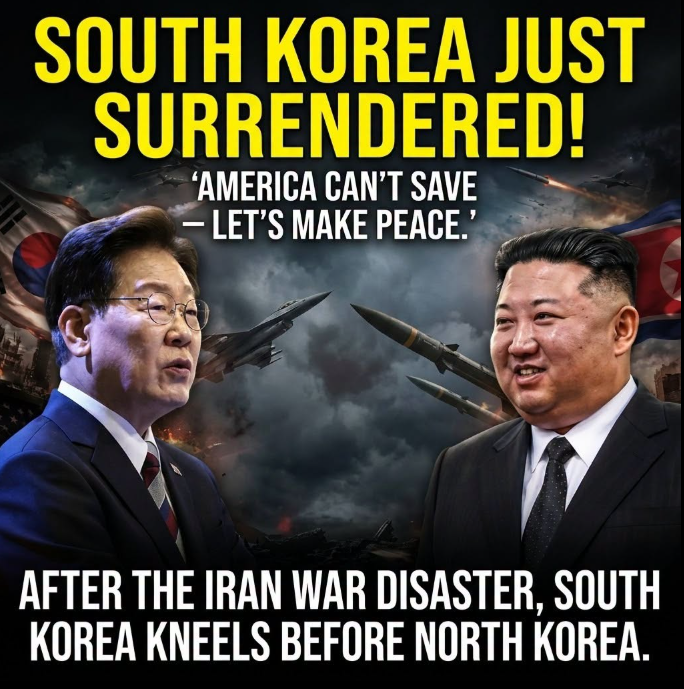
A dramatic claim circulating online says, “South Korea surrenders! America can’t save us — let’s make peace with North Korea!” The headline is designed to sound like a historic turning point: South Korea supposedly abandoning its alliance with the United States and choosing reconciliation with North Korea instead.
But before accepting such a dramatic statement as fact, it is important to separate political rhetoric, speculation, and social-media sensationalism from verified developments. A headline suggesting that South Korea has “surrendered” does not automatically mean that the South Korean government has actually capitulated to North Korea or ended its alliance with Washington.
The relationship between South Korea and the United States is one of the most significant security partnerships in East Asia. For decades, the two countries have maintained a military alliance intended to deter aggression on the Korean Peninsula. Thousands of U.S. service members are stationed in South Korea, while the South Korean military remains one of the world’s most capable armed forces.
That reality makes any genuine decision by Seoul to abandon the United States extremely consequential.
Why the Headline Is So Powerful
The phrase “America can’t save us” appeals directly to fears about whether the United States would intervene in a future conflict with North Korea. It also raises a question that has existed for decades: If another Korean war were to begin, how far would Washington go to defend Seoul?
South Korea has historically relied heavily on the U.S. security commitment while simultaneously developing its own military capabilities. The country possesses advanced fighter aircraft, missile-defense systems, naval forces, artillery, surveillance capabilities, and a large standing military.
North Korea, meanwhile, maintains one of the world’s largest conventional militaries and possesses nuclear weapons and ballistic missiles. Pyongyang has repeatedly threatened South Korea and the United States, although it has also periodically expressed interest in dialogue.
This complicated environment makes peace negotiations attractive to many people, particularly when tensions rise.
Could South Korea Really Choose Peace With North Korea?
Peace between the two Koreas is not an impossible idea. In fact, governments on both sides have repeatedly discussed reconciliation, economic cooperation, family reunification, military confidence-building, and eventually a more permanent peace arrangement.
The problem is that the two governments have fundamentally different political systems and security objectives.
North Korea’s government has long demanded security guarantees and an end to what it describes as hostile policies by the United States and South Korea. Washington and Seoul, on the other hand, have consistently emphasized deterrence and the need to address North Korea’s nuclear and missile programs.
A peace agreement would therefore require much more than a single announcement.
It would involve difficult negotiations over military deployments, nuclear weapons, sanctions, borders, verification mechanisms, and the future of the Korean Peninsula.
The Fear Behind the Debate
One reason sensational headlines gain attention is that people understand how devastating another Korean war could be.
Seoul lies relatively close to the heavily fortified border with North Korea. A major conflict could create enormous civilian casualties, disrupt global markets, threaten supply chains, and involve some of the world’s most powerful militaries.
South Korea is also a major global economic power. Companies based there play important roles in semiconductors, automobiles, electronics, shipbuilding, batteries, and other industries.
A conflict would therefore have consequences far beyond Korea.
For ordinary South Koreans, however, the question is more immediate: How can the country prevent war?
That question has produced different answers.
Some believe that maintaining a powerful alliance with the United States is the safest strategy because a strong deterrent can discourage North Korea from attacking.
Others argue that diplomacy should receive greater emphasis and that reducing military tensions could create opportunities for long-term peace.
These positions can coexist. Supporting the U.S.-South Korean alliance does not necessarily mean opposing dialogue with North Korea.
What “Surrender” Actually Means
The word “surrender” is especially important.
In military terms, surrender generally means accepting defeat and submitting to an opposing force. If South Korea had truly surrendered to North Korea, it would represent an extraordinary geopolitical event.
It would imply the collapse of South Korea’s existing defense strategy, potentially the termination or transformation of its alliance with the United States, and an entirely new political order on the peninsula.
There is no reason to interpret a provocative social-media headline as proof of such an event without reliable evidence.
Political leaders can call for peace without surrendering.
Governments can seek negotiations without abandoning military alliances.
And citizens can criticize their country’s security policy without the country itself changing its national strategy.
This distinction is crucial when evaluating viral content.
The United States and South Korea
The U.S.-South Korean alliance was established after the Korean War and has evolved over many decades.
The two countries conduct military exercises, share intelligence, cooperate on missile defense, and coordinate their responses to North Korean activity.
The alliance also has a political and economic dimension.
South Korea is an important American partner in the Indo-Pacific, while the United States has significant economic interests in South Korea.
That means any serious move to fundamentally alter the alliance would likely produce intense debate in Seoul, Washington, and throughout the region.
Japan, China, Russia, and other governments would also closely watch such developments because the security balance on the Korean Peninsula affects the entire region.
Could Diplomacy Become More Important?
Despite the military tension, diplomacy remains one of the few realistic ways to reduce the danger of accidental escalation.
Direct communication between North and South Korea can help prevent misunderstandings. Negotiations can potentially establish rules for military encounters, reopen humanitarian programs, and create channels for crisis management.
The greatest challenge is trust.
Previous agreements have repeatedly broken down amid disagreements over military exercises, sanctions, nuclear weapons, missile testing, and political changes.
Still, history demonstrates that periods of extreme hostility can sometimes be followed by diplomatic openings.
That is why experts frequently emphasize keeping communication channels available even when relations are poor.
The Bigger Question
The real issue behind the viral headline is not simply whether South Korea has “surrendered.”
The deeper question is whether South Korea should rely primarily on military deterrence, diplomacy, or some combination of both.
There is no simple answer.
A strong defense can discourage aggression, but military strength alone cannot guarantee permanent peace.
Diplomacy can reduce tensions, but negotiations can fail if the parties do not trust one another.
An alliance can provide security guarantees, but alliances also create complicated political responsibilities.
South Korea therefore faces a delicate balancing act.
It must protect its population, maintain international partnerships, respond to North Korean threats, and still leave room for diplomacy.
Why Readers Should Be Careful With Viral Headlines
Social-media headlines often compress complicated geopolitical developments into a few dramatic words.
“South Korea Surrenders” is far more emotionally powerful than “South Korea debates future security policy.”
“America Can’t Save Us” is more likely to generate clicks than “Questions arise about the future of the U.S.-South Korean alliance.”
And “Let’s Make Peace With North Korea” sounds like an immediate national decision rather than a possible argument made by political figures or commentators.
That is why readers should look for the original statement, identify who made it, determine whether it represents government policy, and check whether reputable news organizations have independently confirmed it.
Conclusion
The claim that South Korea has surrendered and decided that America cannot save it should not be accepted at face value simply because it appears in a dramatic viral headline.
The Korean Peninsula remains one of the world’s most sensitive security environments, and calls for peace with North Korea are not the same thing as surrender.
South Korea’s relationship with the United States is deeply rooted in decades of military, political, and economic cooperation. At the same time, the desire to avoid another devastating war is understandable, and diplomacy remains an important part of any long-term strategy.
The most realistic path forward is unlikely to be defined by a single slogan such as “surrender” or “war.” It will depend on deterrence, diplomacy, communication, alliances, and difficult negotiations.
For now, the most important lesson is simple: when a geopolitical headline sounds shocking enough to change the world overnight, check the evidence before believing the headline.