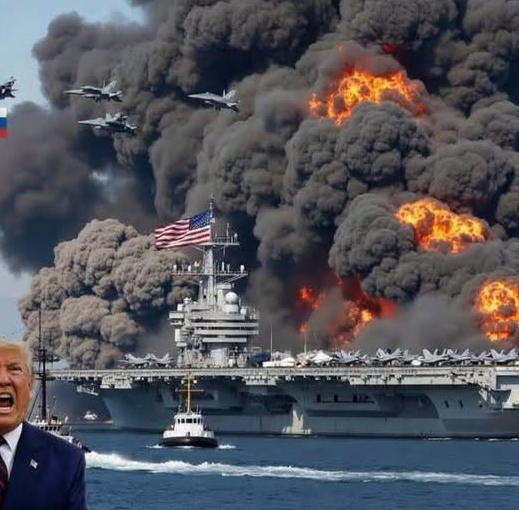
BREAKING: Did a Russian Su-57 Really Destroy a U.S. Aircraft Carrier Carrying 700 Tanks?
A dramatic headline claiming that a Russian Su-57 pilot destroyed a U.S. aircraft carrier carrying 700 tanks has exploded across social media, leaving readers asking whether the United States and Russia have just experienced an extraordinary military confrontation.
The headline sounds like the kind of event that would immediately dominate international news. A Russian fifth-generation fighter allegedly attacking and destroying a U.S. aircraft carrier would represent an extraordinary escalation between two nuclear-armed powers. The claim becomes even more dramatic with the addition that the vessel was supposedly carrying 700 tanks.
However, there is a major problem with the story: there is currently no credible confirmation that this event actually happened.
The exact headline is circulating across Facebook, YouTube, Instagram, Threads, and other platforms. Searches for the wording reveal numerous posts repeating essentially the same claim.
One website published a version of the story on August 19, 2026, but even that article acknowledged that the reports were unconfirmed and that no official confirmation had been released.
That distinction is extremely important.
A social-media headline is not evidence of a military attack. The more extraordinary the claim, the stronger the evidence required before it can responsibly be presented as fact.
Why the Story Sounds So Dramatic
The Su-57 is Russia’s advanced multirole fighter and is frequently portrayed in Russian military discussions as a key component of the country’s modern airpower. The aircraft has attracted significant attention because of its stealth characteristics, sensors, weapons systems, and role in Russia’s military modernization.
A U.S. aircraft carrier, meanwhile, is among the most heavily protected military assets in the world.
An American carrier does not operate alone. It normally functions as the centerpiece of a carrier strike group containing escorts, aircraft, surveillance systems, electronic warfare capabilities, and other defensive assets. That makes the idea of a lone fighter simply destroying such a vessel an extraordinary scenario requiring substantial evidence.
The claim becomes even harder to accept without corroboration when it says the carrier was carrying 700 tanks.
Aircraft carriers are designed primarily to transport and operate aircraft. Large quantities of armored vehicles are generally transported using specialized cargo ships, roll-on/roll-off vessels, amphibious ships, or other logistics platforms.
That does not mean a U.S. military vessel could never transport armored vehicles. Different types of military ships have different roles. But describing a conventional U.S. aircraft carrier as carrying 700 tanks should immediately prompt questions about the identity and type of vessel involved.
The Video Problem
One of the biggest reasons this story may appear convincing is the availability of dramatic video footage online.
Military-themed videos can look extremely realistic. Computer-generated imagery, video-game footage, simulations, and edited clips can all resemble genuine combat footage when presented without context.
In fact, one video carrying essentially the same headline is explicitly identified as an Arma 3 virtual game simulation.
That is a crucial warning sign.
Arma 3 is a military simulation game capable of producing realistic-looking combat scenarios. Clips from the game are frequently shared online without adequate labeling, sometimes accompanied by headlines describing fictional events as though they were real.
A viewer who sees aircraft, explosions, ships, missiles, and smoke may naturally assume the footage came from a battlefield. Without checking the original source, however, it can be impossible to distinguish simulation footage from genuine imagery.
This is why viral military videos should always be investigated before being treated as evidence.
What Would Happen If It Were Real?
If a Russian aircraft actually destroyed a U.S. aircraft carrier in an intentional attack, the consequences would be enormous.
The incident would not be an ordinary military story. It would potentially represent a direct attack by Russia against a major American military asset.
Washington would almost certainly be expected to respond at the highest levels. NATO allies would closely monitor developments. Military commanders would assess whether the incident was deliberate, accidental, or part of a broader confrontation.
Global financial markets could react sharply.
Energy prices could move dramatically.
Governments would issue emergency statements.
News organizations around the world would send reporters to investigate.
In other words, an event of this magnitude would be extremely difficult to keep hidden.
The absence of credible confirmation from major international news organizations is therefore highly significant.
Why “13 Minutes Ago” Headlines Spread So Quickly
The phrase “13 minutes ago” creates a powerful psychological effect.
It tells readers that they are supposedly seeing information before everyone else. That sense of urgency encourages people to click, comment, and share before verifying the claim.
But the timestamp of a social-media post does not prove that the event occurred 13 minutes earlier.
A post can be created today using an old story.
A video can be uploaded today even though the footage was created months or years ago.
A fictional simulation can be presented as breaking news.
An old photograph can be given a new caption.
This is one of the most common problems with viral misinformation.
The headline may technically be new, while the underlying material is not.
The “700 Tanks” Detail
The claim that the vessel carried 700 tanks is another element deserving scrutiny.
Seven hundred tanks represent an enormous quantity of heavy military equipment.
Modern main battle tanks are extremely large and heavy. Transporting hundreds of them requires substantial logistics planning, specialized infrastructure, fuel, crews, maintenance equipment, spare parts, ammunition, and transportation capacity.
A claim involving hundreds of tanks would therefore require considerable supporting evidence.
There should be documentation concerning the vessel, its route, cargo, port movements, satellite imagery, military statements, or other evidence.
At present, the viral claim does not provide that level of verification.
Why Russia and the Su-57 Are Being Used in Viral Stories
The Su-57 has become a popular subject for dramatic military content.
Its futuristic appearance, advanced technology, and relatively limited number of operational aircraft make it an attractive centerpiece for sensational stories.
Online creators can easily build narratives around hypothetical scenarios: one Su-57 defeating an aircraft carrier, destroying an advanced aircraft, penetrating an air-defense network, or carrying out an impossible-looking strike.
Such stories can generate enormous engagement.
But military capability and actual events are two completely different questions.
A fighter may theoretically possess weapons capable of threatening a particular target without having actually attacked that target.
Likewise, a military simulation can demonstrate a possible scenario without proving that the scenario occurred in reality.
The Importance of Independent Confirmation
When a claim concerns a major military confrontation, independent confirmation is essential.
Readers should look for statements from the U.S. Department of Defense, the Russian government, NATO, established international news agencies, and reputable defense publications.
Satellite imagery can also become important when a major ship is allegedly destroyed.
A U.S. aircraft carrier is a massive vessel. Its disappearance or destruction would produce extensive evidence.
There would likely be photographs, satellite observations, maritime tracking information, official statements, and reports from military personnel.
The more significant the event, the more difficult it would be for the evidence to remain limited to anonymous social-media posts.
The Real Lesson
The story is a powerful example of how modern misinformation works.
A sensational headline combines several emotionally powerful ingredients: Russia, America, a stealth fighter, an aircraft carrier, hundreds of tanks, destruction, and the phrase “13 minutes ago.”
Each element increases the sense of urgency.
Together, they create a story that feels enormous.
But feeling believable is not the same as being true.
The safest approach is to pause before sharing.
Ask where the story originated.
Check whether the video is genuine.
Search the exact headline.
Look for independent confirmation.
Determine whether the vessel described actually exists in the claimed configuration.
And pay attention to whether the source itself admits that the information is unconfirmed.
What We Can Say With Confidence
At this stage, the claim that a Russian Su-57 pilot destroyed a U.S. aircraft carrier carrying 700 tanks should not be presented as established fact.
The exact headline is circulating widely online.
A website repeating the claim acknowledges that there was no official confirmation when it published its version.
At least one video carrying the same claim is identified as a virtual Arma 3 simulation rather than genuine combat footage.
Those facts strongly suggest that readers should treat the viral story with extreme caution.
That does not mean every piece of footage associated with the claim is necessarily fabricated. It means that the available evidence does not establish that the alleged attack actually happened.
Final Thoughts
A Russian Su-57 destroying a U.S. aircraft carrier would be an extraordinary event with enormous geopolitical consequences. It would potentially represent a direct military confrontation between two of the world’s most powerful states.
Because of that, such a claim requires much more than a Facebook post, YouTube video, or dramatic headline.
Until credible authorities or multiple independent and reputable sources confirm the event, the responsible conclusion is that the story remains unverified and highly questionable.
The internet rewards speed, but history is written from evidence.
When a headline says something happened “13 minutes ago,” the best response is not necessarily to share it immediately.
Sometimes the smartest thing a reader can do is wait for the facts.