Justin Bieber Admits He Tested Positive for… What the Viral Headline Leaves Out
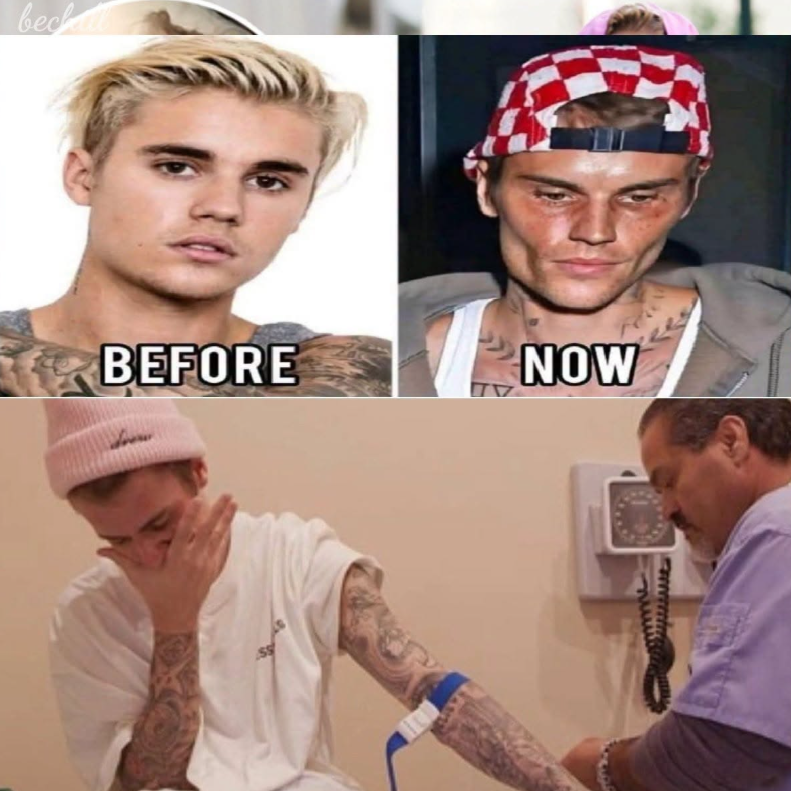
A dramatic social-media headline claiming that Justin Bieber “admits that he tested positive for…” has been circulating online, leaving fans wondering what the singer supposedly tested positive for and whether the claim represents a new health development.
The important detail is that the headline is incomplete. The available viral posts do not clearly identify the test or provide enough reliable information to establish a new diagnosis. Some versions appear to recycle older stories about Bieber’s health, while others use the unfinished phrase to encourage readers to click through to the comments.
That distinction matters, especially when the subject is a person’s health.
Justin Bieber has previously spoken publicly about several health challenges, so a vague headline about a positive test can easily cause confusion. In 2020, Bieber announced that he had been diagnosed with Lyme disease and said he had also been dealing with a chronic viral infection.
Two years later, he disclosed another serious health problem: Ramsay Hunt syndrome, a condition that caused facial paralysis. His health struggles affected his professional schedule and prompted an enormous response from fans around the world.
Bieber also tested positive for COVID-19 in February 2022. His representatives confirmed the positive result, and several Justice World Tour performances were postponed as a result.
Because those events are already part of Bieber’s public history, old information can easily be repackaged into a seemingly new breaking-news story.
The current viral wording appears to take advantage of that familiarity. A post saying that a celebrity “tested positive” immediately creates suspense. Readers may assume the missing word refers to a dangerous disease, a serious diagnosis, or another shocking revelation. But until the specific test is identified and supported by credible reporting, it is not responsible to fill in the blank with speculation.
This is particularly important because health information is personal.
Celebrities live under extraordinary public attention. Every photograph, appearance, performance, and social-media post can generate theories about their physical or emotional condition. Sometimes a person looking tired becomes evidence of an alleged illness. A change in appearance can lead to rumors. A postponed performance can trigger speculation about a medical emergency.
Those assumptions are not reliable medical evidence.
Bieber’s history demonstrates why caution is necessary. His Lyme disease diagnosis was publicly confirmed in 2020 after he addressed speculation about his health. At the time, he said he had experienced a difficult period and explained that he planned to discuss his condition more fully in his documentary series.
Later, his diagnosis of Ramsay Hunt syndrome became another major public health story. The condition caused one side of his face to become temporarily paralyzed, forcing him to cancel or postpone performances while he concentrated on recovery.
Then came the COVID-19 diagnosis in 2022. ABC News reported that Bieber’s representative confirmed the positive result and that the singer’s Las Vegas concert was postponed.
These events are real and documented. But they should not automatically be presented as evidence of a new diagnosis in 2026.
That is where social-media literacy becomes important.
When a post says “Justin Bieber admits that he tested positive for…” the first question should be: Positive for what?
The second question should be: When did this supposedly happen?
The third should be: Where did the information originate?
And the fourth should be: Has a credible news organization or Bieber’s representatives independently confirmed it?
Those questions can prevent an old story from becoming a new rumor.
There is also another problem with incomplete celebrity headlines: they can encourage readers to interpret unrelated information as connected. If Bieber posts something emotional, fans may connect it to the viral headline. If he appears exhausted, people may assume the appearance confirms a medical rumor. If he cancels an event, speculation may intensify.
None of those things proves a diagnosis.
A celebrity’s medical condition should be discussed based on confirmed statements, not photographs or guesses.
The public’s interest in Bieber’s health is understandable. He has been famous since he was a teenager, and millions of people have followed his career for years. Fans naturally become concerned when he talks about difficult periods in his life.
But concern and speculation are different things.
Concern means hoping someone is safe and wishing them well. Speculation means assigning a diagnosis without evidence. The first can be compassionate; the second can be harmful.
There is also a broader lesson here about viral headlines. Posts containing phrases such as “See More,” “you won’t believe,” “shocking,” or an unfinished sentence often depend on curiosity to generate clicks. The dramatic wording is designed to make the reader open another page, watch a video, or enter a comment section.
Sometimes the information underneath is genuine. Sometimes it is outdated. Sometimes it is exaggerated. And sometimes the headline is intentionally vague so that readers mentally fill in the most frightening possibility.
That is why the safest approach is to verify the actual claim.
For Bieber specifically, several confirmed health events are already well documented. His Lyme disease diagnosis was publicly announced in 2020. His Ramsay Hunt syndrome diagnosis was revealed in 2022. His COVID-19 infection was also confirmed in 2022, resulting in postponed performances.
Those facts provide important context, but they do not confirm that a new positive test has occurred now.
The distinction between past and present is especially important in online celebrity reporting. A story can be several years old yet suddenly become popular again because someone reposts it. A video may have been uploaded recently even though the event shown in the video happened years earlier.
The date of the post is therefore not necessarily the date of the event.
Readers should look for the date attached to the original report.
Bieber’s career also illustrates how health can intersect with professional responsibilities. Touring requires enormous physical and emotional energy. Performers travel between cities, rehearse for hours, perform under bright lights, interact with thousands of people, and maintain demanding schedules.
When illness occurs, postponing a show can be necessary.
Fans may be disappointed when a concert is canceled, but health and safety must come first. Bieber’s 2022 COVID diagnosis demonstrated this directly when tour performances were rescheduled following positive COVID results.
His previous health disclosures also show the importance of allowing recovery time rather than expecting a performer to continue working regardless of symptoms.
Ultimately, the viral headline should be treated as an invitation to verify information rather than proof of a new medical emergency.
There is no reliable basis in the sources reviewed here to state that Bieber has just announced a new positive test for a specific condition in August 2026. The wording circulating online is too incomplete to support such a conclusion.
That does not mean every post about Bieber’s health is false. It means the specific claim needs more evidence before it can responsibly be presented as breaking news.
Fans who are worried about the singer should look for direct statements from Bieber, his representatives, or established news organizations reporting specific and verifiable information.
In the meantime, his documented health history deserves to be discussed accurately and respectfully. Bieber has already been open about difficult experiences, including Lyme disease, Ramsay Hunt syndrome, and COVID-19.
The bigger lesson is simple: when a viral headline ends with “tested positive for…” and leaves the most important words hidden, don’t guess what comes next.
Wait for the facts.
A dramatic headline can generate millions of clicks, but only verified information can tell us what actually happened.