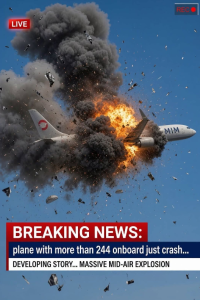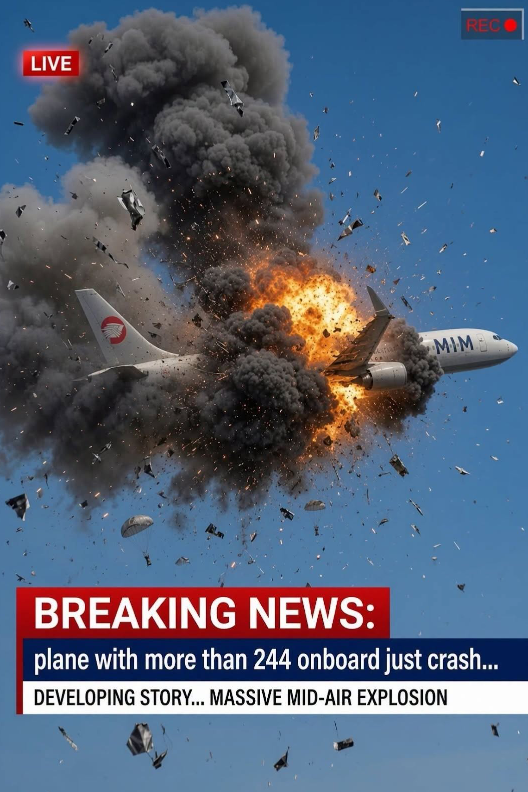
BREAKING: “Plane With More Than 244 Onboard Just Crashed” — What We Know About the Viral Claim
A frightening headline claiming that “a plane with more than 244 people onboard just crashed” is circulating again across social media, prompting alarm among readers and travelers.
The wording makes the event sound immediate and suggests that a major passenger-aircraft disaster has happened within the last few moments. However, there is currently no credible confirmation of a new crash today, August 19, 2026, matching that exact claim.
That distinction is important because the same or nearly identical headline has appeared repeatedly on social-media pages during 2026. Search results show versions of the claim appearing on Facebook as far back as July, with the wording presented as breaking news despite the lack of a clearly identified new accident.
The viral headline also appears to be borrowing language associated with a very real aviation disaster that occurred in 2025.
The Real Crash Behind Some Versions of the Story
On June 12, 2025, Air India Flight AI171 crashed shortly after taking off from Ahmedabad, India, while traveling to London Gatwick.
The Boeing 787-8 Dreamliner was carrying more than 240 people. Air India initially reported 242 passengers and crew members, while an Indian aviation official told the Associated Press that the total was 244, illustrating the confusion that can occur during the first stages of a major disaster.
The aircraft crashed into an area near Ahmedabad airport only minutes after departure.
The tragedy became one of the most closely watched aviation disasters of 2025.
ABC News subsequently reported that 246 people died, including people on the aircraft and people on the ground, while at least one passenger survived the crash.
Because the original flight was widely described in headlines as an aircraft carrying 244 people, that number has become associated with the disaster.
That appears to be one reason the wording can be recycled so effectively.
A Viral Headline Does Not Make a New Crash
The most important point for readers seeing the headline today is that a repeated social-media post should not be interpreted as confirmation of a new accident.
Several Facebook posts continue to display essentially the same wording, including posts using phrases such as “RIGHT NOW” and “JUST CRASH.”
But the posts do not establish the basic facts that would normally accompany a genuine breaking aviation emergency.
There is no clearly identified airline.
There is no flight number.
There is no confirmed crash location.
There is no aircraft registration.
There is no statement from an aviation authority confirming a new disaster.
Those omissions are significant.
Why the Number 244 Gets Attention
The number 244 makes the headline sound highly specific.
Readers may naturally assume that someone must have precise information about the passenger count.
But numbers can be copied from previous news reports and inserted into new viral headlines.
In the case of Air India Flight AI171, even the initial passenger count was reported differently by different officials. Air India said the flight had 242 people aboard, while an aviation official told the Associated Press that the total was 244.
That discrepancy demonstrates why it is dangerous to rely on a single dramatic headline.
A number appearing in a viral post does not necessarily mean the number belongs to a newly developing event.
What Happened to Air India Flight AI171?
The 2025 Air India crash was a genuine tragedy.
The Boeing 787-8 departed Ahmedabad at approximately 1:38 p.m. local time on June 12, 2025. According to reporting at the time, the aircraft crashed into the Meghani Nagar area shortly after takeoff.
Emergency crews rushed to the area as thick smoke rose from the wreckage.
The aircraft was carrying substantial amounts of fuel because it had only just begun a long international journey to Britain. That contributed to the intensity of the fire.
The disaster also affected people on the ground because the aircraft struck a populated area.
The incident immediately triggered a large emergency response involving firefighters, police, medical personnel and aviation investigators.
One Survivor Became a Symbol of the Disaster
One of the most extraordinary details from the Ahmedabad crash was the survival of at least one passenger.
ABC News reported that Vishwaskumar Ramesh survived and was hospitalized after escaping the wreckage. His survival was described by relatives as a miracle.
The circumstances of his survival attracted worldwide attention because of the scale of the destruction around him.
At the same time, families around the world waited for information about relatives who had been traveling on the flight.
The tragedy demonstrated why aviation accidents must be reported with care and precision.
Investigators Had Many Questions
After a major aircraft accident, investigators do not simply assume what happened.
They examine the aircraft’s maintenance history, flight data, cockpit recordings, weather conditions, air traffic control communications, engine performance and the actions of the flight crew.
The Air India investigation therefore became an important international aviation investigation.
The aircraft was a Boeing 787-8 Dreamliner, a widebody aircraft used by airlines around the world.
Boeing said it was aware of the crash and prepared to support the investigation. Indian aviation authorities led the investigation, with international assistance.
The investigation process is essential because determining the cause of an accident can help prevent similar tragedies.
Why Old Aviation Images Keep Returning
One of the biggest problems with viral breaking-news posts is that photographs and videos from older accidents can be reused.
A dramatic image of smoke rising from an aircraft crash site can be posted years later with a completely different caption.
A person who sees the picture without knowing its original source may assume it was taken that morning.
The same thing can happen with video.
A clip from an older accident can receive millions of views after someone attaches a new headline.
That does not make the footage new.
This is why checking the original date and source of an image is just as important as checking the headline.
The Psychology Behind “RIGHT NOW”
The phrase “RIGHT NOW” is particularly powerful.
It creates urgency.
It tells the reader that something is happening at this exact moment and that immediate attention is required.
Combined with phrases such as “more than 244 onboard” and “just crash,” it creates a powerful emotional reaction.
People may click before thinking.
They may share before checking.
They may send the story to friends or relatives who are traveling.
That is precisely why sensational headlines can spread so quickly.
A responsible reader should pause before sharing.
What Would Happen If a Major Passenger Plane Really Crashed Today?
If a large commercial aircraft carrying more than 240 people crashed today, information would likely emerge from several independent sources.
The airline would be expected to issue information.
The airport involved would likely provide updates.
Local emergency services would report the response.
National aviation authorities would become involved.
Major international news agencies would begin reporting the event.
Investigators would eventually identify the aircraft and flight number.
Of course, the first reports after an emergency can be incomplete or contradictory. But as information becomes available, credible sources normally provide increasingly specific details.
That is not what the current viral headline provides.
Why People Should Be Careful With Family Members’ Safety
False or recycled plane-crash headlines can cause real emotional harm.
Imagine a family member is traveling internationally and someone suddenly receives a message saying that a plane with hundreds of people has crashed.
The first reaction may be panic.
The person may immediately try to contact relatives.
If the traveler is still in the air, their phone may be unavailable.
If the traveler has already landed, they may simply have not checked their messages.
For several frightening minutes, a family could believe the worst.
That is why sensational aviation rumors should not be treated casually.
The Importance of Independent Confirmation
One of the simplest ways to evaluate a breaking-news claim is to look beyond the original post.
Ask:
Who reported it first?
Is the airline named?
Is there a flight number?
Where did the crash supposedly occur?
When did it happen?
Which aviation authority confirmed it?
Are reputable international news organizations reporting the same event?
If the only evidence is a Facebook post telling readers to click “See more,” the claim deserves skepticism.
A major aviation disaster cannot be confirmed merely because thousands of people have shared a post.
What the Evidence Shows Right Now
The available search results show that the exact “plane with more than 244 onboard just crash” wording is being repeatedly circulated on social media in 2026.
However, the available evidence does not establish a new crash matching that description on August 19, 2026.
Instead, the wording strongly resembles recycled viral content connected to earlier aviation stories.
The most prominent real-world event associated with the “244 onboard” description is Air India Flight AI171, which crashed in Ahmedabad on June 12, 2025.
That tragedy was real, devastating and thoroughly documented.
But it should not be presented as though it happened today.
Final Verdict
The headline “Right now, plane with more than 244 onboard just crashed” should currently be treated as unverified and potentially recycled, not as confirmed breaking news.
There is no credible evidence in the current search results establishing that a new passenger aircraft carrying more than 244 people has crashed today.
The wording appears repeatedly on social-media platforms, including posts from July and other periods of 2026.
The number 244 is also strongly associated with the tragic 2025 Air India Flight AI171 disaster in Ahmedabad, where conflicting early reports put the number aboard at 242 or 244.
The lesson is straightforward: a dramatic headline is not the same thing as verified news.
When an aviation disaster is genuinely unfolding, accurate information will eventually identify the aircraft, airline, flight number, location and official response.
Until those details are independently confirmed, readers should avoid sharing the viral headline as fact.
In an era when old photographs, recycled stories and sensational captions can spread around the world within minutes, the best response to a frightening aviation claim is not panic.
It is verification.