🔥 BREAKING UPDATE: Iran Tried to Sink a U.S. Aircraft Carrier — What Happened Next?
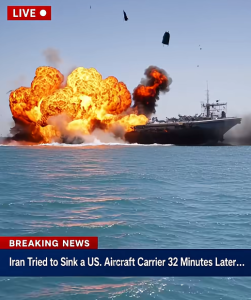
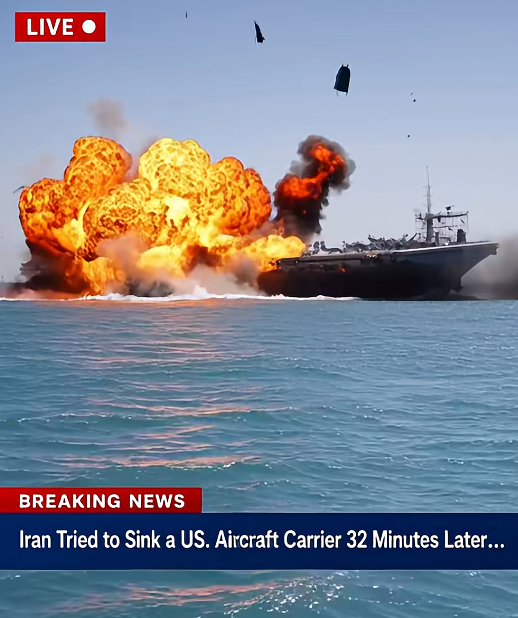
A dramatic headline claiming that “Iran tried to sink a U.S. aircraft carrier — 32 minutes later…” is spreading rapidly across social media. The wording suggests that Iran launched a direct, devastating attack against an American carrier and that something extraordinary happened moments afterward.
But there is an important distinction between the viral headline and the verified information currently available.
There is no credible confirmation that Iran has just successfully attacked and sunk a U.S. aircraft carrier in an incident matching the viral headline. Searches for the exact wording show that the claim is being circulated primarily through social-media posts and sensational websites. One recent article using almost the same headline explicitly describes its scenario as a fictional military analysis, rather than a report of a confirmed real-world attack.
That does not mean tensions between Iran and the United States are imaginary. The two countries have experienced serious military confrontations and naval incidents, and American aircraft carriers have been operating in the wider Middle East during the current conflict. But the specific “32 minutes later” story should not be presented as confirmed breaking news.
Why the Headline Is So Powerful
The headline is carefully designed to create suspense.
“Iran tried to sink a U.S. aircraft carrier” immediately creates the image of a major military confrontation. The phrase “32 minutes later” then promises a dramatic outcome without explaining what actually happened.
This style is common in viral military content.
Rather than giving readers the aircraft carrier’s name, location, date, weapons involved and official confirmation, the headline withholds the information. Readers are encouraged to click “See more” to discover the supposed ending.
That can make a fictional scenario, historical incident or speculative military analysis appear to be a developing event.
There Is a Real Military Context
The story is appearing against the backdrop of genuine U.S.-Iran military tensions.
Recent reporting has documented attacks involving Iranian forces and American military assets in the Middle East. CBS News reported in 2026 that Iranian forces had launched attacks involving cruise missiles, drones and small boats in the Strait of Hormuz, while U.S. forces destroyed Iranian small boats that officials said attempted to interfere with military and commercial vessels.
That real conflict makes sensational headlines much easier to believe.
A reader who already knows that American warships and Iranian forces have confronted one another may see the viral headline and assume it describes another confirmed attack.
But a genuine military confrontation and a specific viral claim are two different things.
The U.S. Aircraft Carrier at the Center of Attention
One carrier receiving substantial attention is the USS Abraham Lincoln, which has been involved in U.S. military operations connected to the conflict with Iran.
Recent reporting says the Lincoln has spent an exceptionally long period deployed in the region. The carrier has been operating in a combat environment for hundreds of days, placing considerable pressure on its sailors and support systems.
That prolonged deployment has generated separate controversy over living conditions, supplies, communications and crew welfare.
The existence of those problems, however, does not mean the carrier has been sunk or destroyed.
In fact, recent reporting indicates that senior U.S. Central Command leadership visited the USS Abraham Lincoln during its deployment.
That is very different from the picture presented by the viral headline.
Could Iran Attack an Aircraft Carrier?
Iran has long emphasized asymmetric naval warfare.
Its military strategy in the Persian Gulf has included missiles, drones, fast attack boats, mines and other systems designed to create serious risks for larger naval forces.
The geography of the Persian Gulf and Strait of Hormuz makes the region especially important. The waterway is strategically vital to global energy markets, while its relatively constrained geography creates challenges for ships operating in the area.
Iran has also conducted military exercises featuring attacks against replicas of American aircraft carriers.
One particularly famous example occurred in 2020, when Iranian forces used a mock U.S. aircraft carrier during military exercises. The replica was struck during an exercise and later became an obstacle in the Strait of Hormuz.
That historical footage has occasionally been recycled online, sometimes without sufficient explanation.
Consequently, an old video of an Iranian exercise can be mistaken for footage of an actual attack on an American carrier.
The 32-Minute Claim
The most suspicious part of the current viral story is the precise “32 minutes later” formulation.
A real military engagement would produce extensive information: the location, ships involved, weapons launched, defensive systems activated, casualties, damage assessments and statements from military officials.
Instead, the viral headline provides a dramatic time interval but little verifiable information.
One recent website carrying essentially the same title explicitly describes the story as a fictional naval scenario in which Iranian forces launch a hypothetical missile ambush against an American carrier.
That is crucial.
A fictional scenario can be entertaining or useful as military analysis, but it should never be rewritten as though it were an actual event.
America’s Carrier Defense
An American aircraft carrier does not operate alone.
A carrier normally forms the centerpiece of a larger carrier strike group containing cruisers, destroyers and aircraft designed to provide layers of defense.
The carrier itself is also protected by fighter aircraft, radar systems, electronic warfare capabilities and other defensive technologies.
The purpose of such a formation is to detect threats before they reach the carrier and create multiple opportunities to defeat incoming weapons.
That does not mean a carrier is invulnerable.
No military ship is.
Modern anti-ship missiles and drones represent serious threats to large surface vessels. A coordinated attack involving numerous weapons could create a complicated defensive problem.
But saying that a carrier could theoretically be attacked is very different from saying that one has actually been attacked and sunk.
History Shows Why Verification Matters
There have been real and serious encounters between Iranian and American forces in the Persian Gulf.
During the 1980s, for example, U.S. and Iranian forces became involved in direct naval combat during Operation Praying Mantis. American forces attacked Iranian naval vessels and platforms after the USS Samuel B. Roberts struck a mine.
There have also been confrontations involving Iranian fast boats and American warships.
These historical events demonstrate that military tensions between the two countries are not new.
But historical incidents are sometimes combined with modern footage and fictional narration to create new viral stories.
That is one reason readers should always ask when an image or video was actually recorded.
A Previous Incident Often Gets Repackaged
Another example illustrates the danger of sensational military content.
In 2016, Iranian forces seized two U.S. Navy riverine boats after they entered Iranian territorial waters near Farsi Island. The incident triggered an intense confrontation, with American and Iranian forces rapidly moving toward a potential escalation.
However, the incident did not become the catastrophic carrier battle suggested by some later online narratives.
Similarly, the USS Stark was seriously damaged in 1987 after being struck by Iraqi missiles during the Iran-Iraq War. Thirty-seven American sailors were killed.
That event is sometimes incorrectly associated with Iran because of the broader regional conflict.
The lesson is simple: military history is complicated, and viral posts often simplify or distort it.
Why Fake Breaking News Spreads
Social media rewards emotional reactions.
A headline saying “Routine naval exercise continues” is unlikely to attract millions of clicks.
A headline saying “Iran Tried to Sink a U.S. Aircraft Carrier — 32 Minutes Later, Everything Changed” is much more likely to attract attention.
The reader wants to know what happened next.
That curiosity drives clicks, comments and shares.
Once hundreds of accounts repeat the same headline, it can begin to look like independently confirmed news even when all of the posts originate from one fictional or speculative source.
This is why the number of shares is not evidence of accuracy.
What Would Confirm a Real Attack?
If Iran genuinely attempted to sink an American aircraft carrier, credible reporting would be expected from multiple sources.
The U.S. Department of Defense, U.S. Central Command, the Navy, major international news agencies and officials in the region would likely provide information.
Satellite imagery could eventually provide additional evidence.
The identity of the carrier would almost certainly become known.
There would also be questions about casualties, damage, defensive responses and the location of the engagement.
At the moment, the evidence supporting the exact viral “32 minutes later” narrative does not meet that standard.
The Bigger Strategic Picture
Even without the viral claim, the situation between Washington and Tehran remains extremely serious.
The Strait of Hormuz remains one of the world’s most strategically important waterways. Any major military confrontation there could affect shipping, energy markets and regional security.
Recent reporting has described Iranian attacks involving drones and missiles against regional targets and confrontations involving U.S. military forces.
The United States, meanwhile, continues to operate significant naval forces in the broader region.
The deployment of additional American carrier forces has also been reported. The USS George Washington has been moving toward the Middle East as the USS Abraham Lincoln approaches the end of an unusually long deployment.
These developments are real.
They should not, however, be confused with an unverified claim that Iran has just attempted to sink a carrier in a dramatic 32-minute battle.
Final Verdict
The viral headline “Iran Tried to Sink a U.S. Aircraft Carrier — 32 Minutes Later…” should not currently be treated as confirmed breaking news.
The phrase is circulating online, but available evidence indicates that at least one prominent version is explicitly based on a fictional military scenario rather than a verified attack.
At the same time, genuine military tensions between Iran and the United States are ongoing, and American naval forces are operating in the region. Recent reporting has documented real Iranian attacks involving missiles, drones and small boats, as well as U.S. responses.
That distinction is essential.
A dramatic headline can be based on real geopolitical tensions while the specific event described in the headline is fictional, exaggerated or recycled.
Before sharing the claim, readers should look for confirmation from official military sources and established news organizations. If those sources do not confirm that a U.S. carrier was attacked, damaged or sunk, the responsible approach is to label the story unverified rather than repeating it as fact.
The real U.S.-Iran confrontation is already serious enough. There is no need to turn fictional military scenarios into fake breaking news.