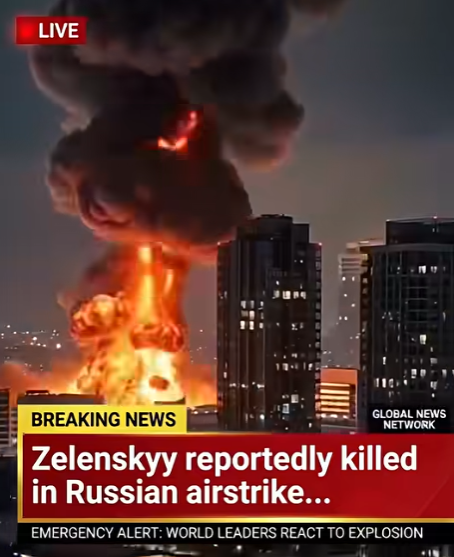
BREAKING NEWS: Zelenskyy Reportedly Killed in Russian Airstrike? What the Evidence Actually Shows
A sensational claim circulating online says that Ukrainian President Volodymyr Zelenskyy was killed in a Russian airstrike. The headline is dramatic and has understandably attracted attention, particularly because Russia and Ukraine remain locked in an extremely dangerous conflict involving missiles, drones, and long-range strikes. However, there is currently no credible evidence that Zelenskyy has been killed.
In fact, reporting available on August 18, 2026, points in the opposite direction. Ukrainian and international news organizations are reporting that Zelenskyy remains active as president. Earlier Tuesday, he submitted nominations for Ukraine’s next foreign and defense ministers, according to Anadolu Agency.
That makes the viral claim that he was killed in a Russian airstrike highly misleading.
What Happened?
There is a real and serious story behind the rumor. Russia has continued conducting missile and drone attacks against Ukrainian territory, while Ukraine has carried out increasingly large drone operations against targets inside Russia.
On August 18, a Russian missile attack struck the village of Pechenihy in Ukraine’s Kharkiv region. According to Reuters, the strike killed at least 10 people and wounded at least 18 others. The attack hit a busy area containing shops, a post office, vehicles, and nearby residential buildings.
Zelenskyy publicly addressed that attack and condemned it, saying Ukraine would respond.
That fact is important because it demonstrates that the Ukrainian president was publicly communicating about the attack rather than being reported missing or dead.
Other attacks were also reported elsewhere in Ukraine. In Kramatorsk, Russian forces carried out several airstrikes that damaged apartment buildings and injured civilians, including an 11-year-old boy, according to Ukrainian officials.
With so many strikes taking place, it is easy for a real military event to become mixed together with an invented claim about a political leader.
Where Did the Death Claim Come From?
False reports about the deaths of major political figures are not new. During wartime, social media posts can spread extremely quickly, particularly when they use phrases such as “BREAKING NEWS,” “JUST NOW,” “SHOCKING,” or “See more.”
These headlines are often designed to create an emotional reaction before readers have an opportunity to check the facts.
A similar claim that Zelenskyy had been killed in a Russian airstrike circulated previously. A fact-check published in June 2026 found no evidence supporting the allegation that the Ukrainian president had died in such an attack.
The latest version appears to follow the same pattern: a genuine Russian attack is combined with an unsupported claim about Zelenskyy’s death.
Evidence From August 18
The strongest reason to be skeptical of the viral headline is the large amount of current reporting showing Zelenskyy conducting presidential duties.
On August 18, Anadolu reported that Zelenskyy submitted nominations for Andrii Sybiha to serve as foreign minister and Yevhen Khmara as defense minister. Ukraine’s parliament was expected to consider the nominations.
Other reports published the same day also describe Zelenskyy making statements about Russian attacks and discussing Ukraine’s international partnerships.
The official website of the President of Ukraine continues to identify Volodymyr Zelenskyy as president and has published recent presidential activity.
These are not the circumstances one would expect if the country’s president had just been killed in an airstrike.
Why Such a Claim Is So Powerful
The possibility of Zelenskyy’s death would be enormously significant.
He has been one of the most recognizable figures of the Russia-Ukraine war since Russia launched its full-scale invasion in February 2022. His survival, public appearances, speeches, diplomatic meetings, and communication with foreign governments have become closely followed around the world.
If Zelenskyy were actually killed, the announcement would not depend on an anonymous social-media post. It would be expected to generate immediate coverage from Ukraine’s government, major international news organizations, allied governments, and diplomatic institutions.
A genuine event of that magnitude would be nearly impossible to contain.
This is why readers should be cautious whenever a headline claims that a major world leader has suddenly died but provides no verifiable details about where the attack occurred, when it happened, what evidence exists, or which authorities confirmed the death.
The Real Situation Is Already Serious
Rejecting the false death claim does not mean the war itself is peaceful.
Quite the opposite.
August 18 has seen major military activity. Russia launched attacks against Ukrainian communities, while Ukraine launched a massive drone offensive toward Moscow and surrounding areas.
ABC News reported that Ukraine launched more than 600 drones toward Moscow overnight, with Moscow’s mayor reporting at least 637 drones heading toward the Russian capital. Russia’s Defense Ministry claimed it intercepted hundreds of Ukrainian drones.
The Associated Press likewise reported that Ukraine launched one of its largest aerial attacks against Russia, with hundreds of drones involved.
This escalation creates an environment in which rumors can easily flourish.
When people see photographs of explosions, destroyed buildings, military aircraft, or emergency responders, they may assume that every accompanying claim is connected to the same event. Social media posts can then combine unrelated pieces of information into a completely false story.
What Readers Should Watch For
When encountering a claim that a world leader has been killed, several warning signs should immediately attract attention.
First, check the date. Old stories and photographs are frequently recycled and presented as new.
Second, check whether major news organizations are reporting the same event.
Third, look for official confirmation. A claim involving the death of a president should normally be confirmed by government officials or multiple highly reliable sources.
Fourth, be suspicious of headlines that intentionally conceal the details behind phrases such as “See more,” “You won’t believe what happened,” or “Full story in comments.”
Finally, consider whether the story makes sense alongside current reporting.
In this case, it does not. Current reporting on August 18 describes Zelenskyy performing presidential duties and communicating publicly about Russia’s attacks.
Why Accuracy Matters
False reports about wartime deaths are more than harmless internet rumors.
They can cause panic, influence financial markets, provoke political reactions, and potentially affect military decision-making. A false report involving a national leader can also be deliberately used as propaganda.
That is why responsible reporting requires separating confirmed events from speculation.
The Russian attacks on Ukraine are real. Civilians have been killed. Buildings have been damaged. Ukraine has responded with its own large-scale drone attacks against Russia. These facts are independently reported.
But the claim that Zelenskyy was killed in one of those attacks is a different matter.
As of August 18, 2026, credible reporting does not support that claim.
Instead, the available evidence shows Zelenskyy continuing to perform his presidential duties, including making political decisions and addressing the consequences of Russian attacks.
The Bottom Line
The headline “Zelenskyy reportedly killed in Russian airstrike” should not be presented as confirmed news.
There have been deadly Russian strikes in Ukraine, including the August 18 attack in the Kharkiv region that killed at least 10 people. But there is no credible evidence in the current reporting that Ukrainian President Volodymyr Zelenskyy was among the victims.
Indeed, reporting from the same day shows Zelenskyy actively conducting government business and communicating about the war.
For readers, the most important lesson is simple: a dramatic headline is not the same thing as verified news.
During an active war, information can move almost as quickly as missiles and drones. Some reports will be accurate, some will be incomplete, and others will be deliberately fabricated.
Before sharing a shocking claim about the death of a national leader, check multiple reliable sources and look for official confirmation.
In this case, the evidence available today points clearly toward the viral death report being false or unsubstantiated, rather than a confirmed breaking-news event.