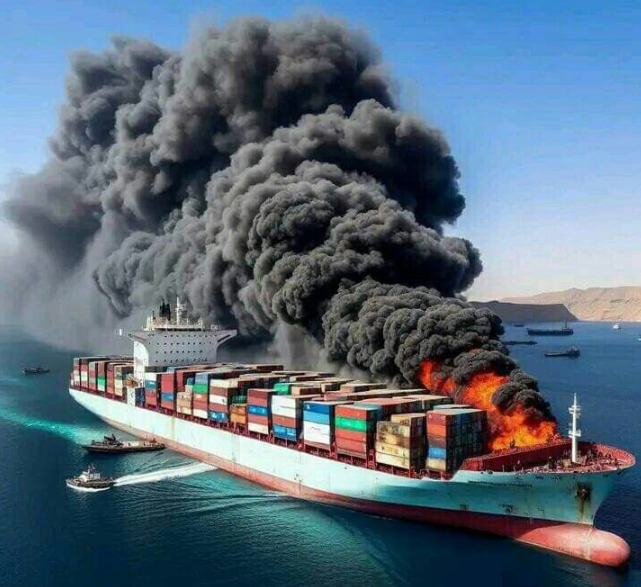
🇺🇸🚢 US Navy Delivers Swift Justice to Defiant Iranian Ship — The Real Story Behind the Headline
A dramatic headline claiming that the U.S. Navy delivered “swift justice” to a defiant Iranian ship is likely to attract immediate attention, especially amid the continuing tensions between Washington and Tehran. 🚨🇺🇸🇮🇷 But the story needs important context: there have been genuine U.S.-Iranian naval confrontations and attacks in 2026, including the sinking of an Iranian warship by a U.S. submarine in March, as well as a separate incident involving an Iranian vessel approaching the aircraft carrier USS Abraham Lincoln.
These events demonstrate how dangerous the maritime environment surrounding Iran has become.
One of the most significant incidents occurred in March, when a U.S. submarine sank the Iranian frigate IRIS Dena in waters off Sri Lanka. Reuters reported that the vessel was struck by torpedoes and that Sri Lankan rescuers subsequently recovered bodies and rescued survivors.
The incident represented a major escalation in the conflict and showed that the confrontation between the United States and Iran was no longer limited to the immediate waters around the Persian Gulf.
🚨 The Iranian Warship That Was Sunk
The IRIS Dena was one of Iran’s major naval vessels.
According to Reuters, the frigate was returning toward Iran after participating in a naval exercise organized by India in the Bay of Bengal. The ship was operating in international waters when it was attacked.
The U.S. military subsequently released footage that it said showed the attack.
The video reportedly showed an explosion striking the Iranian vessel and causing catastrophic damage. U.S. Defense Secretary Pete Hegseth described the operation as a major blow to Iran’s naval capabilities.
For Iran, the loss was significant not simply because a warship was destroyed, but because the incident demonstrated the reach of U.S. naval forces far beyond the Persian Gulf.
Sri Lankan authorities became involved in the aftermath when they received a distress signal and began searching for survivors.
The humanitarian consequences were severe.
Reuters reported that Sri Lankan rescuers found survivors in the water and recovered numerous bodies after the vessel sank.
⚓ Another Dangerous Encounter Near the USS Abraham Lincoln
A separate incident involved an Iranian naval vessel approaching the American aircraft carrier USS Abraham Lincoln.
According to reporting by The Jerusalem Post citing CBS News, a U.S. Navy vessel fired at an Iranian ship after it came too close to the carrier earlier in March. The initial shots reportedly missed, after which a helicopter armed with Hellfire missiles was launched and struck the Iranian vessel.
The exact circumstances were not fully disclosed publicly.
The U.S. military did not provide detailed confirmation of the incident at the time, and the status of the Iranian vessel and its crew was initially unclear.
That distinction matters when evaluating sensational headlines.
A headline saying that the Navy delivered “swift justice” can make an encounter sound like a simple, clearly documented victory. In reality, naval incidents often involve complicated decisions about identification, warnings, distance, rules of engagement, and the potential consequences of escalation.
🛳️ Why Aircraft Carriers Are So Important
The presence of the USS Abraham Lincoln adds another dimension to the story.
A U.S. aircraft carrier is not simply a large ship. It is the centerpiece of a carrier strike group, operating alongside other warships, aircraft, and support assets.
The carrier provides a mobile platform for fighter aircraft and other aviation capabilities, allowing the United States to project military power over enormous distances.
Because of that, an aircraft carrier approaching an area of conflict can become a highly visible symbol of American military power.
For an opposing force, operating a military vessel or aircraft close to a carrier can therefore create an extremely sensitive situation.
Even a relatively small confrontation can potentially escalate.
🇮🇷 Why Iran’s Navy Matters
Iran has spent decades developing military capabilities intended to defend its coastline and threaten hostile forces operating near its territory.
The country’s naval strategy has included conventional warships, fast attack craft, missiles, mines, drones, and other systems.
The geography of the region makes the Iranian Navy especially important.
The Strait of Hormuz is one of the world’s most strategically significant waterways. A huge amount of global energy trade passes through or near the region.
Any major disruption could have consequences for oil prices, shipping companies, insurance markets, and economies around the world.
That is why military activity involving Iranian vessels attracts international attention.
🌎 The Conflict Has Expanded Beyond the Gulf
The sinking of IRIS Dena was particularly significant because it occurred near Sri Lanka rather than directly inside the Persian Gulf.
The Associated Press reported that the Iranian warship had participated in India’s International Fleet Review and the multinational MILAN naval exercise before heading home.
The ship’s presence in the Indian Ocean demonstrated how the conflict had spread geographically.
The attack also created diplomatic complications for countries that had maintained relationships with Iran while attempting to remain outside the conflict.
India, for example, had hosted the Iranian vessel during naval events shortly before it was sunk.
⚠️ Why “Defiant Ship” Headlines Can Be Misleading
Words such as “defiant,” “swift justice,” and “destroyed” are powerful because they transform a complicated military incident into a simple story of confrontation and punishment.
But readers should be careful with such language.
Whether an Iranian vessel was violating an order, approaching an American ship, entering a restricted area, or engaging in hostile behavior can depend on facts that are not immediately available to the public.
Military authorities may also withhold information for operational and security reasons.
Therefore, a responsible report should distinguish between verified facts and dramatic descriptions.
The real events are already significant enough without exaggeration.
🔥 A Dangerous Game at Sea
Naval warfare is particularly dangerous because ships can travel quickly, weapons can cover enormous distances, and misunderstandings can escalate rapidly.
Imagine two warships operating near one another.
One side believes the other is approaching aggressively.
The other side claims it is conducting a routine maneuver.
A warning is issued.
The warning is ignored—or perhaps never properly received.
Then weapons are fired.
Within seconds, a confrontation that began with uncertainty can become a major international crisis.
That is why the presence of American and Iranian forces in the same waters is so closely watched.
🇺🇸 What the U.S. Navy Is Trying to Protect
From Washington’s perspective, American naval operations in the region are closely connected to protecting U.S. personnel, allies, and commercial shipping.
The United States has repeatedly emphasized the importance of freedom of navigation and the security of international maritime routes.
Iran, meanwhile, has its own security interests and has repeatedly warned against what it considers threatening American military activity near Iranian territory.
Those competing objectives create a dangerous strategic environment.
The situation becomes even more complicated when other countries are involved.
📱 Why Viral Posts Need Verification
Social-media posts about naval confrontations often use dramatic videos, military footage, explosions, and urgent captions.
A clip showing a ship exploding may be real—but the caption attached to it may not accurately describe the event.
Footage from the sinking of IRIS Dena, for example, can easily be reposted months later with a completely different headline.
That is why readers should always ask:
🔎 When was the video recorded?
📍 Where did the incident happen?
🚢 Which ship was involved?
📰 Who originally reported the incident?
🇺🇸 Did the Pentagon or U.S. military confirm it?
🇮🇷 What did Iranian authorities say?
Without answers to those questions, a viral headline should not automatically be treated as breaking news.
🕊️ The Human Cost
Behind every dramatic military headline are people.
Warships carry sailors, technicians, officers, engineers, and other personnel who have families waiting for them at home.
The sinking of IRIS Dena illustrated this painfully. Sri Lankan rescuers reportedly found people in the water after the vessel disappeared beneath the surface.
Military victories can therefore have enormous human consequences.
Even when governments describe an operation in terms of strategic success, individual families may experience the event as tragedy.
That reality is often lost when military stories are reduced to slogans.
🇺🇸 The Bigger Picture
The confrontation between the United States and Iran remains one of the most consequential military and geopolitical stories of 2026.
The destruction of IRIS Dena showed that U.S. forces possessed the ability and willingness to strike Iranian naval assets far from Iran’s coastline.
The reported encounter involving an Iranian vessel near USS Abraham Lincoln showed another danger: even an approach toward an American carrier can quickly become a potentially explosive confrontation.
Meanwhile, the Strait of Hormuz continues to be a central focus of the crisis. Reuters reported on August 18 that President Donald Trump said no talks were taking place with Iran and that none were scheduled, while also disputing Iranian claims concerning the status of the Strait.
🔔 Conclusion
The phrase “US Navy Delivers Swift Justice to Defiant Iranian Ship” makes for a dramatic headline, but the real story is more complicated—and in many ways more serious.
There have been genuine U.S.-Iranian naval confrontations in 2026. The United States sank the Iranian frigate IRIS Dena in March, while another reported incident involved an Iranian vessel approaching the USS Abraham Lincoln and being struck by U.S. forces.
These events demonstrate the extraordinary risks created when American and Iranian military forces operate in the same strategic environment.
🚢⚠️ At sea, a single encounter can change the course of an international crisis.
For readers, the most important lesson is to separate verified military events from sensational social-media captions.
The truth is already dramatic enough: the U.S.-Iran confrontation has involved real naval combat, significant loss of life, and the potential for further escalation.
And as tensions continue, the world will be watching the waters around Iran very closely. 🇺🇸🌎🕊️