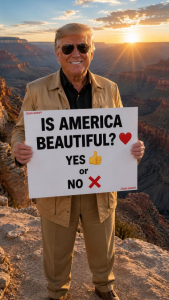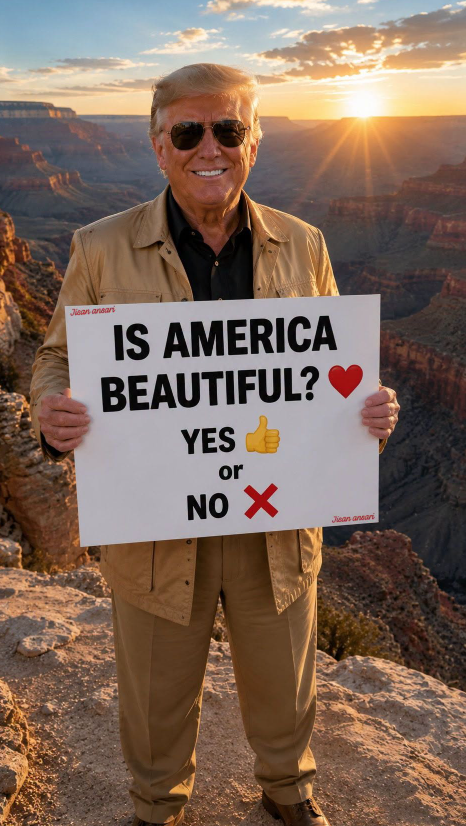
A striking image of a gray-haired man standing at the edge of a vast canyon has captured attention with a simple question written across a large white sign: “IS AMERICA BEAUTIFUL?” Beneath the question are two choices—“YES” accompanied by a thumbs-up symbol and “NO” marked with a red X. Behind him, the sun is setting over an enormous canyon, painting the sky with warm shades of gold and orange while the rugged landscape stretches toward the horizon.
At first glance, the photograph seems straightforward. A man is holding a sign and asking viewers for their opinion about America. But the longer someone looks at the image, the more meanings begin to emerge. It is not simply a question about scenery. It can also be interpreted as a question about identity, patriotism, history, culture, disagreement, and the complicated emotions people associate with the United States.
The landscape itself makes the word “beautiful” difficult to dispute. The enormous canyon walls, dramatic cliffs, distant mesas, and glowing sunset create a scene that represents some of the natural grandeur for which the American West is famous. The image invites viewers to pause and appreciate the scale of the country’s wilderness. From deserts and mountains to forests, beaches, rivers, plains, and national parks, the United States contains an extraordinary variety of landscapes.
Yet beauty can mean much more than scenery.
For many people, America represents opportunity. Generations of families have arrived in the country hoping to build better lives, pursue education, establish businesses, raise children, or simply find a place where they could begin again. The idea of opportunity has become deeply connected to the American identity.
For others, America’s beauty is found in its diversity. The country contains communities with different traditions, languages, religions, foods, music, and cultural histories. In large cities, small towns, rural communities, and immigrant neighborhoods, millions of people contribute to a national story that is constantly changing.
The sign in the photograph therefore raises a surprisingly complicated question.
Can a country be beautiful while still having serious problems?
The answer for many people would probably be yes.
Every nation has moments of achievement and moments of failure. America’s history contains extraordinary accomplishments, including scientific discoveries, technological innovations, artistic achievements, humanitarian efforts, and movements that expanded rights and opportunities. At the same time, the nation has experienced wars, political conflict, economic inequality, discrimination, social divisions, and painful chapters that continue to influence conversations today.
That complexity is one reason the question on the sign can generate such different reactions.
Someone looking at the sunset might immediately choose “YES.” They may see the canyon as a symbol of everything inspiring about the country: open spaces, natural beauty, freedom of movement, and the ability to stand on the edge of a spectacular landscape and simply take in the view.
Another viewer might interpret the question politically. They may think about the country’s current divisions, debates over government, economic concerns, immigration, public safety, international affairs, or disagreements between political parties. For that person, the question may not be about mountains or sunsets at all. It may be asking whether the country is living up to the ideals it claims to represent.
That is what makes the image effective as a piece of visual storytelling.
It provides no complicated explanation. There is no long speech, no detailed argument, and no statistics. Instead, there is one question and two possible answers.
“Yes.”
Or.
“No.”
The simplicity encourages viewers to supply their own reasoning.
The canyon in the background also adds another layer of symbolism. A landscape like this was formed over immense periods of time. Human political arguments, elections, controversies, and cultural debates may seem enormous to the people experiencing them, but against the scale of geological history, they are brief moments.
The setting can therefore encourage reflection. It reminds viewers that America is not only a political institution. It is also a physical place—a collection of rivers, mountains, deserts, forests, coastlines, farmland, cities, and communities.
The image also demonstrates how photographs and digital images can shape public conversation. A picture featuring a recognizable-looking public figure, a dramatic landscape, and a provocative question can quickly attract attention online. People may share it because they agree with the message, disagree with it, find the image amusing, or simply want to know whether it is authentic.
That last question is important. Images circulating online should not automatically be treated as documentary evidence. Modern image-generation and editing technologies can create highly realistic scenes that look photographic even when they are fictional or altered. Details such as unusual facial features, unnatural text, inconsistent shadows, strange hands, or visible digital artifacts can sometimes provide clues. In this particular image, the prominent watermark and stylized presentation are reasons to treat it as an illustrative or digitally created image rather than assume it is an untouched news photograph.
That does not make the question meaningless.
In fact, it may make the question even more interesting.
The image is less important as proof of an event and more interesting as a conversation starter. What does each viewer think makes America beautiful? Is it the landscape? The people? Freedom? Opportunity? Family? Innovation? Music? Sports? Small-town traditions? Big cities? The ability to disagree openly? Or perhaps something entirely different?
Beauty is subjective, and patriotism is personal.
One person might love America because of the possibilities it has provided to their family. Another might love the country while demanding major changes. Someone else might feel disappointed by the direction of the nation while still appreciating its natural wonders and cultural achievements.
Those positions are not necessarily contradictory.
A person can admire a country and criticize it. They can appreciate its history while acknowledging its darkest chapters. They can celebrate its achievements while believing there is more work to do. They can disagree strongly with another citizen while still considering that person part of the same national community.
Perhaps that is the deeper meaning behind the sign.
“Is America beautiful?” may look like a question requiring a simple yes-or-no response, but the most honest answer might be much longer.
America can be beautiful in its landscapes and complicated in its politics. It can be inspiring and frustrating, hopeful and divided, innovative and imperfect. It can mean something different to every person who calls it home or who has dreamed of reaching its shores.
As the sun disappears behind the canyon in the photograph, the question remains suspended between the two choices.
Yes or no?
Ultimately, the answer belongs to the viewer.
And perhaps the most meaningful response is not simply choosing one symbol on the sign, but asking a more important question: What would make America even more beautiful for everyone?
That question leaves room for conversation, disagreement, hope, and change. It transforms a simple photograph into an invitation to think about what the country is, what it has been, and what it could become.